
Behind every memorable brand activation, product launch, or large-scale festival is a layer of work most attendees never see: event production. It covers everything from stage design and AV systems to lighting rigs, vendor coordination, and the visual elements, like custom inflatables, that turn a venue into an experience. If you’re responsible for pulling an event together, understanding how production works isn’t optional. It’s the difference between an event that runs smoothly and one that falls apart before doors open.
The problem is that event production gets used loosely. Sometimes Event Production refers to the full planning process. Other times, Event production is shorthand for the technical side, sound, video, lighting. That lack of clarity makes it harder to scope a project, set a budget, or figure out who you actually need to hire. This article breaks all of that down so you can move forward with a clear picture of what’s involved and what it costs.
At TMP Inflatables, we’ve spent over 20 years working in Event Production alongside event producers, experiential agencies, and brand teams to design and manufacture custom inflatables that anchor the visual identity of an event, from towering product replicas to branded arches and inflatable tents. We sit on the production side of this process every day. That experience shapes what you’ll read here: a practical, no-fluff breakdown of event production, its core components, the production timeline, and how to choose the right team to execute your vision.
Why event production matters
Most people attending an event think about the experience: the energy in the room, how the brand shows up, whether the whole thing feels polished or thrown together. What they’re actually reacting to is the quality of event production. Every technical and visual decision made in the weeks before the event shapes that reaction, even when attendees have no idea those decisions were made. For anyone responsible for a brand’s presence at a live event, understanding why production quality matters is the starting point for getting every other decision right.
For Event Production the stakes are high when things go wrong
When production fails, it fails publicly. A blown audio system during a keynote, a lighting rig that wasn’t tested, or a structural element that doesn’t hold all become the story. Attendees remember what went wrong, not what went right. Social media coverage of live events is immediate, which means a visible failure at 9 AM can be on someone’s feed by 9:15. That kind of exposure punishes weak production faster and more broadly than almost any other business setting.
Event Production Budget overruns are another consequence of treating production as an afterthought. When teams lock in a venue and a guest list before they’ve scoped out the production requirements, they routinely underestimate costs. AV alone can consume 20 to 30 percent of a total event budget at mid-to-large scale. Discovering that reality three weeks before load-in forces cuts in the wrong places, or scrambling for vendor availability at premium rates. Strong event production planning prevents both.
What strong Event Production actually delivers
Good Event production does more than prevent failure. It actively shapes how people feel the moment they walk into a space. Event production includes Lighting temperature, sound quality, and visual anchors like branded inflatables or stage elements work together to set a tone before a single presenter takes the stage. When those elements are aligned and intentional, attendees feel it. They’re more engaged, more receptive, and more likely to connect the experience to the brand behind it.
Strong production doesn’t just execute a plan. It creates a physical environment that does the brand’s work for them.
Operational reliability is the other side of this equation. A production team that has run cue-to-cue rehearsals, confirmed vendor timelines, and stress-tested the run-of-show gives the rest of your event team room to focus on what they’re actually there to do. Speakers can prepare. Sponsors can host their guests. Your internal team can work the room instead of chasing down a missing shipment or troubleshooting a projector. That operational reliability isn’t visible to attendees, but it shapes everything they experience.
Event Production ensures the brand impact that outlasts the event
Events are expensive. Most organizations justify that expense by pointing to the relationships built, leads generated, or awareness created during the event itself. What often gets missed is the content and brand equity that strong production leaves behind. High-quality photography and video captured at a well-produced event becomes marketing material for months. A striking visual installation, a custom inflatable product replica, or a branded activation structure generates social content your attendees create and share without being asked.
That extended value is only possible when the production quality is high enough to photograph well and hold up across formats. A stage setup that looks impressive in person but doesn’t read on camera, or a branded element that fades or warps under venue lighting, cuts the post-event value in half. Treating production as a one-day cost misses what it actually delivers over the long run: a return that extends well beyond the event date.
Event production vs planning and management
People use “event planning,” “event management,” and “event production” interchangeably, but they describe three distinct scopes of work. Treating them as the same thing leads to gaps in your team structure, your budget, and your vendor list. Understanding where each begins and ends helps you build a team that actually covers the full scope of what an event requires.
What event planning covers
Event planning is the strategic and logistical foundation of any event. A planner works mostly in the pre-event phase, turning a concept into a concrete plan with timelines, contracts, and confirmed vendors. Your planner is the person who makes sure the right resources are in place before production and management take over. Core planning responsibilities typically include:
- Defining the event purpose and audience
- Selecting and contracting the venue
- Building the overall budget framework
- Confirming the speaker or performer lineup
- Mapping out the event program and schedule
What event management covers
Management picks up where planning leaves off. An event manager is responsible for coordinating people, vendors, and logistics on the day itself, tracking the run-of-show, handling vendor arrivals, and troubleshooting problems as they surface. A manager executes the blueprint in real time rather than building it in advance.
Some professionals handle both planning and management roles, but at larger events, these are typically separate people with separate responsibilities and separate lines of authority on event day.
The clearest way to separate these three roles: planning builds the plan, management runs the day, and production builds the world the event happens in.
Where Event Production fits in
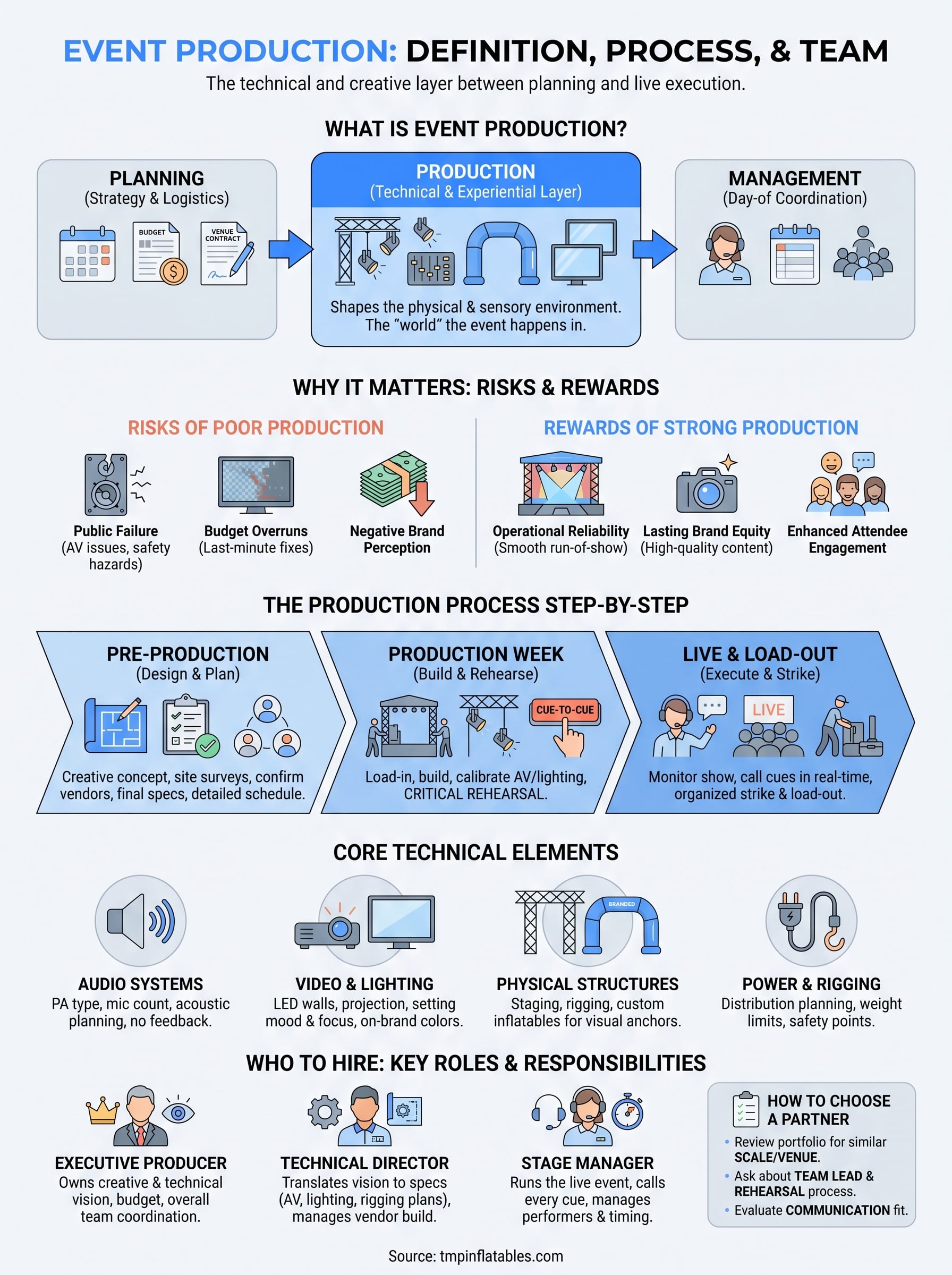
Event production is the technical and experiential layer that sits underneath both planning and management. It covers everything that shapes what the event looks and sounds like: AV systems, lighting design, staging, rigging, power distribution, and the custom visual elements like branded inflatables or activation structures that define the space. Event Production work spans the entire event timeline, from early creative concepting through load-in, the live event itself, and load-out.
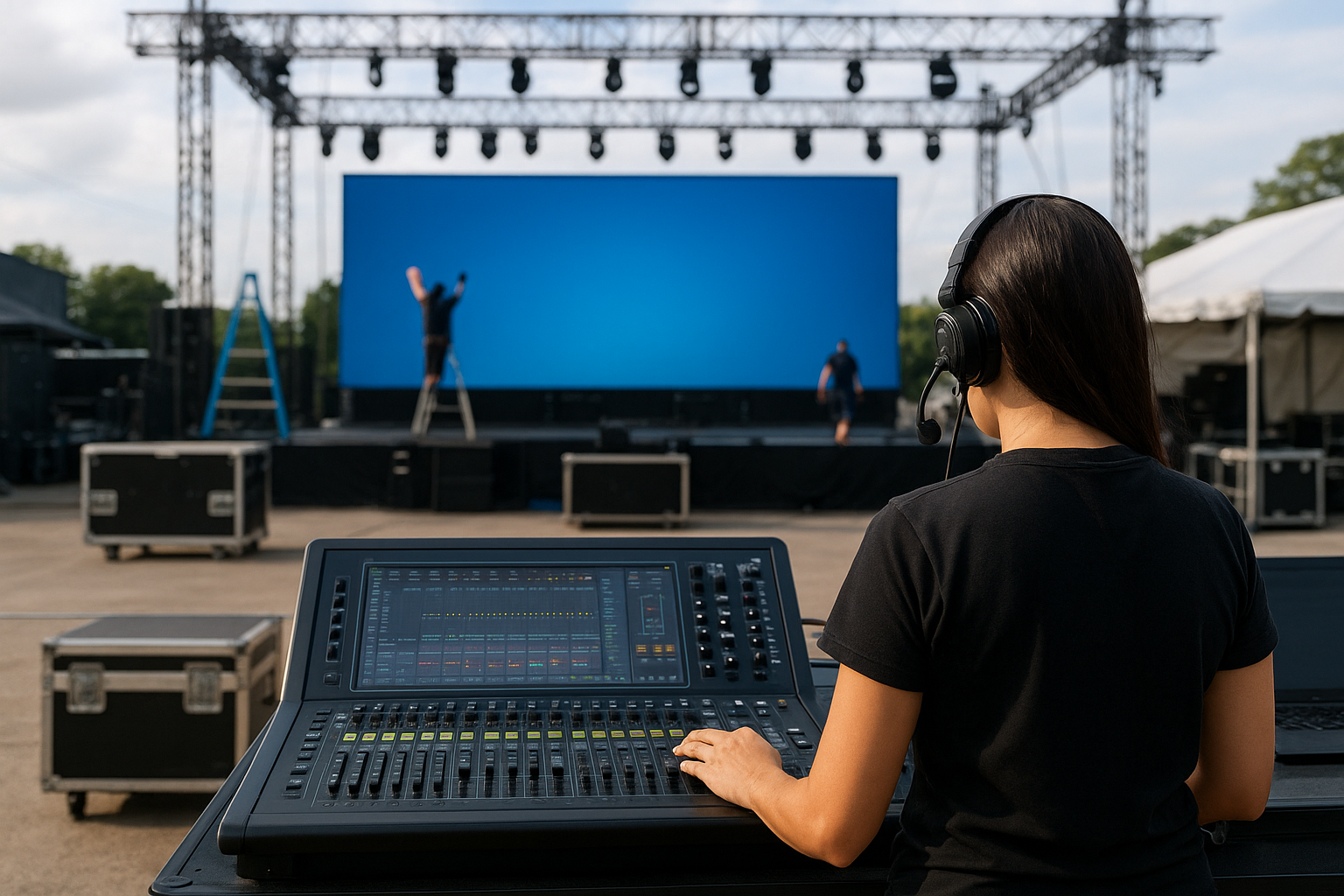
A common mistake is treating production as a single vendor category. In practice, production pulls together multiple specialized teams under a unified creative and technical vision. That’s why many organizations hire a dedicated production company or a lead production manager whose sole job is to coordinate those teams and hold the technical vision together from start to finish.
Event Production Core AV and technical elements
The technical layer of event production determines whether your event feels professional or amateurish. Audio, video, and lighting are the three pillars most people think of, but the technical scope also includes power distribution, rigging, staging, and the physical structures that define your space. Getting these elements right requires coordination across multiple vendors and a clear plan that accounts for your specific venue before load-in day.
Event Production Audio systems
Audio is the most unforgiving technical element at any live event. A feedback incident or a poorly tuned PA system pulls every person in the room out of the experience immediately. Your audio setup needs to account for venue size, acoustics, microphone count, and whether you’re mixing live music, speech, or both. Outdoor events add wind interference and reflection challenges that require extra planning.
The components your audio engineer needs confirmed before load-in include:
- PA system type and placement (line array vs. point source)
- Monitor placement for on-stage talent
- Mixing console inputs and channel count
- Wireless frequency coordination to avoid interference
Event Production Video and lighting
Projection mapping, LED walls, and confidence monitors each serve different purposes in a live event context. LED walls perform well in high-ambient-light conditions where projection struggles. Screen resolution and aspect ratio must match your content specifications before the venue fills with people, not during the program. Mismatched formats are one of the most common and entirely avoidable technical problems teams face on event day.
Test your full video signal chain end-to-end during rehearsal, not at showtime.
Lighting shapes the mood before a single word is spoken. Wash lights, spotlights, and moving heads each fill specific roles: a wash provides even base coverage, a tight spot directs focus, and intelligent fixtures give your designer real-time control over color and intensity. Matching your lighting palette to your brand colors is a direct way to reinforce brand identity throughout the event without layering in additional branded elements.
Physical and branded structures
Staging, rigging, and large-format branded elements complete the technical picture. Custom structures like branded inflatable arches, towering product replicas, or inflatable tents define the shape of the space and carry your brand visually at scale. A well-placed inflatable structure at the entry point or above the stage creates an immediate focal point that anchors the visual identity before any AV system fires up.
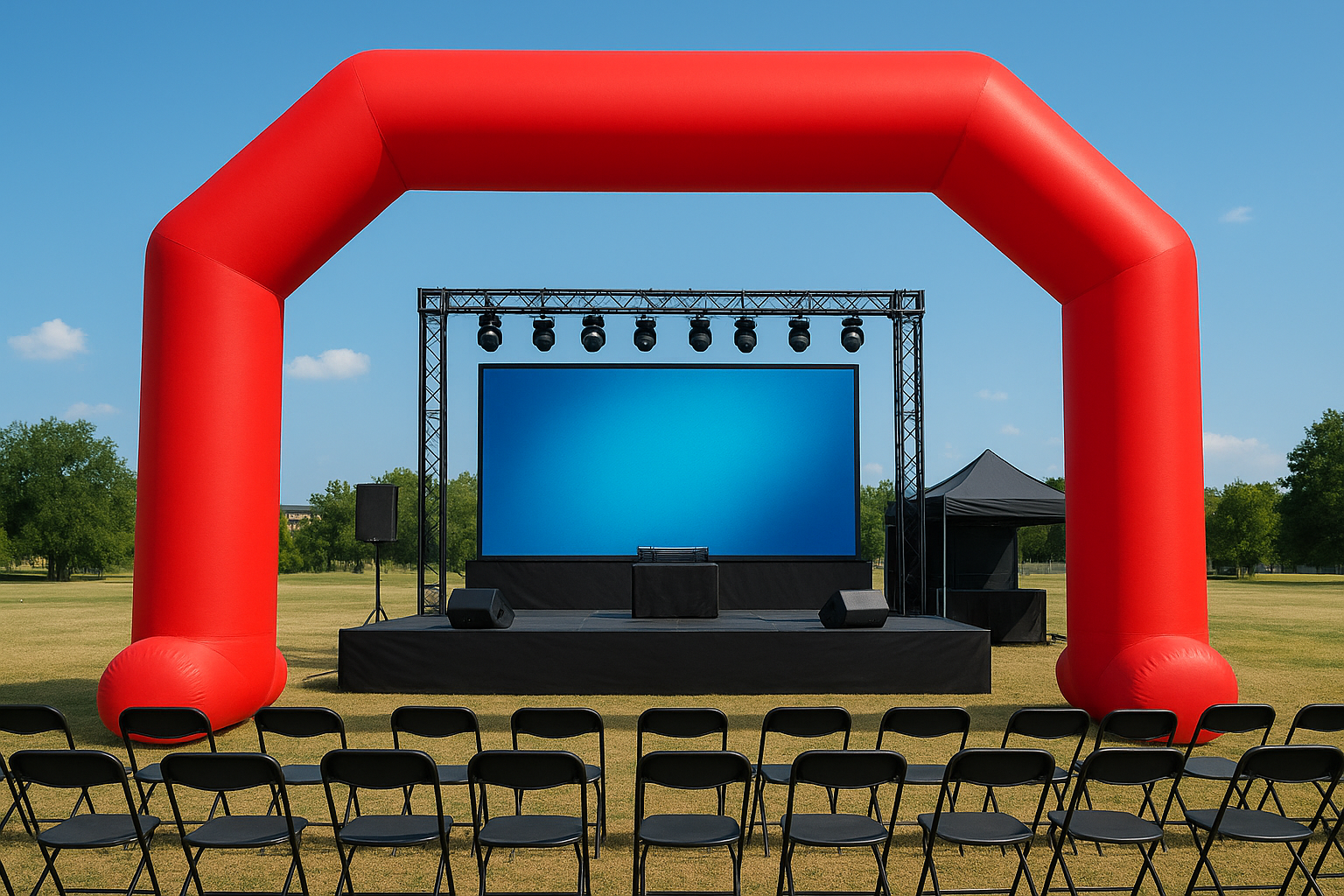
These physical elements need to be factored into your load-in schedule and floor plan early. Weight limits, rigging points, and footprint dimensions all affect what’s possible in a given venue, and surprises in any of those areas on load-in day cost time and money to resolve.
The event production process step by step
Event production follows a predictable sequence, and knowing that sequence helps you spot where most projects go wrong. Teams that skip or compress early stages almost always pay for it in the final days before load-in, when there’s no time to fix structural problems. Understanding each phase gives you the leverage to push back on timelines that are too tight and allocate budget where it actually counts.
Pre-production: concept through confirmed vendor contracts
Pre-production is where the event gets designed. Your production team defines the creative vision, maps out the technical requirements, and starts confirming vendors before any physical work begins. This phase typically covers site surveys, initial design renderings, and the production schedule that every other vendor will build their timelines around.
The deliverables you should expect from pre-production include:
- A detailed production schedule with load-in and load-out windows
- Confirmed AV, lighting, and staging vendor contracts
- Approved floor plans and rigging diagrams
- Finalized specifications for custom elements like branded inflatables or structures
Skipping the site survey is one of the most expensive shortcuts a production team can take. What works on paper often runs into ceiling heights, power access, or floor load limits that require a redesign.
Event Production week: load-in, build, and rehearsal
Load-in is where the plan meets physical reality. Staging gets built, rigging goes up, AV systems get flown and calibrated, and every branded element gets placed according to the approved floor plan. Your production manager owns the load-in schedule, keeping each vendor team on sequence so one delay doesn’t cascade into the next.
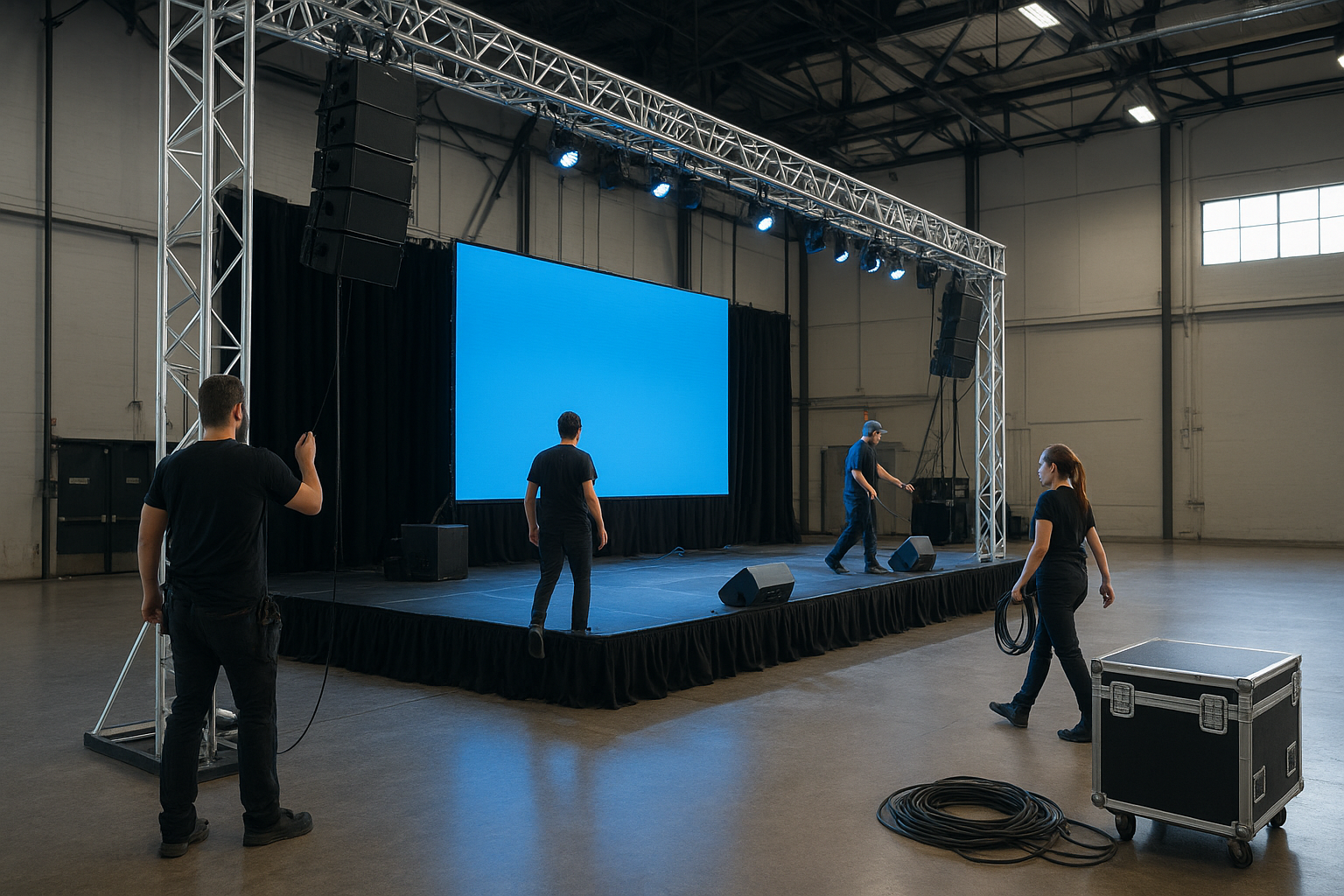
Rehearsal is the most skipped and most critical step in the entire process. A cue-to-cue rehearsal runs through every lighting state, video transition, and audio moment before an audience is present. Problems found in rehearsal take minutes to fix. Problems found during a live program take far longer and happen in front of your guests.
Live event execution and load-out
On event day, your production team shifts from building to monitoring. A stage manager tracks the run-of-show and calls cues in real time. AV technicians manage live audio and video feeds. Any adjustments happen quietly, in the background, so the audience never sees the machinery behind the experience. Load-out follows a reverse sequence of load-in, with each vendor striking their equipment according to a confirmed schedule that respects the venue’s access window.
Who to hire and what each role does
Building the right team is one of the most consequential decisions in event production. Each role carries a specific scope of responsibility, and overlaps or gaps in that structure cause problems on event day. Knowing who owns what before you sign any contracts keeps accountability clear and gives every vendor a single point of contact when issues need fast resolution.
Executive producer and production director
The executive producer or production director sits at the top of the production structure. This person owns the overall creative and technical vision and is accountable for how every element comes together as a unified experience. They set the production budget, select the vendor teams, and make final calls when conflicts arise between departments.
On large-scale events, the executive producer is often the only person who has visibility across every production workstream at the same time.
Your production director should be involved from the earliest creative conversations, not brought in after the venue is locked and the floor plan is set. Late involvement limits their ability to shape decisions that are easier to get right the first time than to reverse later.
Technical director
The technical director translates the creative vision into specific technical requirements. They own the AV specifications, lighting design, rigging plans, and power distribution, and they’re the person your AV vendor, lighting vendor, and staging crew report to during load-in. A strong technical director catches specification conflicts before they become on-site emergencies.
Their job is to make the creative director’s vision physically possible within the constraints of your venue, budget, and timeline. If the production director is the architect, the technical director is the engineer.
Stage manager
The stage manager runs the live event itself. They call every cue in the run-of-show, manage speaker and performer timing, and serve as the central communication point between backstage, the AV booth, and the front-of-house team. Nothing happens on stage without the stage manager’s call.
Smaller events sometimes collapse this role into the production manager’s responsibilities, but at any event with multiple program elements or live performers, separating the stage management function is worth the added cost. A dedicated stage manager keeps the program on time and absorbs the real-time problem-solving that would otherwise pull your production manager away from vendor coordination.
How to choose an event production company
Choosing the right event production company is one of the highest-leverage decisions you’ll make in the entire process. The wrong partner can execute technically but miss your brand vision entirely, while the right one brings both the creative alignment and operational discipline your event needs. Before you send a single RFP, know what you’re actually evaluating.
Review their portfolio for relevant experience
Past work is the clearest signal of what a production company can deliver for you. Look for examples that match your event type, scale, and environment. A company that specializes in large outdoor festival builds may not be the right fit for a refined corporate product launch, even if their reel is impressive. Pay attention to the visual and technical complexity of their previous events, not just the logo of the client.
Ask specifically whether they’ve produced events in your venue or in comparable spaces. Companies that know a venue’s quirks, power access points, and rigging limitations bring an advantage that shows up on load-in day when it matters most.
A production company’s references will tell you more than their portfolio ever will. Talk to past clients about how the team handled problems, not just whether the event went well.
Ask the right questions before committing
Your conversations before signing a contract reveal how a company actually operates under pressure. Strong production companies ask questions back: about your audience, your timeline, your brand standards, and what success looks like for your stakeholders. A company that immediately pitches a package without understanding your specific goals is solving for their workflow, not your event.
The questions worth asking any production company you’re evaluating include:
- Who is the specific team lead assigned to your event, and what is their experience level?
- How do they handle vendor conflicts or last-minute technical failures during load-in?
- What does their rehearsal process look like, and is it included in their quoted scope?
- How do they communicate during production week, and who is your single point of contact?
Evaluate fit alongside capability
Technical competence matters, but working relationship quality matters just as much on a complex production. You want a company that treats your event with the same attention they’d give their flagship accounts. Look for clear communication, proactive problem-solving, and willingness to adapt as your event evolves through pre-production. A production company that listens early is far less likely to surprise you late.
Next steps for your event
You now have a clear picture of what event production actually covers, from AV and lighting to the physical structures that define a space visually. The next move is turning that understanding into action. Start by identifying which production roles your current team can fill and where you have genuine gaps, then build your vendor list around those gaps rather than around who you already know.
If branded visual elements are part of your production scope, custom inflatables are one of the most effective ways to anchor your brand at scale without adding significant load-in complexity. A branded arch, towering product replica, or inflatable tent can do more visual work than an entire staging redesign at a fraction of the cost. TMP Inflatables has worked with event teams across North America for over 20 years to design and produce exactly those elements. Request a custom inflatable quote and get your production team a visual centerpiece worth showing up for.