
Walk down any retail strip and you’ll notice the shops that pull people in versus the ones that blend into the background. That difference almost always comes down to store signage. It’s the first impression your business makes before a customer ever reads a price tag or talks to staff, and getting it wrong means lost foot traffic you’ll never get back.
If you’re trying to figure out what counts as store signage and which types actually fit your storefront, this guide breaks it down plainly. You’ll get a clear picture of the main signage categories, from illuminated storefront signs to window graphics and freestanding displays, plus practical guidance on choosing materials and sizing that hold up outdoors and read well from the street or parking lot.
We’ll also cover what separates a sign that gets noticed from one that gets ignored, and how to think about your budget before you request quotes. At TMP Inflatables, we design custom promotional displays and inflatable signage for retailers who want something bigger and more memorable than a static sign, so we know firsthand what draws eyes and what doesn’t. By the end, you’ll know exactly what to buy and why.
Why store signage matters for your business
Before a customer ever steps through your door, your storefront signage is already selling for you. It tells people what kind of business you run, whether you’re open, and whether you’re worth stopping for. Skip this step or treat it as an afterthought, and you’re asking customers to guess, most won’t bother.
Store Signage works because First impressions happen in seconds
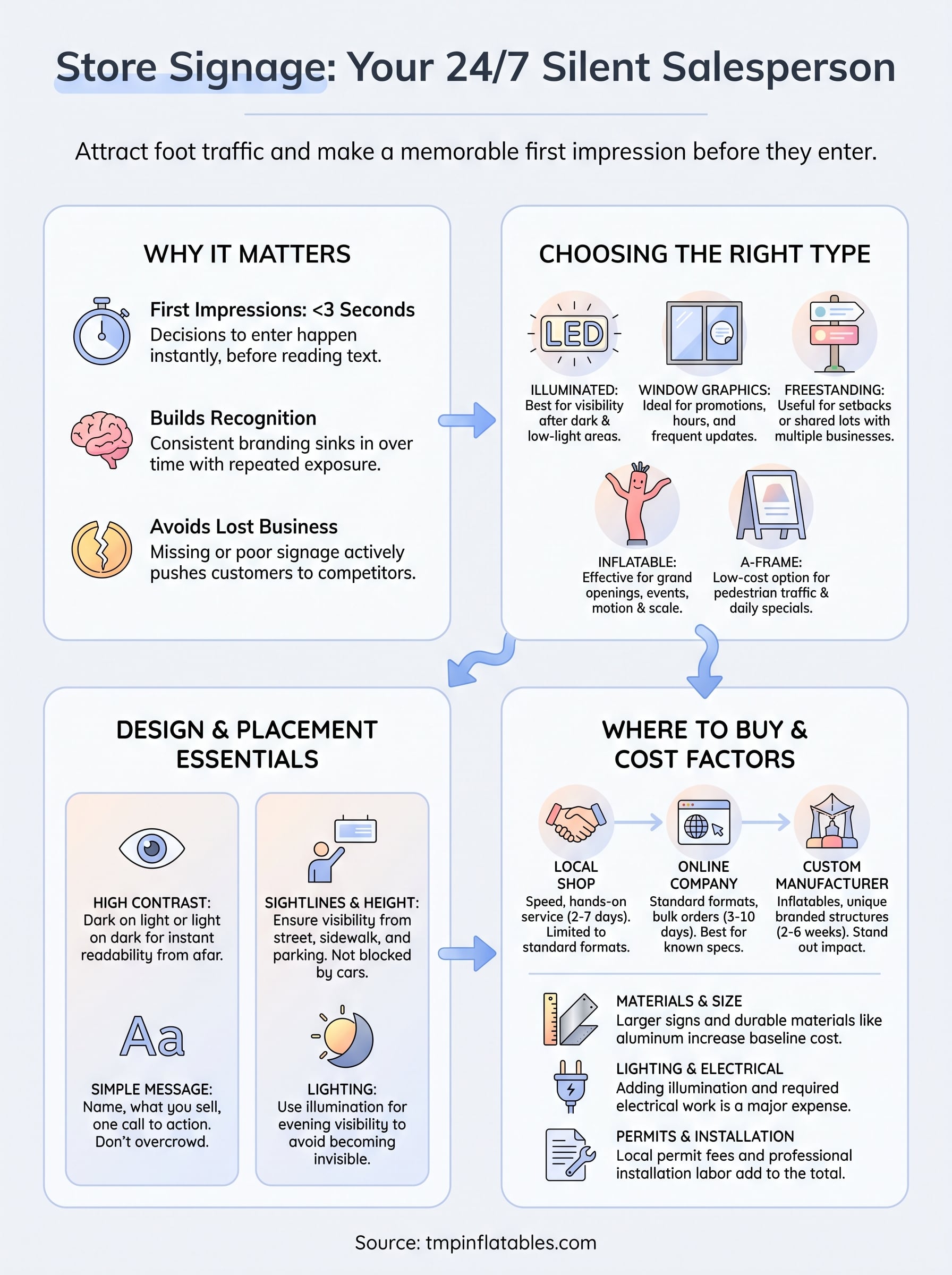
Research from the FedEx Office Signage survey found that roughly 76% of consumers have entered a store they’d never visited before simply because of its signage. That’s not a marginal bump in foot traffic, that’s a huge chunk of walk-in business tied directly to how your sign looks from the sidewalk or parking lot. People decide whether to approach your storefront in under three seconds, often before they’ve read a single word on the sign itself. Shape, color, lighting, and size all register faster than text does.
A sign that’s hard to read from the street is a sign that’s costing you customers you’ll never know you lost.
Store Signage builds recognition over time
Consistency matters as much as first impressions. Every time someone drives past your branded storefront signs, your logo, colors, and name sink in a little further, even if they don’t walk in. This repetition is why national retailers spend so much on consistent signage across every location. A local bakery or boutique doesn’t need a national budget to benefit from the same principle. Matching your sign to your website, packaging, and social media creates a mental shortcut that makes customers more likely to choose you over a competitor with a forgettable storefront.
Poor store signage has a real, measurable cost
Missing or outdated store signage doesn’t just fail to attract customers, it actively pushes them toward competitors. Consider what’s actually at stake when signage falls short:
- Lost walk-ins: Shoppers looking for a specific type of store often pick whichever storefront communicates fastest, not necessarily the better business.
- Reduced trust: Faded, cracked, or dim signage signals a business that isn’t maintained, and customers extend that assumption to your products or service.
- Wasted marketing spend: Digital ads and social campaigns drive people toward a physical location; if that location doesn’t visually match the polish of your online presence, conversion drops.
- Missed impulse traffic: A large share of retail visits are unplanned. Eye-catching retail signage captures that spontaneous foot traffic that scheduled marketing never reaches.
Store Signage supports every other marketing dollar you spend
Think of your signage as the final handoff point in your marketing funnel. Ads and social posts get people curious, but your storefront closes the deal by confirming they’ve found the right place and giving them a reason to walk in right now. Solid retail display signage at the entrance, paired with clear window graphics, reinforces whatever promise you made in your advertising. Without that visual confirmation, some portion of your ad spend simply evaporates once potential customers reach the street and can’t tell which storefront is yours. Treating signage as a core piece of your marketing budget, not a one-time expense you handle last, keeps every other dollar you spend working harder.
How to choose the right store signage for your goals
Not every storefront needs the same solution, and picking signage without a clear goal usually ends in a sign that looks fine but does nothing for your business. Start by asking what you actually want the sign to accomplish: draw first-time visitors off the sidewalk, reinforce your brand for repeat customers, or announce a sale that needs attention right now. Business signage built around a specific goal almost always outperforms signage chosen purely on looks.
Match the Store Signage type to the job
Different formats solve different problems, and mixing them strategically usually beats relying on one big sign to do everything.
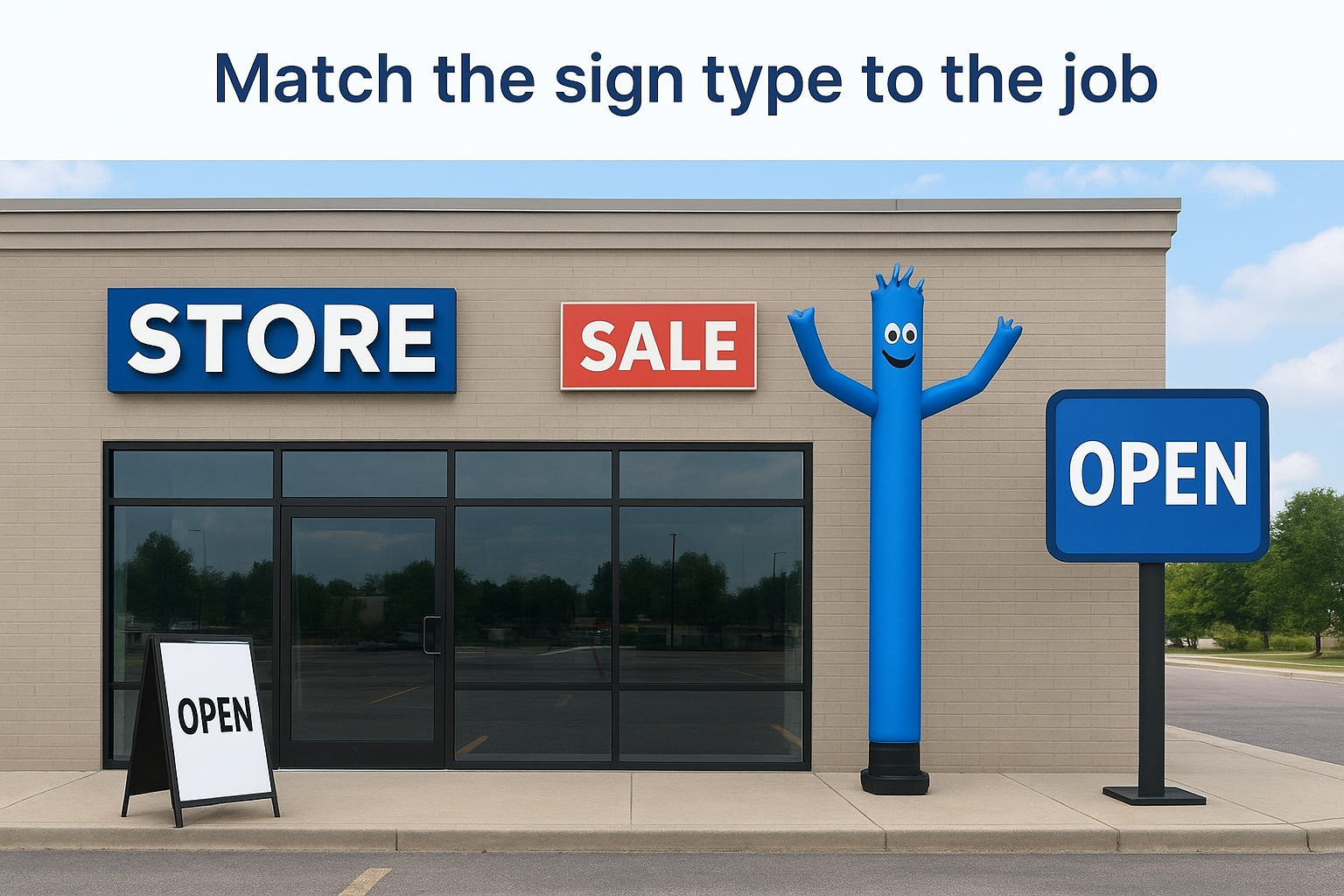
- Store Signage like Illuminated channel letters or lightboxes: best for storefronts that need visibility after dark or in low-light strip malls.
- Store Signage like Window graphics and decals: ideal for promotions, hours, or seasonal messaging you’ll want to swap out often.
- Store Signage Like Freestanding or pylon signs: useful when your storefront sits back from the road or shares a lot with other businesses.
- Store Signage like Inflatable displays and air dancers: effective for grand openings, weekend sales, or any event where you need motion and scale to cut through a busy parking lot.
- Store Signage like A-frame or sidewalk signs: low-cost options for pedestrian traffic and daily specials.
Pick your signage format based on the problem it solves, not on what looks impressive in a catalog.
Consider your traffic type
Foot traffic and drive-by traffic call for different sign strategies. A boutique on a walkable main street can rely on smaller, detailed shop signage since customers pass slowly and read closer up. A business on a busy road needs oversized lettering, bold contrast, and minimal text, because drivers only get a second or two to register your message before they pass. Skipping this distinction is one of the most common reasons retailers end up replacing signage within a year of installing it.
Secret to Store Signage Factor in how often you’ll update the message
Static signs work for your permanent name and logo, but if you run frequent promotions, invest in a format you can change quickly, like banners, window clings, or modular lightbox inserts. Retailers who need seasonal flexibility, think holiday sales or summer events, often find that inflatable signage and temporary displays deliver more impact per dollar than another permanent sign nobody notices anymore.
What drives store signage costs
Price for store signage swings wildly, from under $100 for a basic A-frame to $15,000 or more for a full illuminated storefront installation. Understanding what pushes the number up or down helps you budget accurately instead of getting sticker shock mid-project or, worse, settling for a sign that’s cheap but ineffective.
Store Signage Size and material set the baseline
Square footage is the first lever. A larger sign costs more in raw material and installation labor, plain and simple. Beyond size, material choice changes the math fast: aluminum and acrylic hold up outdoors for years, while foam board or vinyl banners cost less upfront but need replacing sooner. Inflatable signage sits in an interesting middle ground, it’s durable, reusable across seasons, and delivers far more visual scale per dollar than a rigid sign of comparable size.
Store Signage Secret: Lighting and electrical work add real expense
Illuminated signs, whether channel letters or lightboxes, require electrical hookup, which usually means hiring a licensed electrician on top of the sign fabricator. This is often the single biggest cost jump between a daytime-only sign and one that works around the clock.
The biggest cost driver isn’t the sign itself, it’s whatever has to happen behind the wall to power it.
Permits and local codes
Most municipalities require a sign permit before installation, and fees vary by city and sign type. Some areas also enforce size or brightness restrictions tied to zoning, so check with your local building department before finalizing a design. Skipping this step can mean paying for a sign twice.
Customization and complexity
Custom shapes, branded colors, and multi-material builds cost more than off-the-shelf templates. A quick comparison:
| Signage type | Typical cost range | Lifespan |
|---|---|---|
| A-frame sign | $80–$300 | 2–4 years |
| Vinyl banner | $50–$400 | 1–2 years |
| Window graphics | $150–$800 | 1–3 years |
| Illuminated channel letters | $2,000–$15,000+ | 8–12 years |
| Custom inflatable display | $1,500–$8,000 | 5+ years, reusable |
Installation and ongoing upkeep
Finally, factor in installation labor and maintenance. Larger or elevated signs need professional mounting, and anything electrical needs periodic servicing. Building these recurring costs into your budget upfront prevents surprises down the road.
Design and placement tips that make signage work
Great store signage design isn’t about cramming in every detail you want customers to know. It’s about picking the two or three things that matter most, your name, what you sell, and maybe a single call to action, then making sure those elements read instantly. A sign trying to say everything usually ends up saying nothing, because passersby only have a few seconds to absorb it.
Placement decides whether design even matters
Even the best-designed sign fails if it’s mounted where nobody can see it. Height matters: a sign placed too low gets blocked by parked cars or other pedestrians, while one placed too high loses legibility for anyone on foot. Sightline testing from the actual street, sidewalk, or parking lot entrance before you finalize placement catches problems no design mockup will show you.
The right design in the wrong spot is just an expensive decoration.
Color contrast and lighting carry more weight than clever fonts
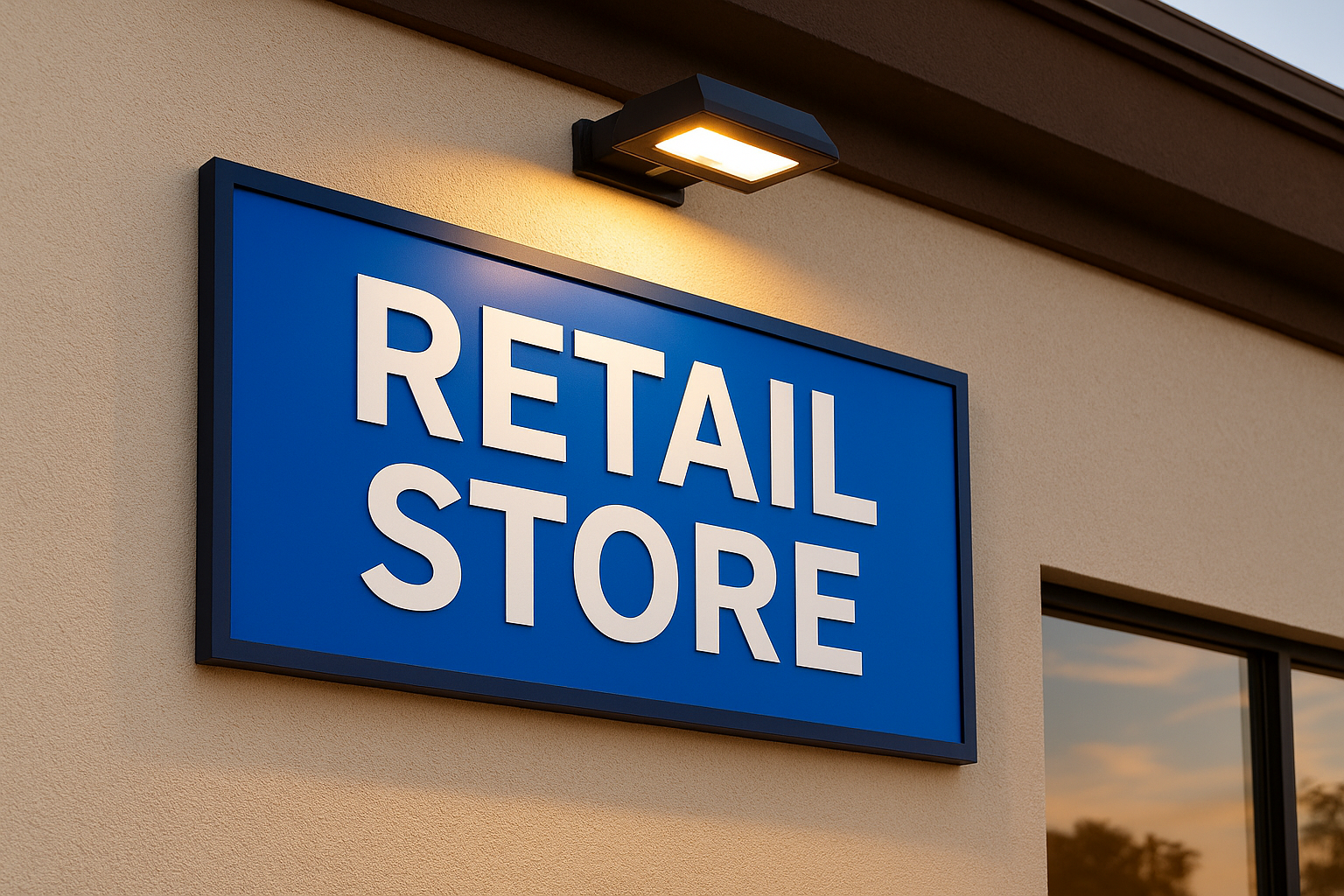
High contrast between your background and text beats a fancy typeface every time. Dark text on light backgrounds, or the reverse, reads faster than subtle color pairings that look nice up close but disappear from thirty feet away. If your storefront gets foot traffic after sunset, illuminated retail signage or at least a spotlight aimed at your sign keeps you visible instead of invisible once the sun goes down.
Run a quick real-world test before committing
Before you finalize any design, walk or drive past your storefront the way a real customer would and check these:
- Can you read the main message from 50 feet away in daylight?
- Does the sign still read clearly at dusk or under streetlights?
- Is anything blocked by trees, poles, or other signage nearby?
- Does the sign match your brand colors used elsewhere, like your website or packaging?
Skipping this walk-through is how businesses end up replacing a sign they just paid for.
Where to buy store signage: local, online, or custom
Once you know what type of store signage you need and roughly what it costs, the next question is where to actually buy it. Each option, local sign shops, online printers, and custom manufacturers, fits a different combination of budget, timeline, and complexity, so matching the source to the job matters as much as matching the sign type to your storefront. Looking for a consultation and more information? Check out our friends
Local sign shops for speed and hands-on service
Local shops win when you need something fast or want to see materials in person before committing. Most can turn around A-frames, window decals, or banners within days, and they know your city’s permit process because they deal with it constantly. The tradeoff is limited range: local shops typically stock standard materials and templates rather than specialized builds like illuminated cabinets or oversized custom shapes.
Online sign companies for standard formats at scale
Online printers work well for straightforward, standardized orders where you already know the exact size, material, and design. Uploading artwork and getting a proof back within 24 hours beats waiting on a local consultation, and pricing is usually transparent upfront. The downside shows up when your project needs design input, structural engineering, or anything beyond a flat printed panel; online signage vendors rarely offer the hands-on guidance a more complex storefront project requires.
Custom manufacturers for signage that has to stand out
Custom manufacturers earn their higher price tag when your goal is standing out, not just informing. This is where inflatable displays, air dancers, and branded arches come in. At TMP Inflatables, we build custom promotional inflatables for retailers who want signage that moves, towers over a parking lot, or gets photographed and shared, something a printed banner simply can’t do.
The cheapest signage option isn’t always the cheapest choice once you count the foot traffic it fails to attract.
| Source | Best for | Typical turnaround |
|---|---|---|
| Local sign shop | Fast, standard signage with in-person service | 2–7 days |
| Online sign company | Standardized formats, bulk orders | 3–10 days |
| Custom manufacturer | Inflatables, unique branded structures | 2–6 weeks |
Weigh turnaround against impact. A rushed order gets a sign up quickly, but a custom build gets one that customers actually remember.
Putting your signage plan into action
Good store signage isn’t a one-time purchase, it’s a decision you’ll live with for years, so treat it with the same weight you’d give any other marketing investment. Start with your goal, match the format to your traffic and budget, then choose a source that fits the complexity of what you’re building. Skip any of those steps and you risk paying twice, once for the sign, again for the customers it never pulled in.
Sometimes a printed panel just won’t cut it. If your storefront needs something bigger, more memorable, and built to get noticed from across a parking lot, an inflatable display does what static signage can’t. Get a quote from TMP Inflatables and let’s talk about a custom piece that actually earns the foot traffic you’re chasing.