

From design software that generates 3D inflatable prototypes to production systems that optimize material usage, artificial intelligence manufacturing is reshaping how physical products get made. At TMP Inflatables, we’ve spent over 20 years producing custom inflatables, tents, arches, and promotional products for agencies and brands across North America, and we’ve watched firsthand as AI-driven tools have changed the production floor.
So what does AI in manufacturing actually look like in practice? It’s not just robotics on an assembly line. It includes predictive maintenance that prevents costly equipment failures, computer vision systems that catch defects humans would miss, and demand forecasting algorithms that keep supply chains running without excess inventory. For companies that rely on custom production and tight turnaround times, like ours and many of the businesses we work with, these capabilities aren’t theoretical. They’re operational advantages.
This article breaks down the core use cases, measurable benefits, and real-world examples of AI across the manufacturing sector. Whether you’re a marketing team planning a product launch that depends on manufactured promotional materials arriving on time, or an operations leader evaluating where AI fits into your workflow, you’ll walk away with a clear picture of what AI manufacturing looks like right now, and where it’s headed next.
Why AI matters in manufacturing now
Manufacturing has always run on tight margins, but the pressures hitting the sector right now are different in scale. Labor shortages, rising material costs, and supply chain volatility have combined to create conditions where traditional process management simply can’t keep up. AI isn’t a luxury response to these pressures; it’s a direct answer to them. For companies producing custom physical products at volume, from promotional inflatables to automotive components, the stakes are real and the costs of slow adaptation are measurable. The manufacturers pulling ahead aren’t waiting for conditions to stabilize. They’re using AI to build operational flexibility into the core of how they produce and deliver.
The pressure manufacturers face today
The core problem in modern manufacturing is that variability has increased while tolerance for error has shrunk. Your clients expect faster delivery, tighter quality control, and lower defect rates than they did ten years ago. At the same time, the inputs to your production process, including raw materials, labor, and logistics, have become harder to predict. Manual systems built for stable, repeatable environments struggle to adapt when conditions shift. AI systems, by contrast, are built to handle variability because they continuously learn from new data rather than relying on fixed rules written during more predictable times.
When your production environment changes faster than your planning systems can adapt, AI provides the feedback loop that closes the gap.
You can see this play out clearly in custom manufacturing. When a client needs 200 branded inflatable arches in three different sizes with a six-week lead time, every step of the process, from material sourcing to production scheduling, needs to run without costly surprises. AI-driven planning tools exist specifically to reduce those surprises by spotting bottlenecks and resource conflicts before they become delivery problems.
What changed to make AI viable
For much of the past two decades, AI in manufacturing was a concept discussed at conferences rather than implemented on production floors. That changed because three things happened simultaneously. First, cloud computing made it affordable for mid-size manufacturers to access the processing power that AI models require, without building dedicated infrastructure. Second, industrial sensors and connected equipment became standard, giving manufacturers the data that AI needs to function properly. Third, AI development platforms matured enough that you don’t need a full data science team to deploy and operate basic applications.
These shifts matter because artificial intelligence manufacturing applications are no longer limited to companies with billion-dollar R&D budgets. A regional promotional products company, a mid-size tent fabricator, or a custom production shop can now access predictive maintenance tools, quality inspection software, and demand forecasting systems through standard software subscriptions. The barrier to entry dropped sharply, and adoption accelerated after 2022 for exactly that reason. The question for most manufacturers today isn’t whether AI belongs in their operations. It’s which part of the production process delivers the fastest return when you apply it first.
Core AI technologies used in manufacturing
Artificial intelligence manufacturing doesn’t run on a single tool. It runs on a stack of technologies that work together, each solving a specific operational problem. Understanding what these technologies actually do helps you evaluate which ones fit your production environment, and where to focus your investment first.
Machine learning and predictive systems
Machine learning (ML) is the engine behind most predictive applications in manufacturing. ML models analyze historical data from your equipment, production runs, and supply chain to identify patterns that humans would miss. Once trained, these models generate predictions in real time. For example, an ML model monitoring a cutting machine can flag early signs of wear or calibration drift before the equipment produces defective output or fails mid-run, which means fewer unplanned stoppages and lower maintenance costs over time.
Predictive systems trained on your specific equipment and production history outperform generic models because the patterns they detect are native to your environment.
Beyond maintenance, ML powers demand forecasting and production scheduling. These applications ingest order history, seasonal trends, and external signals like shipping lead times to generate production plans that balance throughput with material availability. For custom product manufacturers, that kind of scheduling intelligence directly reduces rush costs and last-minute sourcing problems.
Computer vision and quality inspection
Computer vision systems use cameras and image recognition models to inspect products at speeds and accuracy levels no manual process can match. In practice, you mount cameras at key points in your production line, and the system flags defects, misalignments, or dimensional errors in real time. This approach catches problems at the point of production rather than after they’ve compounded across a full batch.
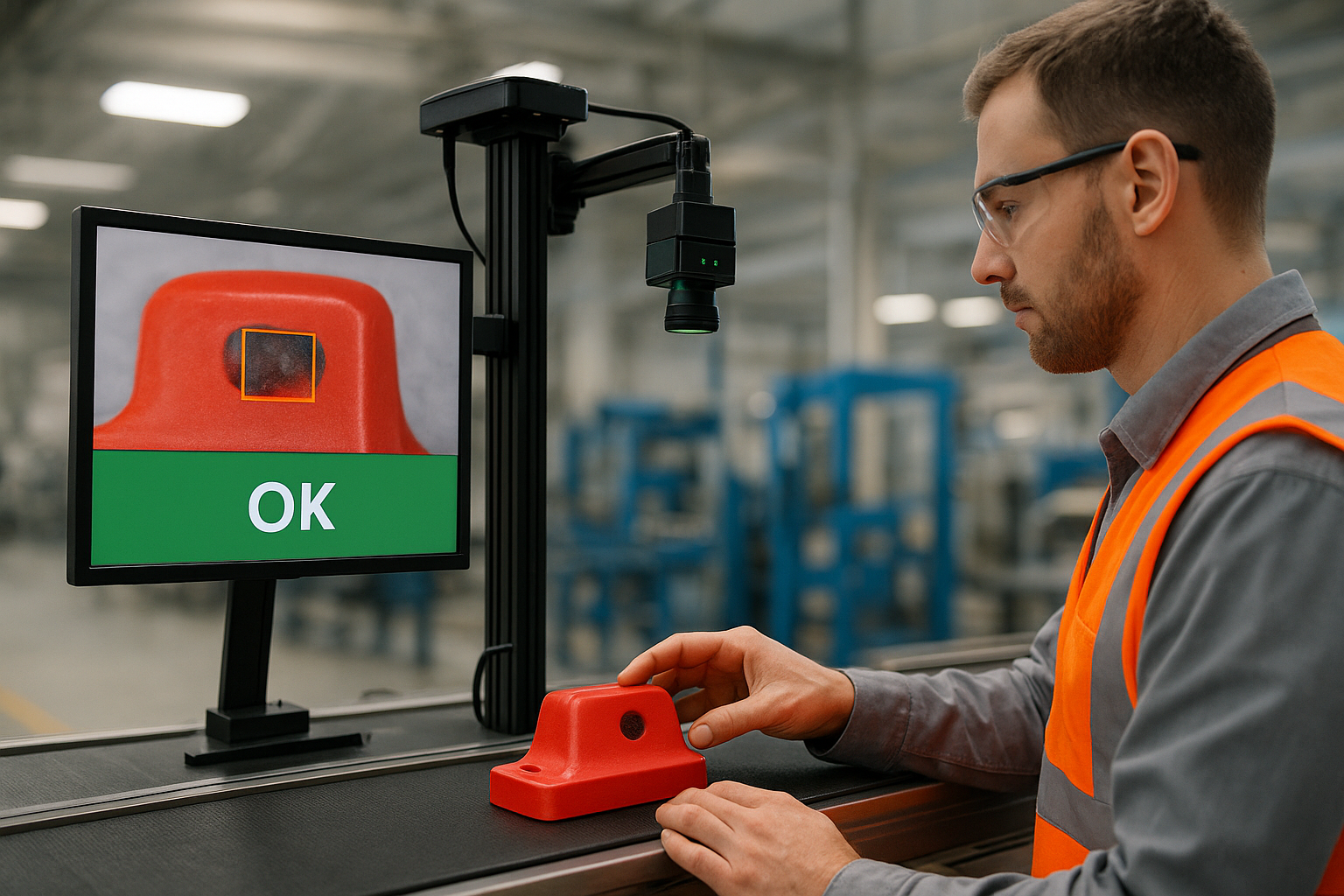
Natural language processing (NLP) plays a supporting role in manufacturing by extracting insights from maintenance logs, supplier communications, and quality reports. These tools surface patterns in unstructured text data that would otherwise sit unused. Together, computer vision and NLP give your operations team a more complete picture of where quality and process problems originate.
High-impact AI use cases across the value chain
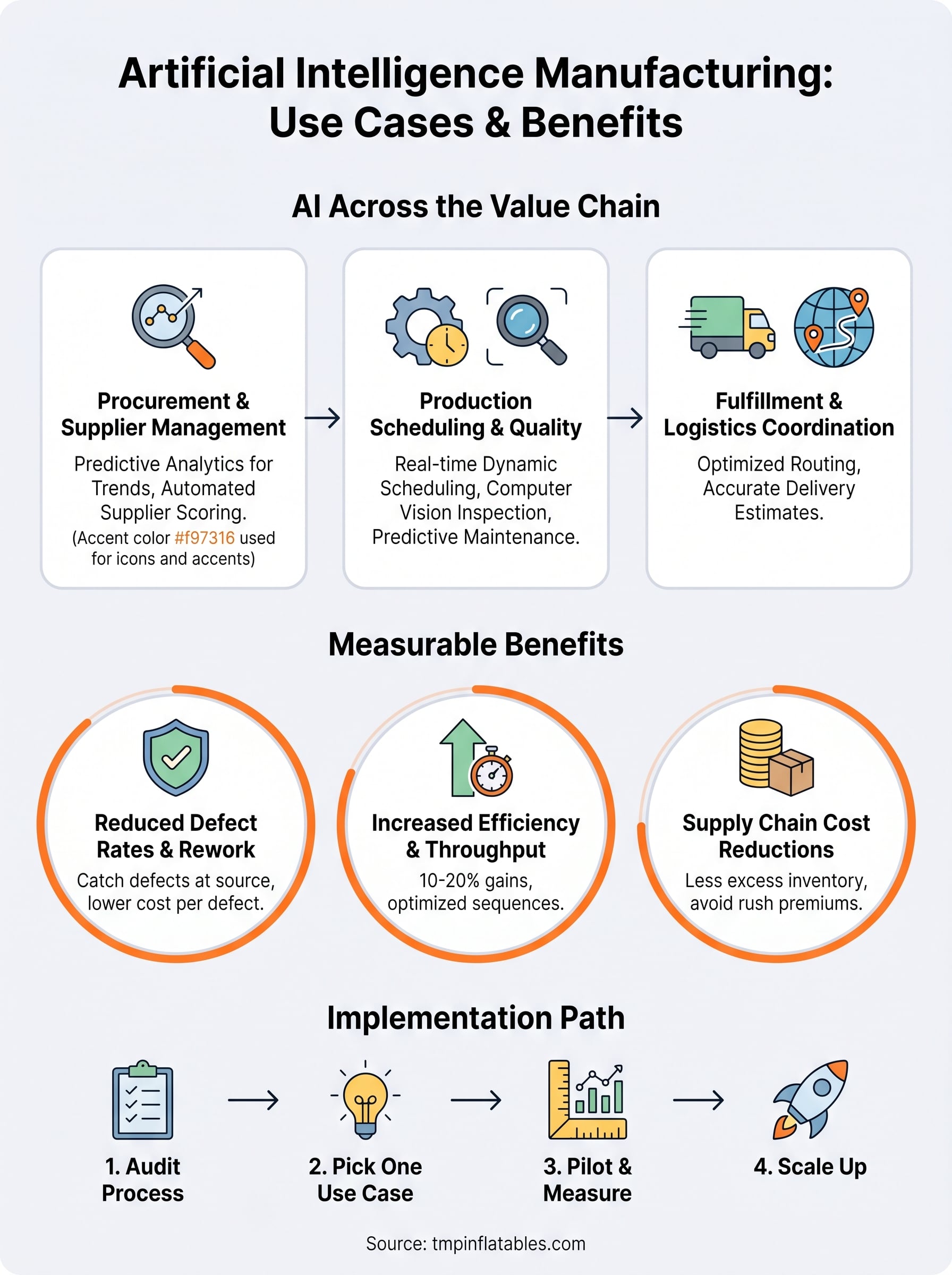
AI touches every stage of the manufacturing process, but some applications deliver outsized results depending on where you apply them. Understanding which use cases move the needle helps you prioritize rather than spreading resources across every available tool at once. Artificial intelligence manufacturing applications cluster around three high-impact zones: procurement, production scheduling, and fulfillment, and each one has direct consequences for your delivery performance and client satisfaction.
Procurement and supplier management
Your procurement decisions set the conditions for everything that follows on the production floor. AI tools analyze supplier performance data, lead time variability, and commodity price trends to recommend purchasing decisions before shortages or cost spikes hit your operation. Instead of reacting to supply disruptions after they’ve already stalled production, you get early warnings with enough lead time to reroute orders or adjust schedules. Automated supplier scoring reduces the manual review burden on your purchasing team and flags underperforming vendors with concrete data rather than gut feel.
Production scheduling and throughput
Getting the most out of your equipment means more than running it continuously. AI-powered scheduling systems balance machine capacity, material availability, and order priority in real time, adjusting automatically as conditions change. When a rush order arrives or a machine goes offline for maintenance, the system recalculates the production plan rather than leaving that problem to a scheduler working from a static spreadsheet.
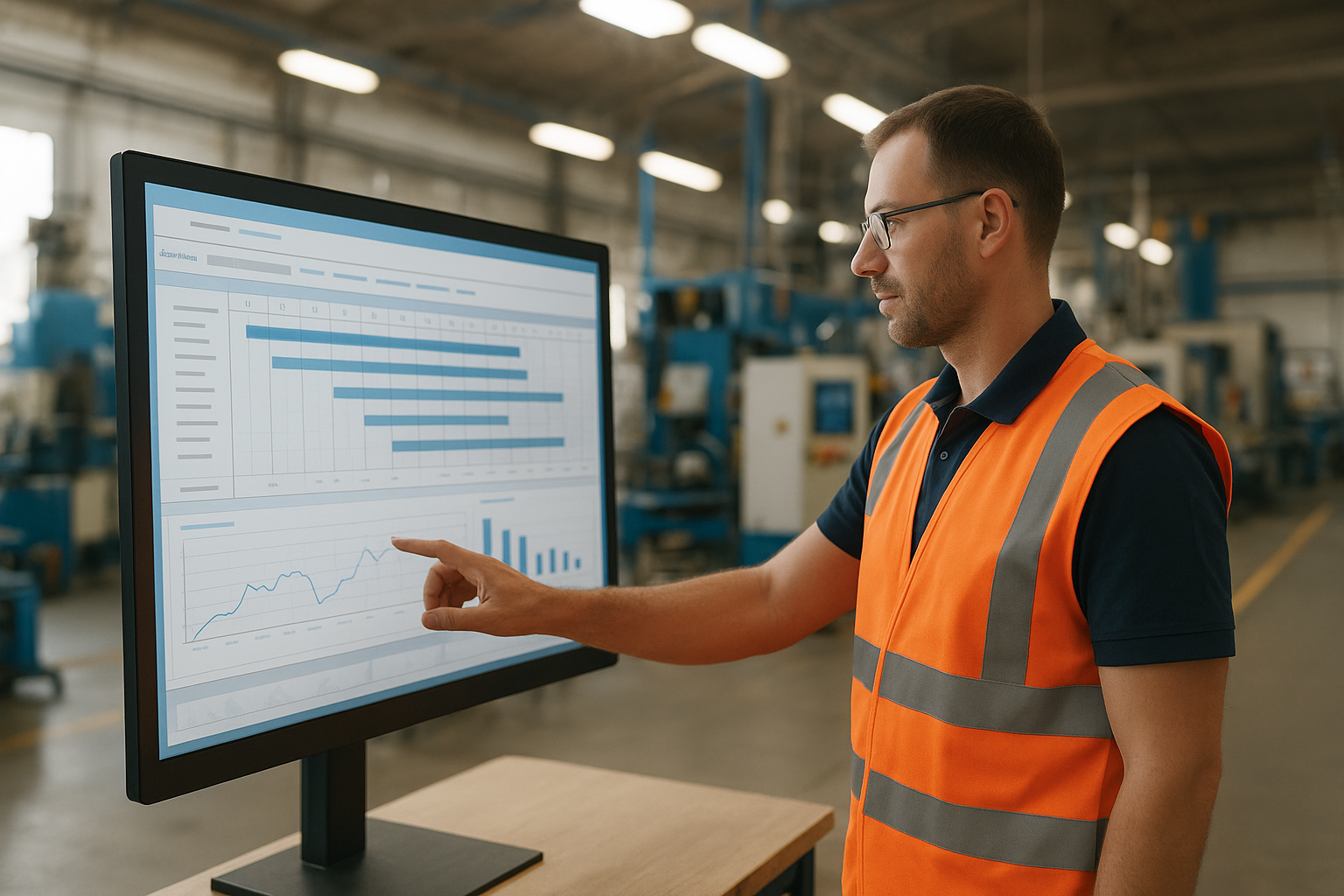
Real-time scheduling adjustments close the gap between planned and actual output, which is where most production inefficiencies originate.
For manufacturers running custom orders with variable specifications, like inflatable tents in multiple configurations or branded arches in different sizes, this dynamic scheduling capability prevents one complex order from creating a bottleneck that delays everything behind it.
Fulfillment and logistics coordination
AI systems improve the final stage of the value chain by predicting shipping timelines, optimizing routing, and flagging delivery risks before they reach your client. Logistics tools trained on carrier data and regional volume patterns generate more accurate delivery estimates than static lead time tables. For event-based orders where missing a delivery window means missing the event entirely, that accuracy matters as much as the production quality itself.
Benefits of AI in manufacturing you can measure
The case for artificial intelligence manufacturing comes down to numbers. Companies that have deployed AI across their operations report measurable improvements in defect rates, equipment uptime, labor efficiency, and supply chain costs. These aren’t projections from vendor pitch decks. They’re outcomes that show up in your production reports and balance sheet when you apply the right tools to the right problems in the right order.
Reduced defect rates and rework costs
Computer vision inspection systems catch defects at the point of production, before defective units move downstream and require rework or replacement. Manufacturers using automated quality inspection consistently report defect detection rates that outperform manual inspection, along with a sharp drop in the cost per defect found. Catching a problem at the source costs a fraction of what it costs to address after the product ships or reaches a client.
Eliminating rework late in the production cycle protects both your margin and your delivery timeline at the same time.
Labor efficiency and throughput gains
AI-driven scheduling tools reduce idle time between production runs by optimizing the order sequence based on real-time material availability and machine capacity. When your equipment runs closer to its actual capacity rather than the capacity your planners estimated from a static spreadsheet, output per shift increases without adding headcount. Throughput gains between 10 and 20 percent are common in facilities that move from manual scheduling to dynamic AI-based planning.
Your workforce also benefits directly, because AI absorbs the repetitive analytical work and frees your team to focus on decisions that require human judgment, like resolving client escalations or managing supplier relationships under pressure.
Supply chain cost reductions
Demand forecasting models reduce both overstock and stockout situations by giving your procurement team accurate, forward-looking signals instead of relying on last season’s order history. Carrying less excess inventory frees up working capital you can redirect toward growth. Avoiding emergency sourcing when materials run short eliminates the premium costs that surface every time you order under time pressure, and those savings compound across every production cycle.
How to implement AI in manufacturing step by step
Starting with artificial intelligence manufacturing doesn’t require a full digital transformation budget or a dedicated data science team. The manufacturers that see the fastest results start small, prove value in one area, and then expand. A structured approach prevents the most common mistake, which is trying to automate everything at once before your team understands what the tools actually do inside your specific production environment.
Start with a process audit
Before you buy any software, map your current production workflow from material intake to final delivery. Identify where delays, defects, and cost overruns consistently occur. These pain points are your starting list. Prioritize the problem that creates the most direct cost or client impact, because that’s where an AI application will deliver a return fast enough to justify further investment.
Your audit doesn’t need to be complex. A simple process map with documented failure points gives you enough clarity to choose the right first application.
- Document defect rates by production stage
- Record equipment downtime frequency and cause
- Track order fulfillment delays by step
- Note where manual scheduling creates bottlenecks
Pick one use case and build from there
Once you’ve identified your highest-cost problem, select one AI tool that addresses it directly. If defects are your primary issue, start with computer vision inspection. If scheduling creates your biggest delivery risk, start with a dynamic planning tool that integrates with your existing production data. Avoid evaluating five tools simultaneously. A focused pilot gives you clean results you can actually learn from.
Run your pilot for at least 60 days with clear metrics in place before drawing conclusions. Tracking specific numbers, like defect rates per production run or schedule adherence percentage, gives you the evidence you need to justify scaling the tool or replacing it with a better fit.
Measure results before scaling
Scaling an AI application before you’ve validated the results in your own environment is how implementations fail. Collect baseline data before you go live, compare it to results after deployment, and document what changed. Then expand to the next problem on your audit list using the same process.
Where to go from here
Artificial intelligence manufacturing isn’t a distant trend you need to prepare for. It’s running right now across procurement, production, quality inspection, and logistics in facilities of every size. The manufacturers gaining ground today are the ones that picked a specific problem, applied a focused tool, and measured what happened before moving to the next step. That structured approach is what separates companies that see real returns from those that stall on overbuilt implementation plans.
Your production environment is unique, and the tools that work best for you depend on where your current costs and delays actually come from. Start with your audit, identify your highest-impact problem, and build from there. If your business depends on custom manufactured products arriving on time for campaigns and events, the quality and reliability of your production partners matters as much as any internal system. When you’re ready to put a custom inflatable order into motion, request a quote from TMP Inflatables and we’ll get to work.