

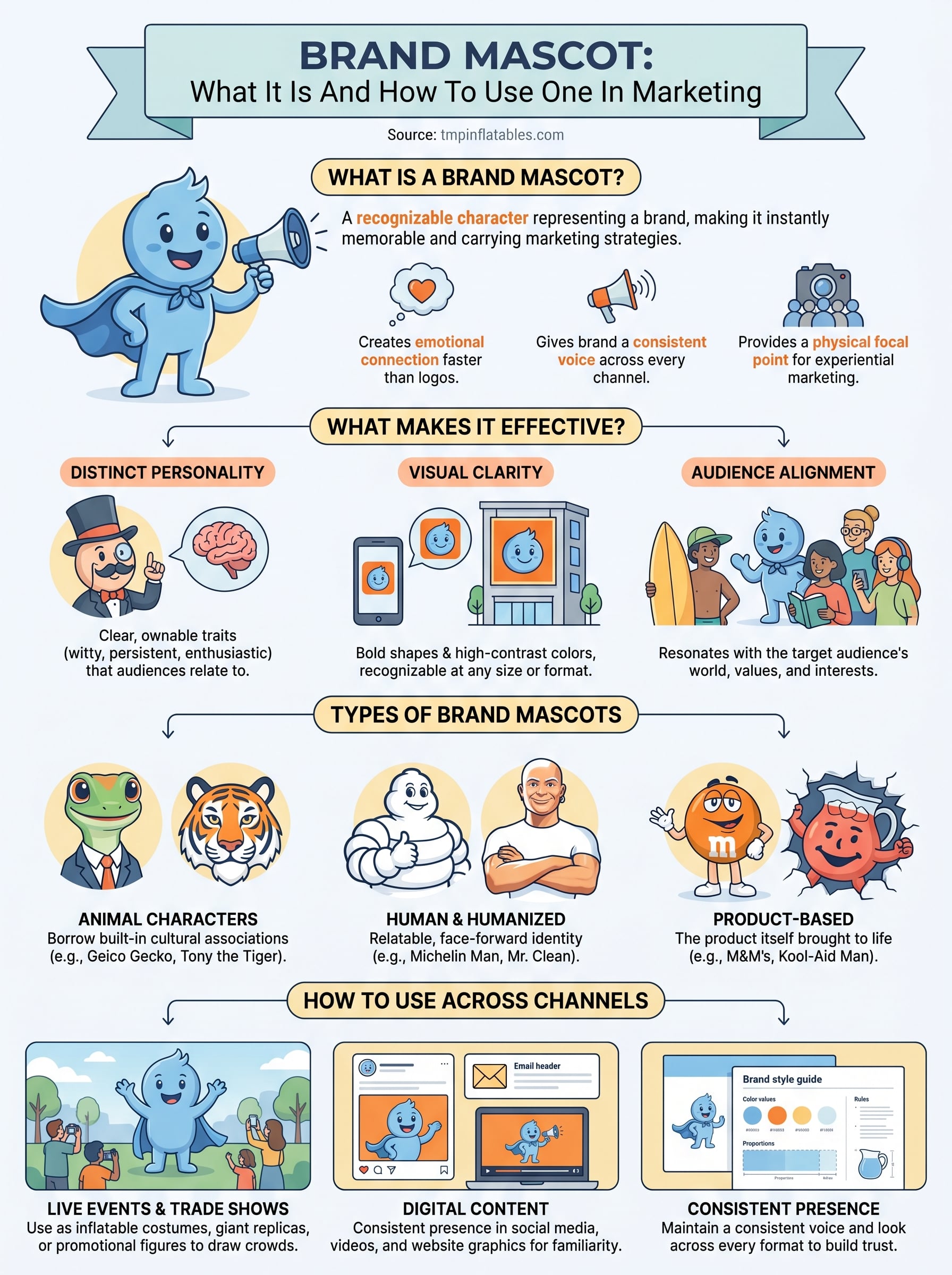
A brand mascot is one of the most effective tools a company can use to make itself instantly recognizable and emotionally memorable. Think of the Geico Gecko, the Michelin Man, or Tony the Tiger, these characters don’t just represent their brands, they carry entire marketing strategies on their shoulders.
But mascots aren’t reserved for Fortune 500 companies with massive ad budgets. Any business that wants to stand out at events, trade shows, or product launches can put a well-designed character to work. At TMP Inflatables, we’ve spent over 20 years helping brands bring their mascots to life as inflatable costumes, giant character replicas, and custom promotional inflatables, so we’ve seen firsthand what separates a forgettable mascot from one that stops people in their tracks.
This article breaks down exactly what a brand mascot is, why it matters for marketing, and how to create one that actually connects with your audience. We’ll also look at famous examples worth studying and walk through the practical steps to design and implement a mascot that works for your brand.
Why brand mascots work in modern marketing
Marketing has gotten noisier. Your audience sees hundreds of brand messages every day across social media, email, outdoor signage, and video platforms. In that environment, a well-designed brand mascot does something most traditional advertising can’t: it gives people something emotionally tangible to connect with. Humans are wired to respond to faces and personalities, and a mascot activates that response every time someone encounters your brand.
Mascots create emotional connection faster than logos or taglines
A logo tells people who you are. A tagline tells them what you do. A mascot tells them how you make them feel. Research in consumer psychology consistently shows that character-based branding triggers stronger emotional responses than abstract visual identities. When people form a positive emotional association with a character, they transfer that feeling to the brand itself. That’s why the Geico Gecko drove some of the most successful advertising campaigns in insurance history, a notoriously dry and transactional category.
A mascot doesn’t just represent your brand identity, it gives your audience a reason to care about it.
Your mascot can appear in scenarios that resonate with your audience, behave in ways that reflect your brand values, and express personality traits that a logo simply cannot. This character-driven quality makes your brand more approachable and memorable, particularly in markets where products and services are difficult to differentiate on features alone.
They give your brand a consistent voice across every channel
One of the biggest challenges in marketing is maintaining consistent brand communication across wildly different channels. A brand mascot solves a significant part of that problem by acting as a through line. Whether your character appears in a video ad, on your website, at a trade show, or at a live activation in full inflatable costume form, it signals the same personality and values every time.
Consistency builds familiarity, and familiarity builds trust. When your audience repeatedly encounters the same character across multiple touchpoints, your brand becomes easier to recall and harder to ignore. That’s a real competitive advantage, especially in crowded markets where attention is the scarcest resource and switching costs between competitors are low.
Mascots give experiential marketing a physical focal point
Live events and experiential campaigns need something people can physically interact with and photograph. A mascot fills that role better than a banner or a product display. When you bring your character to life as a large-scale inflatable replica, a costumed performer, or an oversized promotional figure, you create a natural gathering point that draws foot traffic and drives social sharing without requiring any additional incentive.
For brands that invest in trade shows, product launches, outdoor activations, or sporting events, a physical mascot presence does more than entertain. It anchors your space, extends your brand’s visual reach across an entire venue, and gives attendees a shareable moment that keeps working for you long after the event ends. In that sense, a mascot is one of the few marketing assets that generates ongoing brand exposure far beyond its initial activation.
What makes a brand mascot effective
Not every character breaks through. The market is full of mascots that companies spent real money developing but that audiences immediately forgot. What separates the ones that stick from the ones that don’t comes down to a few specific qualities you need to get right from the start.
A distinct, ownable personality
Your brand mascot needs a clear, consistent personality that people can recognize and relate to instantly. Vague or generic characters don’t create emotional attachment. The ones that work have specific traits: the Geico Gecko is witty and self-aware, the Aflac Duck is persistent and slightly absurd, Tony the Tiger is relentlessly enthusiastic. Each of those personalities maps directly to a brand positioning and reinforces it every time the character appears.
The strongest mascots feel like they could only belong to one brand, and that exclusivity is what makes them valuable.
When you define your mascot’s personality, tie it explicitly to what your brand stands for. If your brand values precision and reliability, your character should communicate those traits through its design, expressions, and behavior across every channel.
Visual clarity that works at any size
A mascot that looks sharp in a digital ad but becomes unreadable on a large-format banner or a custom inflatable isn’t doing its full job. Visual simplicity is critical. Strong mascots use bold shapes, high-contrast colors, and distinctive silhouettes that remain recognizable whether they appear on a mobile screen, a trade show display, or a 20-foot inflatable replica in the middle of a live activation.
Avoid designs that rely on fine details to communicate the character’s identity. At scale, those details disappear, and what remains needs to carry the full weight of brand recognition on its own.
Alignment with your audience, not just your brand
Many companies design mascots that reflect their internal brand values but fail to think about what actually resonates with the people they’re trying to reach. Your character needs to connect with your audience’s world, not just your brand’s world. That means understanding what your audience finds relatable, entertaining, or aspirational and building those qualities into the mascot from the ground up.
A mascot designed for trade show attendees and B2B buyers needs a different tone than one built for families at a summer festival. Getting that alignment right from the start determines whether your character builds genuine loyalty or simply fills space.
Types of brand mascots with real-world examples
Not all mascots take the same form, and the type you choose shapes how your audience connects with your brand. Understanding the main categories of brand mascot helps you make a deliberate creative decision rather than defaulting to whatever feels obvious. Each type carries distinct strengths depending on your industry, your audience, and how you plan to activate the character across physical and digital channels.
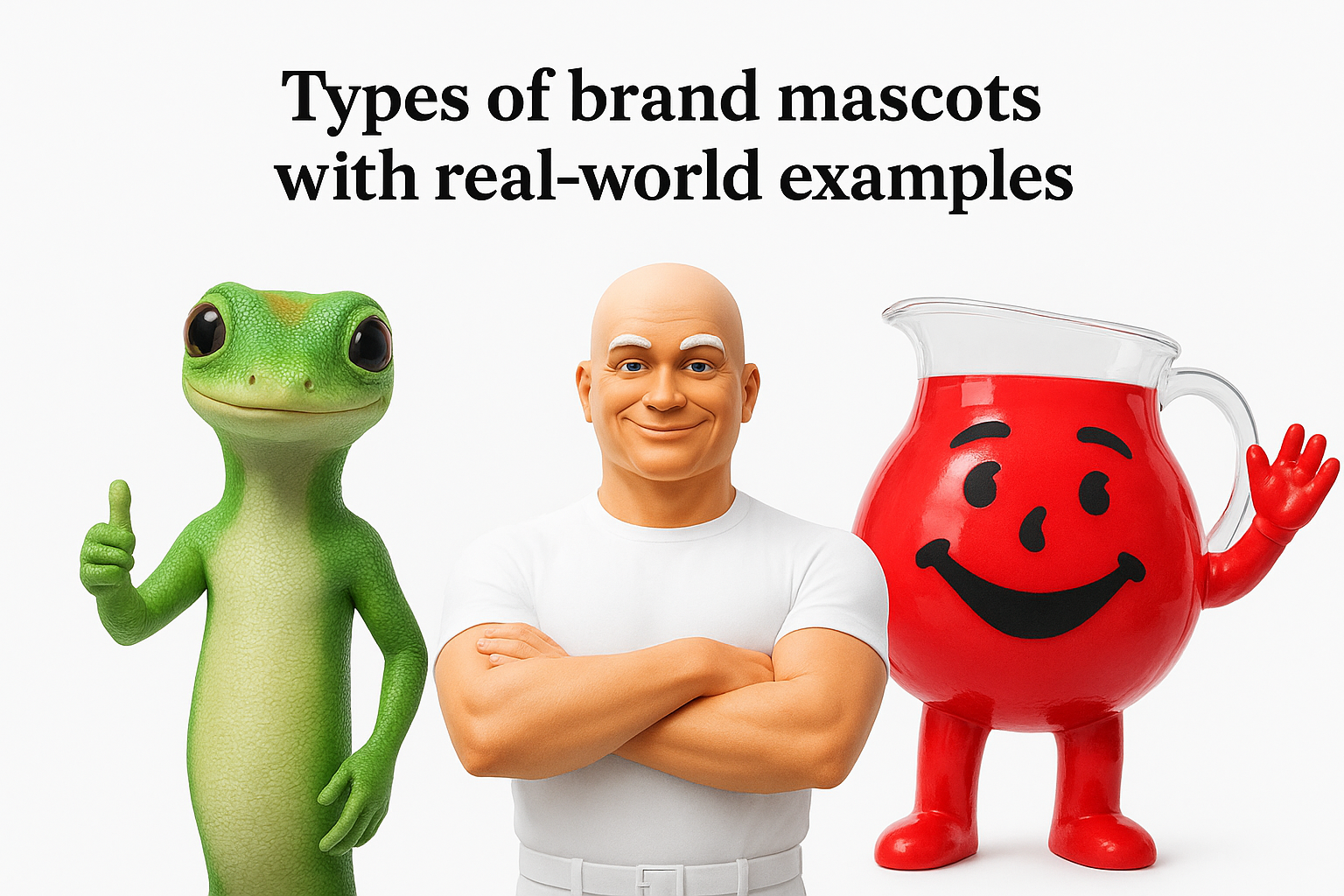
Animal characters
Animal mascots are among the most recognized in marketing history, and for good reason. Animals carry built-in personality associations that audiences absorb instantly. The Geico Gecko communicates approachability and wit. The AFLAC Duck signals persistence with a touch of humor. Tony the Tiger from Kellogg’s projects strength and excitement in a way that’s directly tied to the product it promotes. When you choose an animal character, you’re borrowing a set of cultural and emotional associations that already exist in your audience’s minds, which accelerates connection.
Choosing the right animal isn’t about what you find interesting, it’s about what signals the right qualities to your specific audience.
Human and humanized characters
Human-shaped mascots give brands a relatable, face-forward identity that feels natural in social, video, and live contexts. The Michelin Man is a classic example: a human-like figure made from the product itself, immediately recognizable and endlessly adaptable across formats. Mr. Clean is another strong example, a character with clear physical traits that communicate strength and reliability without a single word. Human mascots work particularly well for brands that want to project expertise, warmth, or authority, since audiences naturally read personality into human faces and body language.
Product-based characters
Some of the most effective mascots are simply the product itself brought to life. The M&M’s characters turn candy into personalities with distinct traits and ongoing storylines. The Kool-Aid Man is literally the product container in motion. These characters work because they eliminate the gap between the mascot and what you’re selling, making brand recall and product recall happen simultaneously. For businesses that manufacture a distinctive product or work with a recognizable physical form, animating that product directly into a mascot can create a stronger connection than introducing a separate character entirely.
How to design and launch a brand mascot
Creating a brand mascot that actually works starts long before you open a design brief. The brands that get it right spend time on strategic decisions upfront rather than jumping straight into visual concepts. If you skip the foundation, you end up with a character that looks polished but fails to connect with your audience or reinforce anything meaningful about your brand.
Define your character before you hire a designer
The biggest mistake companies make is treating mascot creation as a design project when it’s really a brand strategy project first. Before a single sketch gets made, you need to clearly define your mascot’s personality, the emotions you want it to trigger, and the specific audience it needs to reach. Write down three to five core traits that the character must communicate consistently, whether that’s warmth, authority, energy, or humor, and use those as the creative brief’s foundation.
The clearest creative briefs produce the strongest characters, because designers work better with precise direction than open-ended freedom.
Once you have your character defined on paper, you can bring in a designer or creative team with confidence. Share your brand guidelines, your audience profile, and your personality traits as a package. This gives the designer what they need to make deliberate visual choices rather than guessing what you want.
Work with designers who understand character scalability
Your mascot needs to work at multiple sizes and across multiple formats: a small social media avatar, a trade show banner, a website icon, and potentially a full-scale inflatable replica or costume. Hire a designer with explicit experience in character design and brand identity rather than general graphic design. Ask to see examples of characters they’ve created that have been applied across both digital and physical formats. If the design doesn’t translate well at large scale, you’ll face expensive revisions later.
Test your mascot before full rollout
Before you invest in production at scale, gather structured feedback from a representative sample of your target audience. Show them the character without any brand context and ask what personality traits they perceive. If the responses don’t match your intended traits, you still have time to refine the design. Launch your mascot in one controlled context first, such as a single event or a limited campaign, collect real-world data, and then scale from there.
How to use a brand mascot across channels
Having a well-designed brand mascot is only half the job. How you deploy it across channels determines whether it builds genuine recognition or sits unused in a brand guide. The most successful mascots appear consistently and deliberately across every touchpoint your audience encounters, from physical events to digital platforms to packaging.
Activate your mascot at live events and trade shows
Live events are where a brand mascot earns its most immediate return. When you bring your character to life as a large-scale inflatable replica, a costumed performer, or an oversized promotional figure, you create a physical presence that draws crowds and generates organic social sharing. People photograph, film, and post content without any prompting, which extends your brand’s reach far beyond the event itself.
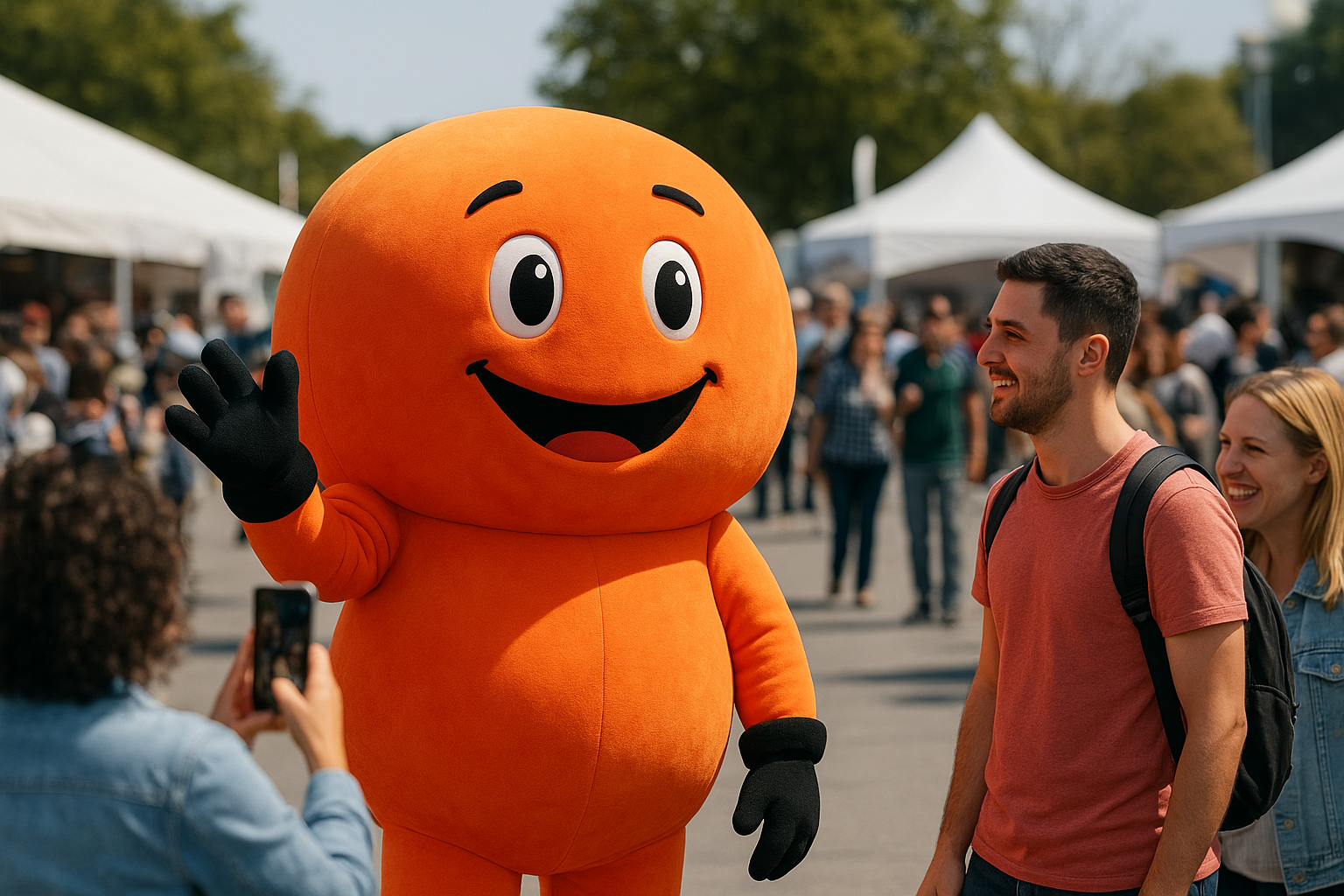
A mascot at a live event doesn’t just attract attention, it becomes the event for everyone who photographs it and shares it.
For trade shows specifically, your mascot gives attendees a clear reason to stop at your booth rather than walking past. A giant inflatable character positioned at your entrance signals that something interesting is happening at your space before anyone reads a single word of your signage.
Extend your mascot into digital content
Your mascot needs a consistent presence across digital channels to build the familiarity that drives recall. Use your character in social media graphics, email headers, explainer videos, and website illustrations. Each appearance reinforces the same personality and visual identity you’ve established in physical activations, which keeps your brand coherent across formats.
Short video content is particularly effective for mascot-based storytelling. Animated clips or behind-the-scenes footage of your character at events perform well on social platforms because they prioritize entertainment and personality over direct promotion. Audiences share content they enjoy, and a character-driven clip gives them a genuine reason to do exactly that.
Keep your character consistent across every format
Consistency is what turns a mascot into a recognizable, long-term brand asset rather than a one-off creative element. Build a simple mascot style guide that documents approved color values, proportions, personality traits, and tone of voice. Distribute that guide to every vendor, agency, or internal team that produces content featuring your character, and apply it without exception across every channel and format your brand occupies.
Next steps
A strong brand mascot does more than decorate your marketing materials. It gives your audience a character to remember, a face to associate with your brand, and a reason to pay attention at every touchpoint you occupy. The key is treating your mascot as a long-term strategic asset rather than a one-time creative project. Define the personality first, build a scalable visual identity, and deploy your character consistently across every channel where your audience spends time.
If you’re ready to bring your mascot to life at events, trade shows, or live activations, the physical format you choose makes a significant difference. Custom inflatables, inflatable costumes, characters and custom promotional replicas give your brand mascot an immediate, high-visibility presence that flat graphics simply cannot match. TMP Inflatables has over 20 years of experience turning a brand mascot into inflatables that stop people mid-step. Request a custom inflatable quote and start building something your audience won’t forget.