
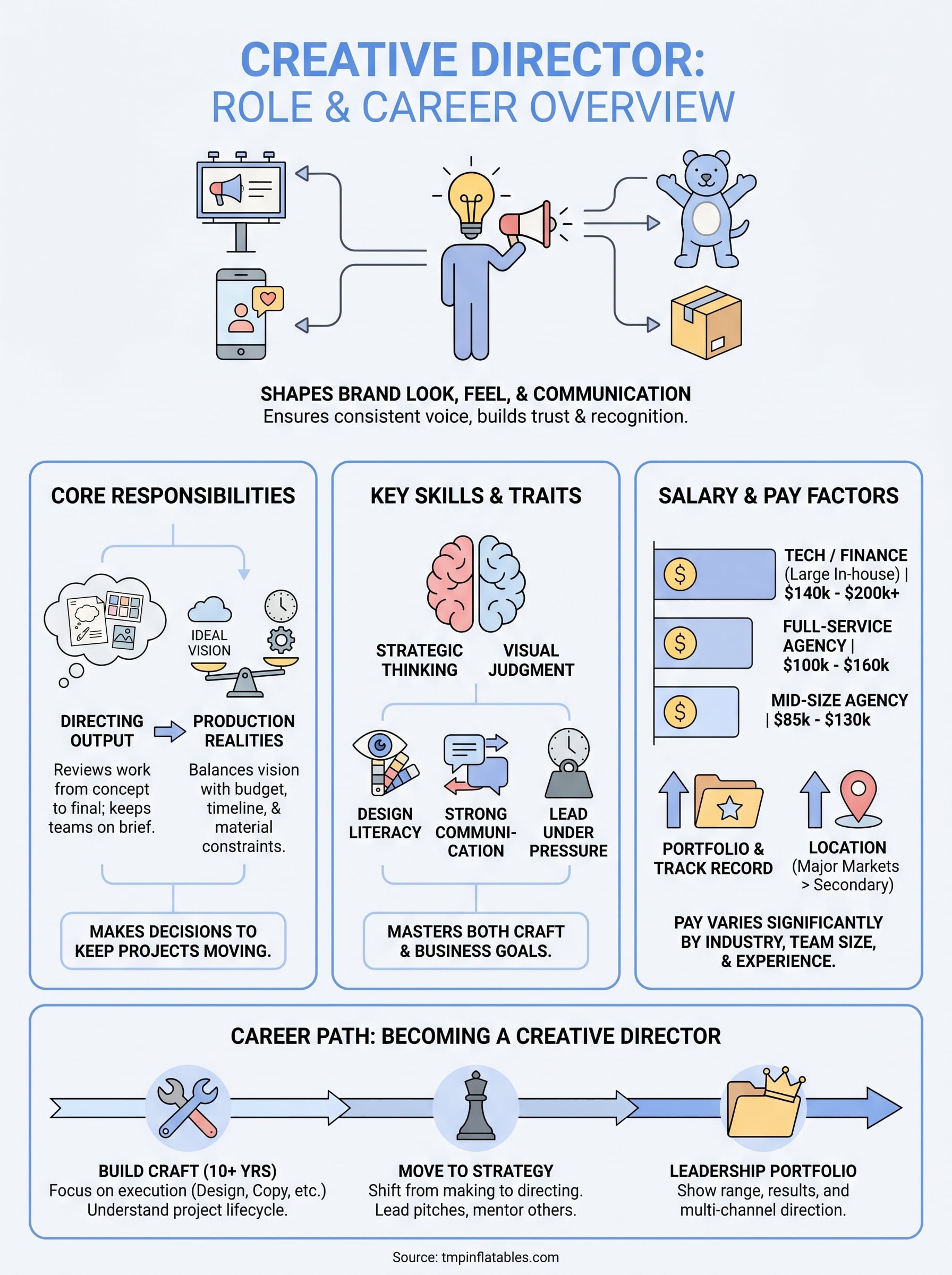
A creative director is the person who shapes how a brand looks, feels, and communicates across every touchpoint, from a billboard campaign to a 30-foot inflatable product replica at a music festival. They’re the ones who turn a brief into a visual and strategic direction that entire teams rally behind.
At TMP Inflatables, we work alongside creative directors every day. When an agency or brand needs a custom inflatable tent, a larger-than-life mascot costume, or an eye-catching arch for a product launch, it’s usually a creative director who brings the initial vision to our design team. That working relationship gives us a front-row seat to what this role actually demands, and why it matters so much to the success of experiential campaigns.
If you’re considering this career path, or you’re already in a creative role and want to understand what it takes to reach the director level, this article breaks it all down. We’ll cover the core responsibilities that define the position, the skills you need to develop, what creative directors actually earn, and the educational and professional steps that get you there. No vague advice, just a clear, practical look at the role from definition to career trajectory.
Why creative directors matter in modern business
A business with no clear creative direction ends up with fragmented messaging, inconsistent visuals, and campaigns that fail to connect with the people they’re meant to reach. The creative director is the person who prevents that from happening. They function as the central decision-maker for all creative output, ensuring every asset and campaign speaks with one clear voice. Without this leadership, even talented teams with generous budgets produce work that feels scattered and forgettable.
The creative director doesn’t just approve designs; they define the standard that every piece of creative work gets measured against.
The role of creative leadership in brand consistency
Brand consistency is one of the most undervalued drivers of business performance. When people encounter the same visual language, tone, and messaging across every channel, they build trust and recognition faster. The creative director maintains that consistency whether the team is producing a social media post, product packaging, or a 20-foot inflatable structure for a trade show. They set the guardrails so that no matter who executes the work, the output still feels like the same brand.
This consistency challenge becomes more acute as businesses scale. As teams grow and projects multiply across agencies, vendors, and internal departments, the creative director becomes the single point of accountability for brand integrity. Without someone holding that position, individual contributors make independent decisions that slowly pull the brand apart. You end up with a portfolio of work that looks like it came from five different companies, which confuses audiences and dilutes everything you’ve built.
Creative direction in experiential marketing and live events
Experiential marketing has become one of the most effective ways to build genuine brand connection with audiences. When someone physically interacts with a brand at an event, through a branded inflatable arch, a misting tent at a summer festival, or a giant product replica on a trade show floor, the impression lasts far longer than a digital ad. The creative director determines how a brand shows up in real-world, three-dimensional spaces, and that decision carries real strategic weight beyond aesthetics.

Choosing that a campaign needs a custom inflatable dome or a 15-foot mascot character isn’t just a creative preference; it’s a business judgment call. The creative director has to understand the target audience, the event context, the brand positioning, and the production logistics well enough to make that call with confidence. Agencies and marketing teams rely on that expertise to direct their budgets toward the right executions. A poorly conceived live installation doesn’t just waste money; it creates a public-facing impression that’s difficult to undo, which is exactly why strong creative leadership is worth the investment.
Why businesses invest in senior creative leadership
Companies that bring in a capable creative director see measurable improvements in both external brand perception and internal team efficiency. Without senior creative leadership, teams cycle through conflicting revision rounds and stall on approvals because no one has final authority over what goes out the door. A creative director eliminates that friction by establishing clear direction from the start of every project.
For marketing leads and brand managers, this translates into faster execution and better outcomes across campaigns. You stop burning time on work that doesn’t align and start moving toward launch with clarity. Whether you’re organizing a single product reveal or a multi-city brand activation, that kind of focused creative leadership compresses timelines and sharpens results in ways that generic creative processes simply can’t replicate.
What a creative director does day to day
The daily work of a creative director is less about sitting at a drawing board and more about making decisions that keep projects moving in the right direction. You spend a significant portion of your day in conversations: reviewing concepts, aligning with account teams, and giving feedback that shapes the direction of work in progress. No two days look exactly alike, but the common thread is always the same: keeping every piece of creative output on strategy and on brand without losing momentum.
Directing creative output across teams
A creative director reviews work at multiple stages of production, from early sketches and mood boards to near-final executions ready for client review. Your job is to spot where something drifts off brief and redirect the team before too much time gets invested in the wrong direction. This requires both sharp visual judgment and a solid understanding of the business objective behind every project.

The best creative directors give feedback that’s specific enough to act on, not just reactions to whether something looks good or not.
Here’s what that review and direction loop typically looks like across a given workday:
- Morning: Review overnight submissions and prioritize feedback by project deadline
- Midday: Lead or attend creative presentations with clients or internal stakeholders
- Afternoon: Work through active revisions with designers, copywriters, and production vendors
- Ongoing: Align with project managers to surface timeline risks before they become real problems
Balancing vision with production realities
Managing the gap between what looks ideal on a concept board and what’s actually buildable within budget and timeline takes up more of your day than most people outside the role expect. When a campaign calls for a custom inflatable structure or a large-format experiential installation, the creative director evaluates the brief against hard production constraints early so the team isn’t forced to redesign under deadline pressure.
Strong vendor relationships and a working knowledge of materials, timelines, and fabrication processes are non-negotiable in this role. You need to understand what a supplier can realistically deliver in a given window, and you need to make creative calls that account for those realities without sacrificing the campaign’s impact. That practical awareness is what separates a director who consistently ships strong, executable work from one who produces concepts that fall apart the moment they meet real-world conditions.
Skills and traits creative directors need to lead well
A creative director carries a dual responsibility that most roles don’t: they need to think visually and strategically at the same time. You can’t lean entirely on artistic instinct and ignore the business goal, and you can’t bury creative talent under spreadsheets and briefs. The strongest directors master both modes and know when to prioritize each one based on what a given project actually demands. These skills don’t develop overnight, and the path to the director level is largely a process of building them through years of deliberate practice.
Visual judgment and design literacy
You don’t need to be the best designer on the team, but you need to speak the language of design fluently. A creative director evaluates work based on composition, hierarchy, color, and narrative tone, and that evaluation only carries weight if the team trusts your eye. That trust develops when your feedback is grounded in craft and not just personal taste, pointing toward concrete improvements rather than vague reactions.
Design literacy gives your direction authority. Without it, feedback becomes noise, and teams stop bringing their best work to review.
Beyond visual judgment, you also need a working familiarity with the production processes behind every format your team touches. Whether a project involves print, digital, video, or physical fabrication like large-format inflatables for a brand activation, understanding how things actually get built shapes smarter creative decisions from the start of every brief rather than after costly revisions.
Communication and the ability to lead under pressure
Strong communication is the skill most candidates underestimate on the way to the director level. You spend far more time translating creative vision into clear direction for designers, writers, producers, and clients than you spend generating ideas yourself. If you can’t explain why something works or doesn’t in terms that a non-designer understands, your leadership loses traction with the people who need it most.
Pressure comes with the title. Tight deadlines, shifting client expectations, and competing project priorities all land on the creative director’s desk simultaneously. You need to make fast calls without sacrificing quality and keep the team focused when things get difficult. The directors who perform consistently rely on clear decision-making habits built over time rather than reacting differently to each new problem, which is what teams need when timelines compress.
Salary and what affects creative director pay
Creative director compensation varies significantly depending on where you work, the industry you’re in, and the scope of your responsibilities. According to the U.S. Bureau of Labor Statistics, art directors (the closest comparable classification) earn a median annual wage around $106,000, but senior creative leadership roles at major agencies or in-house at large brands frequently reach well above $150,000. The range is wide because the title itself covers a lot of ground, from a two-person studio to a global brand with dozens of creatives reporting up to a single director.
The difference between a $90,000 and a $180,000 creative director salary often comes down to industry, team size, and your demonstrated track record, not just years of experience.
What creative directors earn across industries
Your earning potential as a creative director shifts considerably depending on where you land. Technology and finance companies tend to pay the highest base salaries for in-house creative leadership because they compete aggressively for talent and have larger marketing budgets to work with. Advertising agencies often offer lower base salaries but balance that with bonuses tied to client retention and campaign performance. Here’s a general breakdown of where salaries typically fall:

| Setting | Typical Salary Range (US) |
|---|---|
| In-house at a large tech or finance firm | $140,000 – $200,000+ |
| Full-service advertising agency | $100,000 – $160,000 |
| Mid-size creative or experiential agency | $85,000 – $130,000 |
| Freelance or independent consulting | Highly variable |
Factors that move pay up or down
Your portfolio and the caliber of brands you’ve worked with carry more weight than almost anything else when salary is being negotiated. Hiring managers and executives look at whether your campaigns produced measurable results and whether you’ve led complex, multi-channel projects from concept through delivery. If your background includes large-scale experiential work, such as directing branded activations or overseeing the production of custom physical installations for major events, that specialized knowledge adds tangible market value.
Location also plays a direct role in what you can command. Markets like New York, Los Angeles, and San Francisco consistently show higher salaries than secondary markets, though remote work has started to compress that gap for some roles. Building a reputation that extends beyond your immediate market, through published work, case studies, or industry recognition, gives you more negotiating leverage regardless of where you’re physically based.
How to become a creative director
Most creative directors reach the role after 10 to 15 years of progressive experience across design, art direction, copywriting, or production. There’s no shortcut that skips that foundation. The title reflects genuine leadership authority, and that authority only holds weight when the people you’re directing know you’ve done the work yourself at a high level.
Build your craft before you manage others
Start by becoming genuinely excellent at one core discipline. Whether that’s graphic design, copywriting, photography, or motion, you need to develop a skill set that earns respect from peers before you can earn it from a team you’re responsible for leading. Your early years should be focused on volume and quality of output, taking on diverse briefs, working inside agencies or in-house teams, and learning how campaigns move from concept through production.
The creative director role rewards people who built real craft first and then grew into strategy, not the other way around.
Take every opportunity to understand the full project lifecycle, including budget constraints, client communication, and production timelines. These operational realities will shape your leadership decisions later, and the earlier you understand them, the faster you develop into someone a company will trust with senior responsibility.
Move from executor to strategic thinker
At some point, your value shifts from making things to directing how others make things. That transition usually begins at the senior designer or associate creative director level, where you start owning pieces of a brief rather than just executing tasks within it. Look for chances to pitch concepts, lead client-facing presentations, and mentor junior team members, because those experiences are what hiring managers look for when filling creative director roles.
Build a portfolio that reflects leadership
Your portfolio needs to show range and results, not just technical polish. Include work where you directed a team, managed a complex multi-format campaign, or oversaw production of an experiential element like a branded installation or large-format physical activation. Clients and employers want evidence that you can drive a creative vision from brief to delivery without losing quality or momentum. A portfolio built on execution alone won’t open director-level doors; a portfolio that shows strategic leadership will.
Common misconceptions and related roles
Several misconceptions follow the creative director title around, and they tend to distort both how people pursue the role and how organizations structure their creative teams. Understanding where those misconceptions come from helps you position yourself more accurately, whether you’re building toward the role or hiring for it.
Creative directors aren’t just senior designers
The most common confusion is treating creative director as a natural continuation of the design track, as if the role is simply what happens when a designer improves enough over time. In practice, the two roles demand fundamentally different orientations. Designers execute within a defined direction, while creative directors define the direction itself. That shift from making to leading requires a different skill set, and organizations that automatically promote their best designer often discover the person excels at craft but struggles with leadership accountability.
Giving someone the title without transferring real decision-making authority doesn’t create a creative director; it creates a designer with a misleading job description.
How the role differs from closely related positions
Art directors focus primarily on the visual execution of a specific campaign or project, often reporting to a creative director above them. They make decisions about photography, layout, and visual style within a defined brief. A creative director sets the strategic framework that art directors then work inside. The scope, accountability, and authority at each level are genuinely different, not just a matter of seniority or pay grade.
Brand directors and chief marketing officers overlap with creative direction but operate from different functional starting points. A brand director typically owns the positioning and messaging architecture of a brand, while a CMO manages the full marketing function including budget, media, and channel strategy. Creative directors sit at the intersection of brand vision and executional output, which is a distinct lane even when titles blur in smaller organizations where one person carries responsibilities across multiple functions.
Knowing these distinctions matters practically when you’re negotiating a role, building a team, or deciding which career track to commit to. Clarity about where each role begins and ends prevents the kind of authority gaps that stall creative work and frustrate everyone involved in the process.
Final takeaways
The creative director role sits at the intersection of strategic thinking, design literacy, and team leadership. It’s not a title you earn by being the most talented person in the room; you earn it by developing the judgment and communication skills that help entire teams produce better work. The salary range reflects that scope, and the career path rewards people who invest in both craft and leadership over time.
If you work in experiential marketing or brand activation, you already know that physical creative executions carry their own production demands that test even the most organized creative leaders. When your next campaign calls for a large-format inflatable installation, a branded arch, or a custom tent structure, having the right production partner makes your vision executable. Request a quote for your next custom inflatable and bring your creative direction to life in the real world.