
You’ve got a trade show booth, a product launch, or a company party coming up, and a plain wall just won’t cut it. A custom backdrop solves that problem fast: it turns any dull space into a branded moment worth photographing. But before you order one, you need to know what you’re actually paying for and how the process works.
A custom backdrop is a large printed surface, usually fabric or vinyl, designed with your logo, colors, images, or event theme, then mounted on a frame or stand so it holds its shape under lights and foot traffic. Ordering one means choosing a material and finish, sending your artwork or working with a designer, picking a size that fits your venue, and confirming a production timeline that matches your event date.
Below, we break down the types of backdrops available, what makes one hold up at a busy event versus a quiet photo corner, and the exact steps to place an order that arrives on time and looks right the first time. If you’re planning a launch, trade show, or seasonal campaign, this is the groundwork you need before you send over your design files.
Why a custom backdrop matters for your event or brand
Every event has a backdrop, whether you plan for it or not. Skip the custom backdrop and your guests get a folding table, a fire exit sign, or someone else’s booth in every photo they post. Invest in one and every photo, video, and livestream frame becomes free advertising with your logo placement front and center. That’s the real value: a custom backdrop turns a physical space into a repeatable marketing asset that keeps working after the event ends.
A custom backdrop controls what people remember
Attendees forget speeches and forget swag, but they remember pictures. A branded photo backdrop gives every attendee a reason to stop, pose, and share, which means your booth or party gets tagged and reshared without you spending another dollar on ads. Trade show research from event organizers consistently shows that visual displays drive the majority of booth traffic decisions, which is why the Center for Exhibition Industry Research tracks visual engagement as a top driver of attendee recall.
A custom backdrop is the cheapest brand impression you’ll buy that keeps generating impressions long after the event closes.
A Custom Backdrop builds consistency across every touchpoint
Consistency is what separates a professional brand from a scattered one. When your backdrop matches your booth signage, your email invites, and your social graphics, people recognize your brand faster, and recognition builds trust over repeated exposure. A mismatched wall or a generic pipe-and-drape setup does the opposite; it signals that the details weren’t a priority, and guests notice that even if they can’t name why the space feels off.
A Custom Backdrop works harder than a printed banner
A custom backdrop isn’t just decoration, it’s a functional tool that changes behavior. Here’s what a well-designed one actually does for you at an event:
- Anchors your photo zone so guests know exactly where to take pictures
- Extends your reach through user-generated social posts tagged with your event or hashtag
- Reinforces sponsorship value when partner logos share the space cleanly
- Covers unattractive venue features like exposed wiring, storage doors, or blank drywall
- Signals scale and investment, which matters when you’re competing for attention at a trade show floor
Given that list, the cost of a quality backdrop looks small next to what it delivers in visibility and perceived professionalism.
A Custom Backdrop protects your brand at scale
Small businesses and Fortune 500 teams alike use backdrops for the same reason: control. Once your artwork is locked and printed, there’s no risk of a volunteer taping up a crooked sign or a venue swapping your space at the last minute. Marketing teams running multi-city tours or seasonal campaigns rely on this repeatability, since the same backdrop design can travel to a dozen cities and still look sharp and on-brand at every stop, whether it’s a product launch, a sports activation, or a real estate open house.
Finally, think about what happens without one. Plain walls, generic pop-up displays, and hastily printed posters all cost money too, they just don’t return anything after the event. A custom backdrop, by contrast, keeps paying off in shares, tags, and repeat bookings for as long as your artwork stays current, which is exactly why marketing and event teams treat it as infrastructure rather than an afterthought.
How to order a custom backdrop step by step
Ordering a custom backdrop is straightforward once you know the sequence. Most delays happen because someone skips a step, like confirming size before sending artwork, then has to redo the file at the last minute. Follow the order below and you’ll avoid the back-and-forth that eats into your production timeline.
Nail down your specs before you contact anyone
Before you request a quote, figure out your venue dimensions and where the backdrop will stand. Measure the wall or booth space, note ceiling height if you’re hanging it, and decide whether it needs to travel between events. Vague specs force suppliers to guess, and guesses lead to a backdrop that’s too short for the stage or too wide for the doorway it needs to fit through.
Choose your custom backdrop material and finish
Your venue and event type dictate the material. An outdoor festival needs something wind-resistant; a step-and-repeat for a press event needs a matte finish that kills camera glare. Get quotes on at least two finishes before committing, since price differences between fabric and vinyl can shift your budget more than people expect.
Submit your custom backdrop artwork or work with a designer
Most suppliers accept print-ready files in vector format, but if you don’t have a designer on staff, ask if the supplier offers design support. This is where a design proof matters most, since catching a color mismatch or a misplaced logo on a digital proof costs nothing, while catching it after printing costs you the whole order.
Never approve a print run without seeing a full-size digital proof first.
Confirm Custom Backdrop production and shipping timelines
Lock in your event date early, then work backward. Here’s a rough sequence that works for most orders:
- Request quote and confirm size, material, and finish (1-2 days)
- Submit or finalize artwork (1-3 days)
- Review and approve digital proof (same day, ideally)
- Production run (3-10 business days depending on complexity)
- Shipping and setup buffer (add 2-5 days for international delivery)
Rush orders are possible with most suppliers, but they cost more and limit your material choices, so building in buffer time saves money as much as stress.
Ask about Custom Backdrop setup and reuse
Finally, confirm what comes with the backdrop itself. Does it include a stand, hanging grommets, or a travel case? If you’re planning multiple events, ask whether the frame is reusable with swappable graphics, since that detail can turn a one-time expense into a long-term asset you reuse for years.
Types of custom backdrop and materials to choose from
Not every backdrop should be built the same way. A press wall needs different specs than a birthday party backdrop, and picking the wrong format wastes money on features you’ll never use. Start by matching the backdrop style to how you’ll actually use it, then narrow down the material based on your venue and how often it’ll travel.
Step-and-repeat vs. single-image custom backdrops
Step-and-repeat backdrops repeat a logo pattern across the whole surface, which is the standard choice for press events and red-carpet-style photo ops because the logo shows up no matter where someone stands. Single-image backdrops print one continuous design edge to edge, better suited for scenic themes, product launches, or party photo zones where you want a cohesive picture rather than a repeated mark. If you’re deciding between the two, ask how the photos will be used; media coverage favors step-and-repeat, while social sharing favors a single striking image.
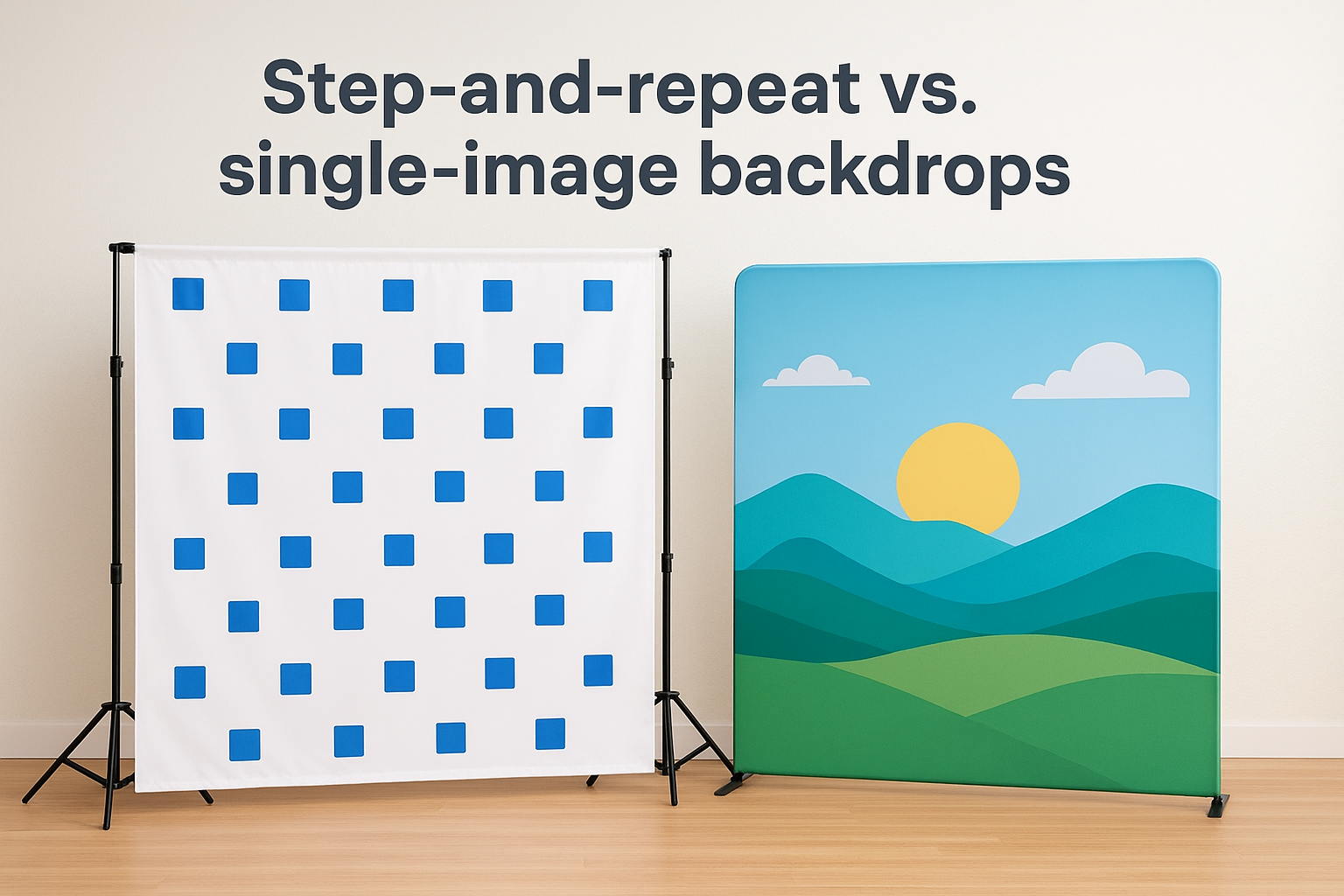
Pick the format based on how the photo gets used, not on which one looks fancier in a sample photo.
Fabric, vinyl, and mesh: how they compare in Custom Backdrops
Material choice affects everything from wrinkle resistance to shipping weight. Here’s how the three most common options stack up:
| Material | Best for | Durability | Portability |
|---|---|---|---|
| Fabric (polyester) | Indoor events, step-and-repeat, trade shows | Wrinkle-resistant, folds without creasing | Lightweight, easy to pack |
| Vinyl | Outdoor events, high-traffic booths | Weatherproof, scratch-resistant | Heavier, bulkier to transport |
| Mesh | Windy outdoor spaces, fencing | Allows airflow, reduces tearing | Moderate weight, rolls easily |
Fabric wins for most indoor events because it packs flat and shows up wrinkle-free straight out of the case, which matters when you’re setting up thirty minutes before doors open. Vinyl holds up better against rain and direct sun, so it’s the right call for outdoor festivals or long-running installations. Mesh solves a problem fabric and vinyl can’t: wind. If your backdrop will stand against a fence or in an open lot, mesh lets air pass through instead of turning your backdrop into a sail.
Frames, stands, and mounting options for your Custom Backdrop
Beyond the printed surface, you need something to hold it up. Pop-up frames work well for step-and-repeat walls that need frequent reassembly, while tension fabric frames give a cleaner, wrinkle-free look for a custom backdrop meant to stay in one spot for days. Freestanding stands suit venues where you can’t attach anything to a wall, and grommet-and-cable setups work best when you’re hanging a backdrop from a truss or pipe-and-drape system already in place.
Design tips for a custom backdrop that grabs attention
A backdrop can be printed on the best fabric available and still fall flat if the design doesn’t hold up in photos. Good design for a custom backdrop isn’t about cramming in every logo you have, it’s about making sure the one thing you want people to notice actually gets noticed. Before you finalize any file, run it through the checks below.
Keep the focal point simple
Busy backgrounds photograph badly. Once you add a person standing in front, plus phone flash or stage lighting, a cluttered design turns into visual noise nobody can read in a shared photo. Pick one primary logo or message and give it the most space, then treat every other element, sponsor logos, taglines, hashtags, as supporting detail placed around the edges rather than competing for the center.
If you can’t describe your backdrop’s message in five words, it has too much going on.
Plan around the photo, not just the wall
Remember that most people won’t see your backdrop in full. They’ll see a cropped photo with someone’s head and shoulders covering the bottom third. Place your logo repeat height and key text in the upper half of the design, above where a standing adult’s head typically lands, so your brand still shows up even when the shot is tight. This single adjustment fixes more bad backdrop photos than any color choice.
Get your colors and contrast right
Venue lighting rarely matches your monitor. Fluorescent trade show lighting washes out pastels, while outdoor sun can blow out anything too light. Test your design against these common trouble spots before approving a proof:
- Low contrast text that disappears under bright stage lights
- Pure white backgrounds that photograph as blown-out and flat
- Thin fonts that lose legibility once printed at full scale
- Gradient backgrounds that band or shift color slightly in large-format printing
Dark backgrounds with bright logo colors tend to photograph most reliably across different lighting setups, which is why you’ll see them so often at press walls and product launches.
Match resolution to print size
A logo file that looks sharp on a laptop screen can turn blurry once it’s stretched across an eight-foot backdrop. Send your supplier the highest-resolution vector or high-DPI files you have, and ask them to flag anything that won’t scale cleanly. Catching a low-resolution logo during the design proof stage costs you nothing; catching it after printing means reprinting the whole order.
Where custom backdrops make the biggest impact
A custom backdrop earns its cost fastest in places where photos already drive the action. Trade shows, product launches, and weddings all generate a flood of images, and every one of those images either shows your brand clearly or shows a blank wall. Knowing which venues get the most return helps you decide where to spend on premium materials versus a simpler setup.
Trade shows and conventions
Booth traffic at a trade show floor depends heavily on what catches a walker-by’s eye from twenty feet away. A branded photo wall placed at the entrance of your booth gives attendees a reason to stop, and once they’re standing there for a photo, you’ve got their attention long enough to start a conversation. Convention centers also mean harsh overhead lighting and constant foot traffic, so this is where fabric backdrops with tension frames earn their keep, since they resist wrinkling through repeated setup and teardown across multi-day events.
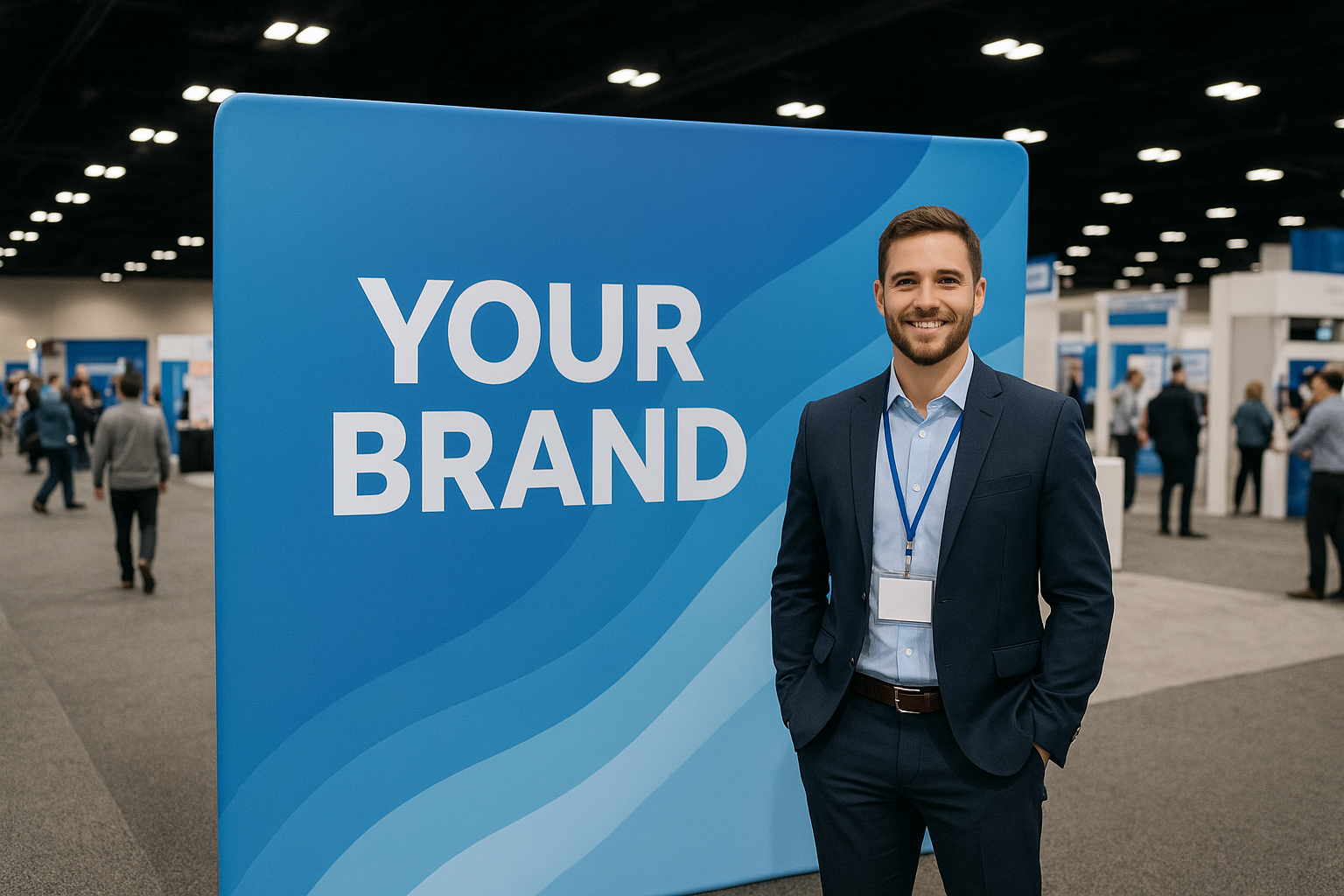
The busiest floor at any trade show is the one in front of the best photo backdrop, not the loudest booth.
Product launches and press events
Press events run on captured images, and a step-and-repeat wall gives photographers a consistent frame that puts your logo in every published shot. Product launches benefit from a single-image backdrop instead, since the scene can echo the product’s design language rather than just repeating a mark. Either way, this is the setting where color accuracy matters most, since press photos get published at full resolution and any printing flaw shows up in coverage you can’t edit after the fact.
Weddings, parties, and private celebrations
On the private-event side, backdrops do double duty as decor and as a guest photo op. A wedding backdrop needs a softer palette and finer detail than a corporate wall, since guests view it up close rather than from across a room. Birthday parties and milestone celebrations lean toward playful single-image designs, and portability matters more here since the same setup often moves between a ceremony space and a reception hall in the same day.
Retail and pop-up activations
Retail spaces and pop-up shops use backdrops to create a photo-worthy corner that pulls foot traffic off the sidewalk. A well-placed backdrop near a storefront window signals that something worth photographing is happening inside, and that signal works even on people who never planned to stop. Seasonal retail campaigns, holiday pop-ups, and real estate open houses all use this same principle: give people a reason to pause, and they’ll create marketing content for you without being asked.
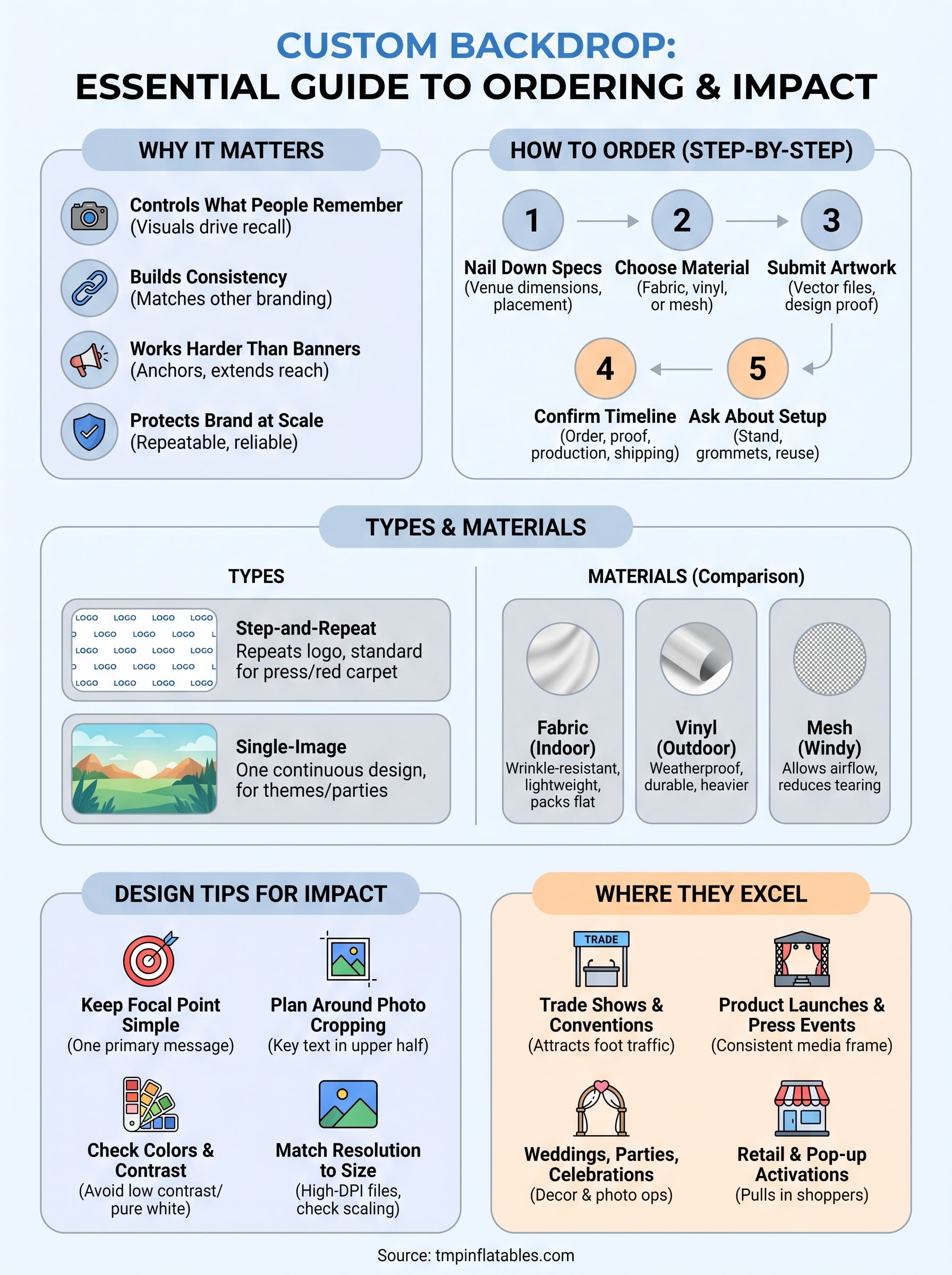
Bringing your backdrop to life
A custom backdrop only pays off when the specs, material, and design all point toward the same goal: a clean shot that puts your brand in front of the camera. You now know how to size it, what material fits your venue, and how to design a layout that survives bad lighting and cropped photos. The last step is matching those decisions to a supplier who can turn your files into a finished product without missing your event date.
Getting there doesn’t require guesswork. Send over your venue dimensions and rough concept, and a good production team will walk you through material options, turnaround times, and proof approval before anything gets printed. If you’re ready to move past planning and get real numbers for your event, request a quote and start the conversation today.