

A plain white tent at a trade show or outdoor event does exactly one thing: blend in. Custom branded event tents do the opposite, they put your logo, colors, and messaging on a structure that’s visible from across a parking lot or exhibition hall. For businesses that invest in event marketing, a branded tent acts as both a functional shelter and a high-impact advertising tool that works the entire time it’s set up.
But choosing the right tent isn’t as straightforward as picking a size and slapping a logo on it. Tent styles vary widely, pop-ups, inflatables, domed canopies, and so do printing methods, material grades, and customization options. The wrong choice can mean faded graphics after a few uses, a frame that buckles in wind, or a design that simply doesn’t represent your brand the way you imagined. Getting it right takes some upfront knowledge.
That’s where this guide comes in. We’ll walk through the main types of branded event tents, explain how printing and production actually work, and give you practical tips for making a smart purchase. At TMP Inflatables, we’ve spent over 20 years designing and manufacturing custom inflatables, including inflatable event tents, domes, and branded structures, so the advice here comes from real production experience, not guesswork. Whether you’re outfitting a trade show booth or setting up a branded activation outdoors, this article will help you make a confident, informed decision.
Why custom branded event tents work
Events are crowded. Whether you’re at a trade show, outdoor festival, or brand activation, you’re competing for attention with every other booth and display in the space. A custom branded event tent gives your team a physical anchor point that people can find, recognize, and return to. The branding doesn’t just look good; it communicates that you’re a serious business that invested in showing up right.
Beyond attention, there’s a practical layer. Event staff benefit from a defined, branded space to operate from. It creates a home base where conversations happen, materials stay organized, and your team can work without feeling exposed. The tent itself removes friction by giving visitors a clear place to gather and engage with your brand.
Visibility that passive signage can’t match
Flat banners and table signs are easy to overlook in a packed venue. A tent structure, especially a tall inflatable dome or a large pop-up canopy, occupies vertical and horizontal space in a way that draws the eye naturally. Your branding isn’t competing with a table full of brochures. It rises above neighboring displays, visible from multiple angles, and in some cases readable from hundreds of feet away before a visitor even decides which direction to walk.
A well-branded tent acts as a billboard that also serves a functional purpose, giving people a reason to walk over and stay.
This dual function is what separates a tent from most other event marketing tools. People approach for the shade or shelter, and they leave with brand exposure they didn’t even realize they were absorbing. That kind of passive impression stacks up across an entire event day. By the time someone visits your booth, they’ve already seen your brand multiple times just by being in the vicinity.
Consistency builds recognition
If your team attends multiple events per year, showing up with the same custom branded structure creates a recognizable presence across different locations and audiences. People who encountered your tent at one event will spot it at another. Over time, that visual consistency reinforces brand familiarity in a way that’s hard to achieve with materials you replace after every show.
Consistent branding also signals credibility to new prospects. A business that arrives with a professionally printed, well-constructed tent looks more established than one that shows up with a folding table and a clip-on sign. First impressions at events happen fast, and a branded structure does a lot of the work before anyone on your team says a word. When your tent looks sharp and reflects your brand identity accurately, it sets the tone for every conversation that follows.
Return on investment over repeated use
Single-use event materials carry high per-event costs relative to what they deliver. A quality branded tent, on the other hand, spreads its cost across every event you attend. If you use it ten times in a season, the per-event price drops significantly. Use it for three or four seasons, and you’re looking at a marketing asset that pays for itself many times over.
Getting that return depends on making smart choices at the start. A tent that fades after three outdoor events or a frame that buckles under moderate wind isn’t a bargain at any price. Prioritizing durable materials and professional printing upfront is what turns a branded tent into a long-term asset. The goal isn’t to spend the least money possible; it’s to spend wisely on something that performs consistently event after event. We’ll cover what to look for in materials and print quality later in this guide.
Types and sizes of branded event tents
Not every tent fits every event. The structure you choose affects how your brand displays, how quickly you can set up, and how well the tent holds up outdoors. Understanding the main categories helps you match the right product to your specific event needs and budget before you spend a dollar on production.
Pop-up canopy tents
Pop-up canopies are the most common format you’ll see at outdoor markets, sporting events, and trade shows. They use a collapsible steel or aluminum frame that expands in minutes, making them practical for teams that transport and set up without a large crew. Most pop-up tents come in 10×10, 10×20, and 10×15 footprints, with full-print options on the canopy top, side walls, and back panels. Smaller 10×10 setups work well for single-brand activations or tight booth spaces, while 10×20 configurations give you room for product displays and multiple staff working the floor.
Inflatable event tents and domes
Inflatable structures take a different approach to branded presence. Rather than a frame with fabric stretched over it, an inflatable tent or dome holds its shape through continuous air pressure, which creates a seamless, 360-degree surface ideal for large-format printing. This makes them especially effective when your goal is maximum visual impact from a distance. Custom branded event tents in inflatable formats can be built as tunnels, arched entrances, full domes, or enclosed branded spaces, and they often stand out in ways that standard canopy tents simply can’t match in dense or competitive event environments.
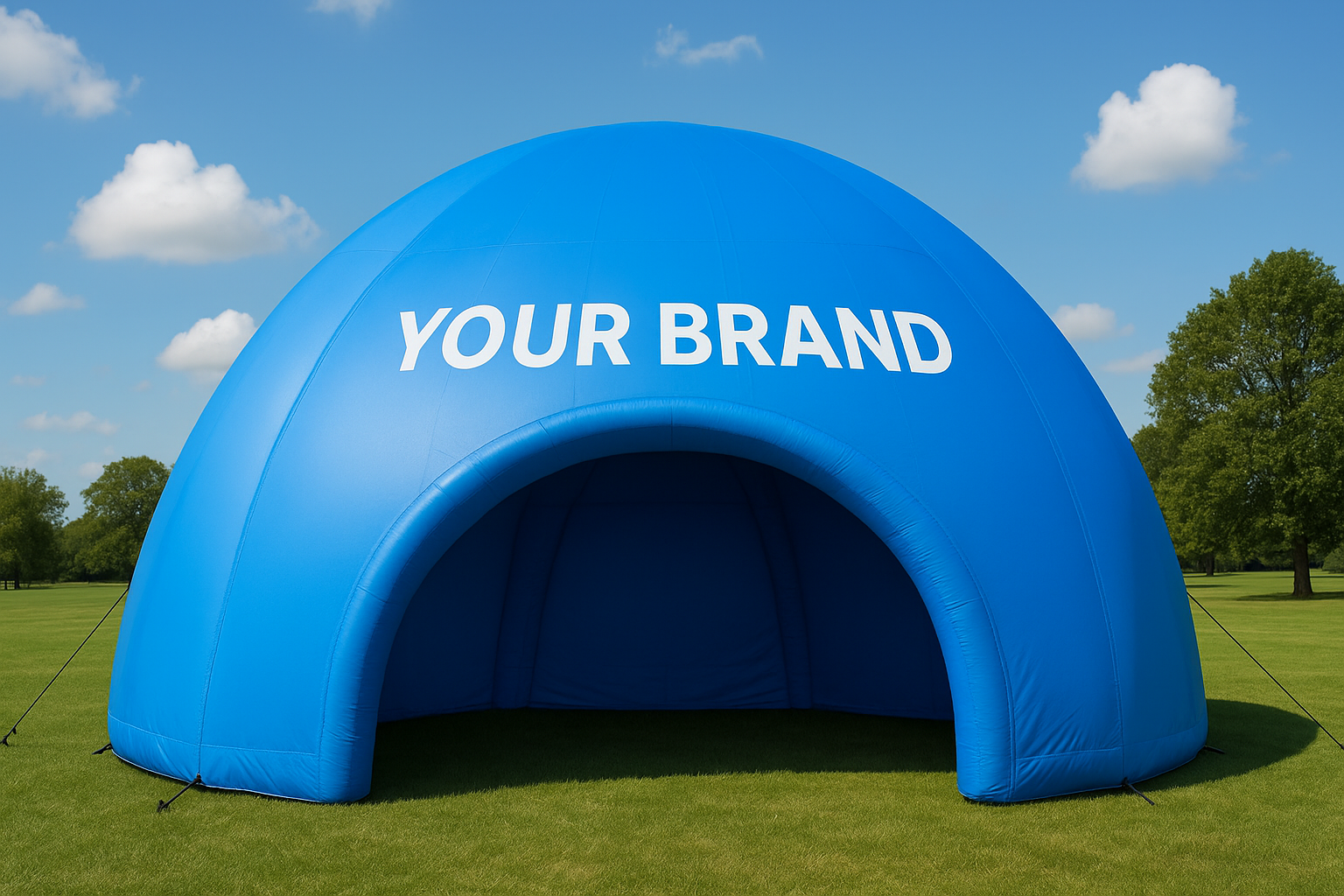
Inflatable domes and tunnels can be printed edge-to-edge with your brand, making them visible from well beyond the event perimeter.
Matching tent size to your event
Choosing the right size starts with your specific use case, not just the available footprint. A 10×10 canopy suits a solo exhibitor with a focused pitch and minimal materials. A 20×20 or larger inflatable dome fits product launches, experiential activations, or situations where you need to guide foot traffic through a defined branded space. Consider the number of staff, the equipment you’re bringing, and how much time you expect visitors to spend before committing to a size. Going too small forces a cramped experience; going too large without enough staffing leaves your space feeling underpopulated.
Printing and branding options for event tents
The printing method you choose determines how sharp your branding looks after repeated setup, outdoor exposure, and transport. Two tents can carry the same design, but one fades after a summer season while the other holds its color for years. Understanding the difference between print techniques upfront saves you from ordering a tent that looks great in the product photo but disappoints once it hits the field.
Dye sublimation vs. direct printing
Dye sublimation is the standard for high-quality tent canopies and fabric walls. The process bonds ink directly into the fabric fibers rather than sitting on top, which means the color doesn’t crack, peel, or wash out the way surface-applied ink can. For custom branded event tents, dye sublimation delivers consistent color accuracy across the full print area, making it the better choice when your brand colors are specific or your design includes gradients and detailed graphics.
Dye sublimation produces vibrant, lasting results on fabric because the ink becomes part of the material itself, not just a coating on the surface.
Direct inkjet printing appears on lower-cost options, but it typically produces duller colors and wears down faster under UV exposure and weather. If you expect to use a tent more than a handful of times, dye sublimation is worth the additional investment over a cheaper alternative that needs replacing sooner.
Positioning and coverage options
Where and how much branding you apply to the tent structure determines how far your brand reads across a crowded event space. A full canopy top print keeps your logo visible from elevated viewpoints and surrounding areas, which matters for outdoor events where foot traffic approaches from multiple directions. Sidewall printing extends your brand coverage and gives you additional surface to carry messaging, product visuals, or contact information.
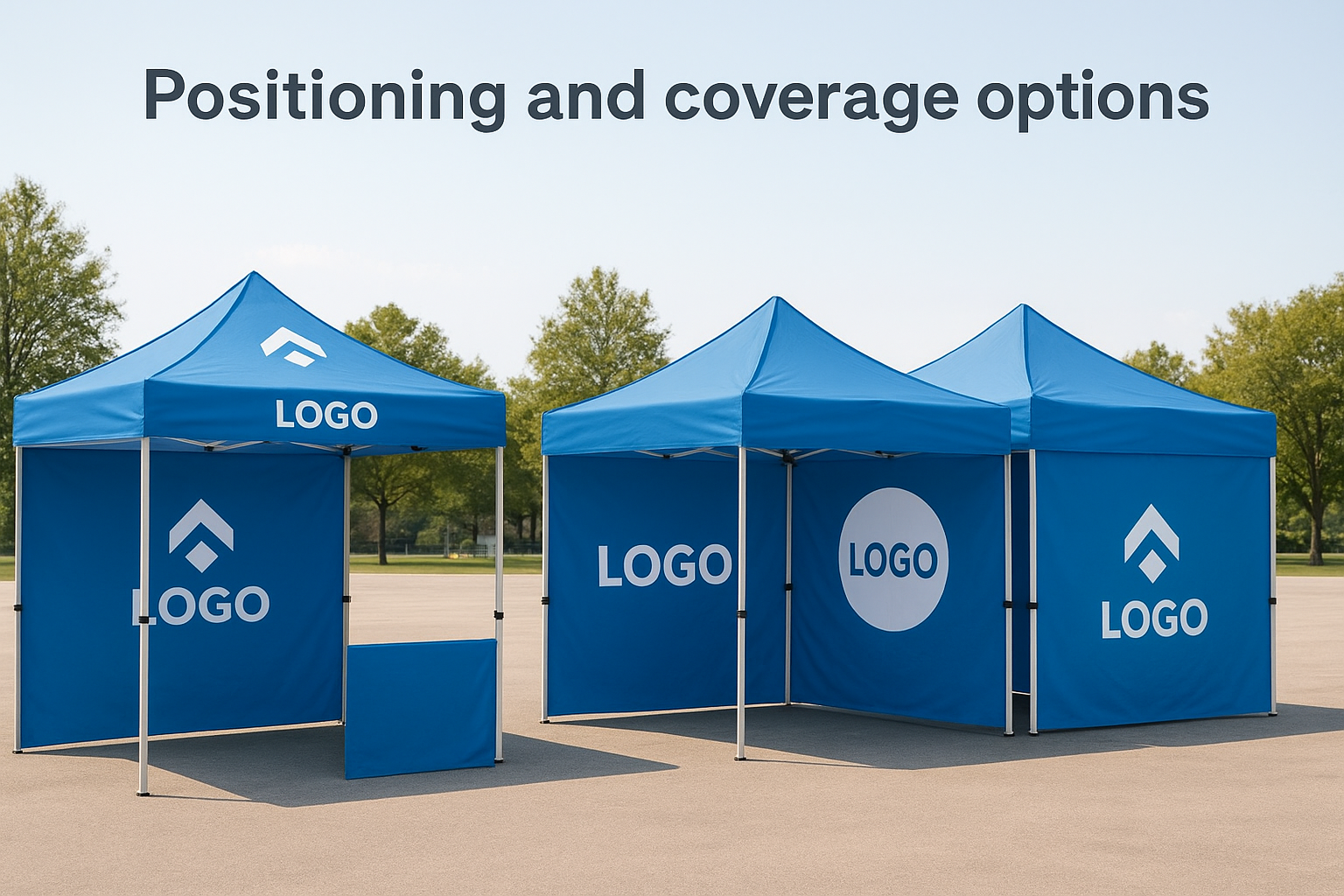
Here’s a breakdown of common coverage choices:
- Canopy top only: Budget-friendly, visible from above and nearby angles
- Canopy + back wall: Adds a backdrop behind your team or display area
- Full wrap (top + three walls): Maximum brand coverage and visual impact from every direction
- Custom panel placement: Logo or messaging applied to specific sections only
Your event format, booth layout, and how much you want to communicate should guide which configuration makes the most sense before you finalize your order.
What to check before you buy
Buying a branded tent without doing some homework first is how organizations end up with a product that looks fine in photos but fails in the field. Before you finalize an order for custom branded event tents, evaluate material quality, supplier capabilities, and lead times carefully. These three areas cover the majority of problems buyers encounter after a product arrives.
Material and frame quality
The material your tent is made from determines how well it holds up to outdoor conditions over repeated use. Polyester with a high denier count (600D or above) resists tearing and handles UV exposure better than lower-grade fabric. For the frame, powder-coated steel or aircraft-grade aluminum gives you the stability you need in wind without bending or snapping under load.
Cheap frames flex under moderate wind, and that movement stresses fabric seams and accelerates wear at the connection points.
Ask your supplier directly what denier rating the canopy fabric carries and what material the frame uses. If they can’t answer those questions clearly, treat it as a signal to look elsewhere before committing any budget.
Supplier experience and production capabilities
Not every company that sells branded tents actually manufactures them. Some act as resellers with limited control over print quality or production schedules. Working with a manufacturer that handles production directly gives you more visibility into the process and faster resolution when changes are needed. Look for demonstrated experience with commercial-grade products and a portfolio that includes work for brands or event organizers operating at a professional scale.
Confirm whether they provide a design proof before production starts. A supplier that skips this step leaves you no opportunity to catch errors before they’re printed permanently onto your structure.
Turnaround time and shipping
Production timelines vary widely between suppliers, and most events have fixed dates that won’t move. Confirm the actual production window upfront, not just the stated average, but the realistic timeline based on your order complexity and the supplier’s current queue. Custom printed structures often take two to four weeks from approved artwork to shipping, sometimes longer during peak event seasons.
Factor in shipping time on top of production. If your tent is coming through an international supply network, freight transit and customs clearance add days that aren’t always included in the quoted turnaround, so build a buffer into your planning calendar.
How to order and get it event-ready
Once you’ve selected your tent style and confirmed the print specifications, the ordering process moves quickly if you come prepared. Most suppliers require print-ready artwork files before they can begin production, so having your design in the correct format before you reach out saves you days of back-and-forth during a timeline that’s already tight. The cleaner your prep work, the smoother the production run.
Preparing your artwork for production
Graphic files for tent printing need to meet specific technical requirements that differ from standard print or digital formats. Vector files (AI or EPS) are the preferred format for most commercial fabric printing because they scale without losing detail, which matters when your design is being printed across a large canopy surface. If you’re working from raster files, submit them at 150 DPI or higher at the intended print size to avoid pixelation in the final output.
Sending low-resolution files is one of the most common causes of production delays, because the artwork needs to be corrected before printing can begin.
Confirm your brand colors using Pantone or CMYK values rather than RGB, since screens display color differently than fabric printing equipment. Before you approve the final proof, check that your logo, text, and key graphic elements sit within the safe zone margins your supplier specifies, keeping them clear of seams, folds, and frame attachment points.
Setting up and testing before the event
Receiving your custom branded event tents a few days before the event date gives you time to unpack, set up, and inspect the structure before any stress of an event day. Run a full setup at your facility or in a parking lot rather than checking only the box contents. Look for any print misalignments, hardware issues, or fabric defects that need to be reported to the supplier while there’s still time to address them.
Pack a simple maintenance kit for the event itself: spare stakes, bungee cords, a rubber mallet, and a clean cloth for wiping down panels. After each event, clean the fabric before storing it and fold it loosely rather than compressing it tightly, which reduces stress on printed surfaces and extends the life of your investment across future events.
Next steps
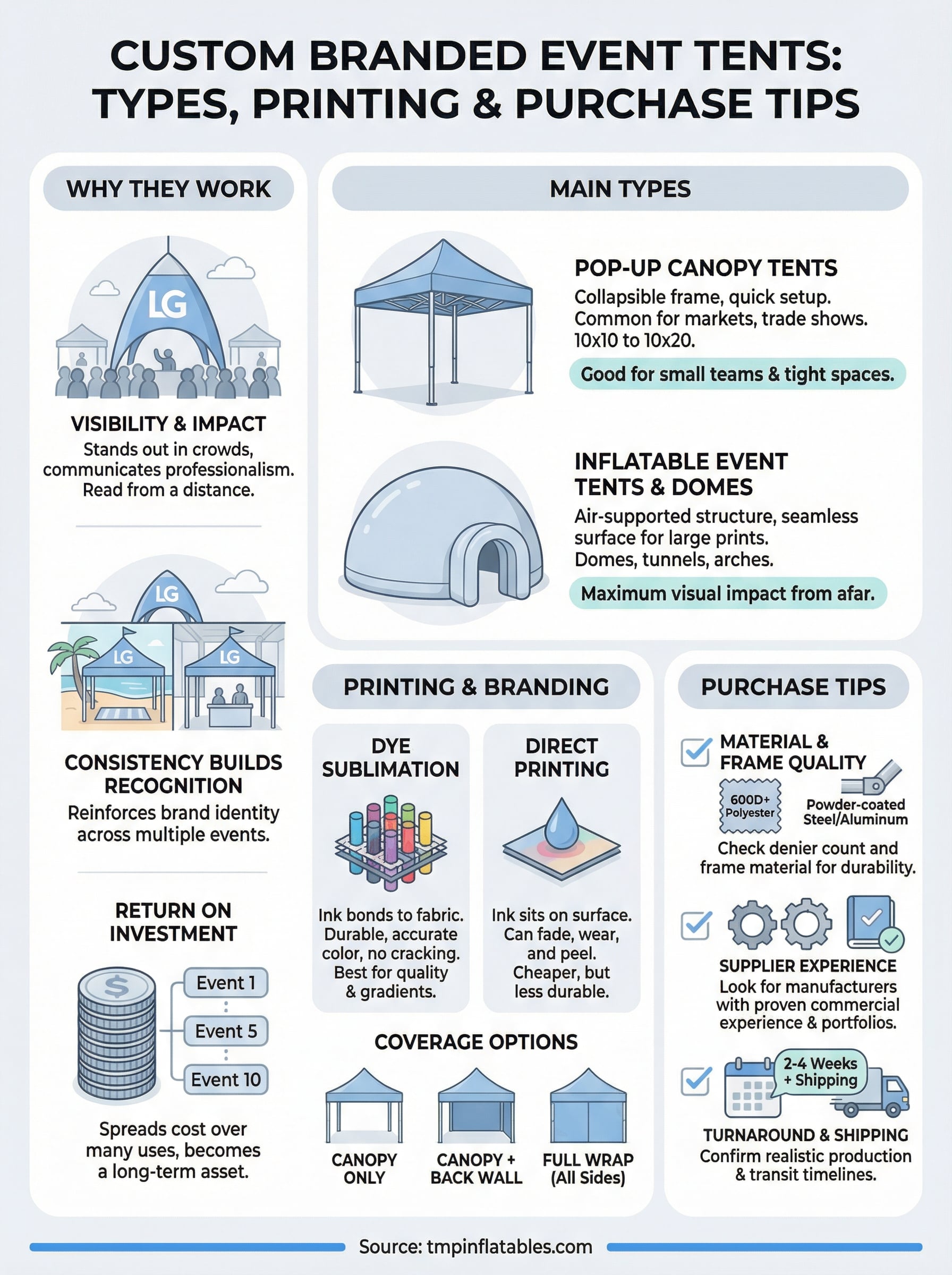
You now have a clear picture of how custom branded event tents work, what types are available, and what to evaluate before placing an order. The details covered here, from printing methods to frame quality to artwork prep, are the same factors that separate a tent that performs season after season from one that disappoints after a few uses. Making an informed decision upfront saves you time, money, and the frustration of replacing equipment sooner than planned.
Your next move is to define your event requirements: the format, footprint, print coverage, and timeline you need. Once you have those specifics in hand, you’re ready to talk to a supplier who can build the right structure for your brand. TMP Inflatables has been manufacturing custom inflatable tents, domes, and branded event structures for over 20 years. Get in touch with the TMP Inflatables team to start your order and get a quote tailored to your event.
