
Walk any trade show floor or street festival and you’ll see rows of white pop-up tents that all blend together. A custom canopy breaks that pattern. It’s a branded tent structure, printed with your logo and colors, built to make your booth or activation impossible to miss instead of just another folding frame in a sea of them.
If you’re trying to figure out exactly what a custom canopy is, how it differs from a stock tent, and what the ordering process actually looks like, you’re in the right place. We’ll walk through the materials and printing methods that hold up outdoors, the sizing and frame options that fit your event footprint, and the timeline you should expect once you place an order.
We’ve built inflatable structures and branded tents for marketing teams and event agencies since 2004, so this isn’t guesswork. Below you’ll find a straightforward breakdown of what goes into a quality custom canopy and the questions to ask before you commit to a supplier, so your next event has a branded presence that actually gets remembered.
Why a custom canopy matters for your brand
Marketing budgets get judged on results, and a canopy is one of the few pieces of event gear that works for you the entire day without anyone touching it. Once it’s up, a custom canopy turns into a moving billboard that people photograph, walk past, and remember, long after the flyers you handed out get thrown away. Compare that to a plain white or blue rental tent, which tells attendees nothing about who you are or why they should stop.
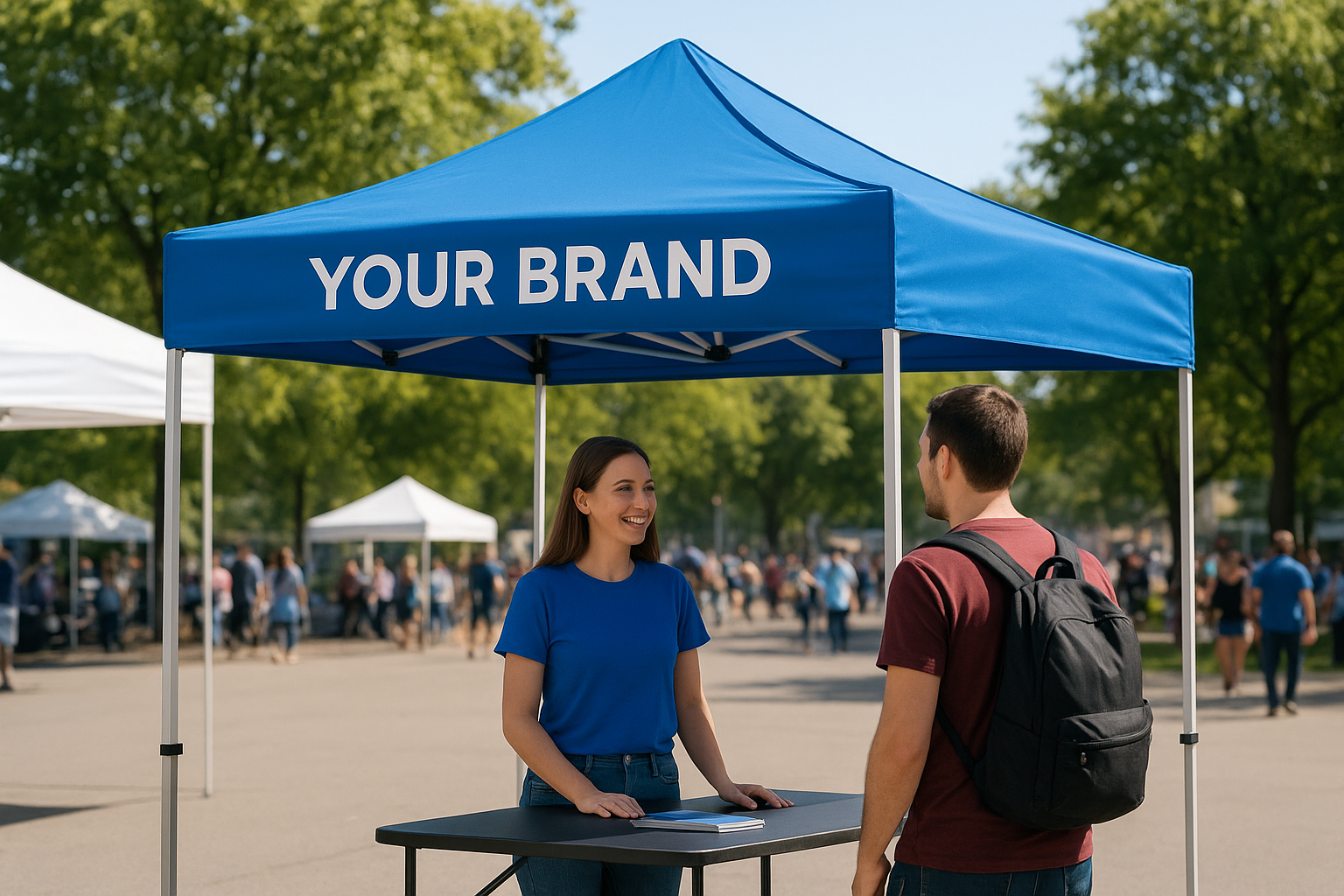
Custom Canopy & Visibility that stock tents can’t deliver
At a crowded festival or trade show, attention is the scarcest resource you have. A branded canopy with your logo printed across the roof panels and valances gets spotted from fifty yards away, which matters when foot traffic is moving fast and decisions about where to stop happen in seconds. Generic tents force people to read a small sign or banner just to figure out whose booth they’re looking at, and most won’t bother.
A canopy with your logo on it does the work of a billboard, a sign, and a booth attendant, all before a single conversation starts.
Retail brands, sports teams, and real estate developers use this to their advantage at outdoor activations, where a tent is often the only structure tall enough to be seen over crowds and other booths.
The cost comparison most teams skip for the Custom Canopy vs others
Teams often assume a stock tent saves money, but that math ignores the cost of lost visibility and repeated printing on separate signage. Here’s how the two options typically stack up over a season of events:
| Factor | Stock Rental Canopy | Custom Printed Canopy |
|---|---|---|
| Brand visibility | None, unless paired with extra signage | Built into the tent itself |
| Reusability across events | Limited, generic look every time | Consistent branded look every time |
| Cost per event (amortized) | Lower upfront, recurring rental fees | Higher upfront, drops per use over multiple events |
| Photo and social media value | Low | High, attendees photograph branded structures |
| Setup time | Similar | Similar (frame construction is the same) |
Once you run three or four events, the custom printed canopy usually costs less per use than repeated rentals, and it builds brand recognition every time it goes up.
Consistency builds trust with the Custom Canopy
Buyers notice when a brand shows up looking the same way every time, whether that’s a trade show in Chicago or a street festival in Miami. Consistent colors, logo placement, and messaging on your canopy signal that you’re organized and established, which matters more than most marketing teams give it credit for. Sloppy, mismatched booth setups do the opposite, and attendees pick up on that faster than you’d think.
Experiential marketing agencies lean on this consistency because it lets them replicate a client’s brand identity across multiple simultaneous activations without redesigning anything each time. A canopy printed once with the right specs can travel to a dozen events and still look sharp, as long as the materials and printing hold up to weather and repeated setup.
The Custom Canopy pays for itself faster than you’d expect
Some marketing teams hesitate on custom canopies because the upfront cost is higher than renting a plain tent. But a canopy isn’t a single-use expense. It’s a reusable asset that shows up at every outdoor event on your calendar for years, provided you choose durable printed fabric and a solid aluminum frame. Teams that track cost-per-impression across a season almost always find custom tents outperform repeated rentals or one-off banner buys.
Real estate developers marketing a new property, sports teams running fan activations, and retail brands doing pop-up promotions all use canopies this way, treating them less like a rental and more like a piece of permanent marketing equipment that just happens to fold up and travel.
How to order a custom canopy step by step
Ordering a custom canopy feels intimidating the first time, mostly because most buyers don’t know what a supplier actually needs from them before production can start. Break it down into a handful of decisions and the process moves fast, usually two to four weeks from first email to shipped tent, depending on size and print complexity.
Nail down your specs before you request a quote for a Custom Canopy
Getting a quote fast depends on how much you already know about your event footprint and branding needs. Suppliers need these details to price your job accurately:
- Canopy size, measured in feet (10×10, 10×20, and 20×20 are the most common)
- Frame material, aluminum or steel, based on how often you’ll transport and set up the tent
- Number of printed panels, roof only or roof plus valances and full walls
- Logo files, vector format (AI or EPS) whenever possible for sharp printing
- Event timeline, so the supplier can confirm turnaround
Having these ready before your first call cuts out a round or two of back-and-forth email.
Approve a digital proof before anything gets printed for the Custom Canopy
Once you submit artwork, a reputable supplier sends back a digital proof showing exactly how your logo and colors will sit on the panels. This step matters more than most buyers realize, because color shifts and logo placement are far cheaper to fix on a screen than on a finished tent.
Never approve a canopy order without seeing a proof first, because reprinting after production starts costs you both time and money.
Check the proof against your brand guidelines line by line, not just a glance, since small placement errors are easy to miss on a quick review.
Confirm production and shipping timelines for the Custom Canopy
After you sign off on the proof, production starts and the clock on your event deadline starts ticking too. Ask your supplier for a written timeline that separates production days from shipping days, especially if you’re ordering from a supplier that ships internationally into the US, Caribbean, or Latin America.
| Stage | Typical Timeframe |
|---|---|
| Quote and spec confirmation | 1-2 days |
| Digital proof approval | 2-5 days |
| Production | 7-14 days |
| Shipping | 3-10 days, depending on destination |
Build in a buffer of at least a week past the estimated delivery date, since weather, customs, and shipping carriers introduce delays that no supplier fully controls.
Types of custom canopy and which to choose
Not every event calls for the same Custom Canopy, and picking the wrong one wastes money on features you don’t need or leaves you without coverage you do. The type you choose should follow directly from your footprint, your climate, and how often the tent gets set up and torn down.
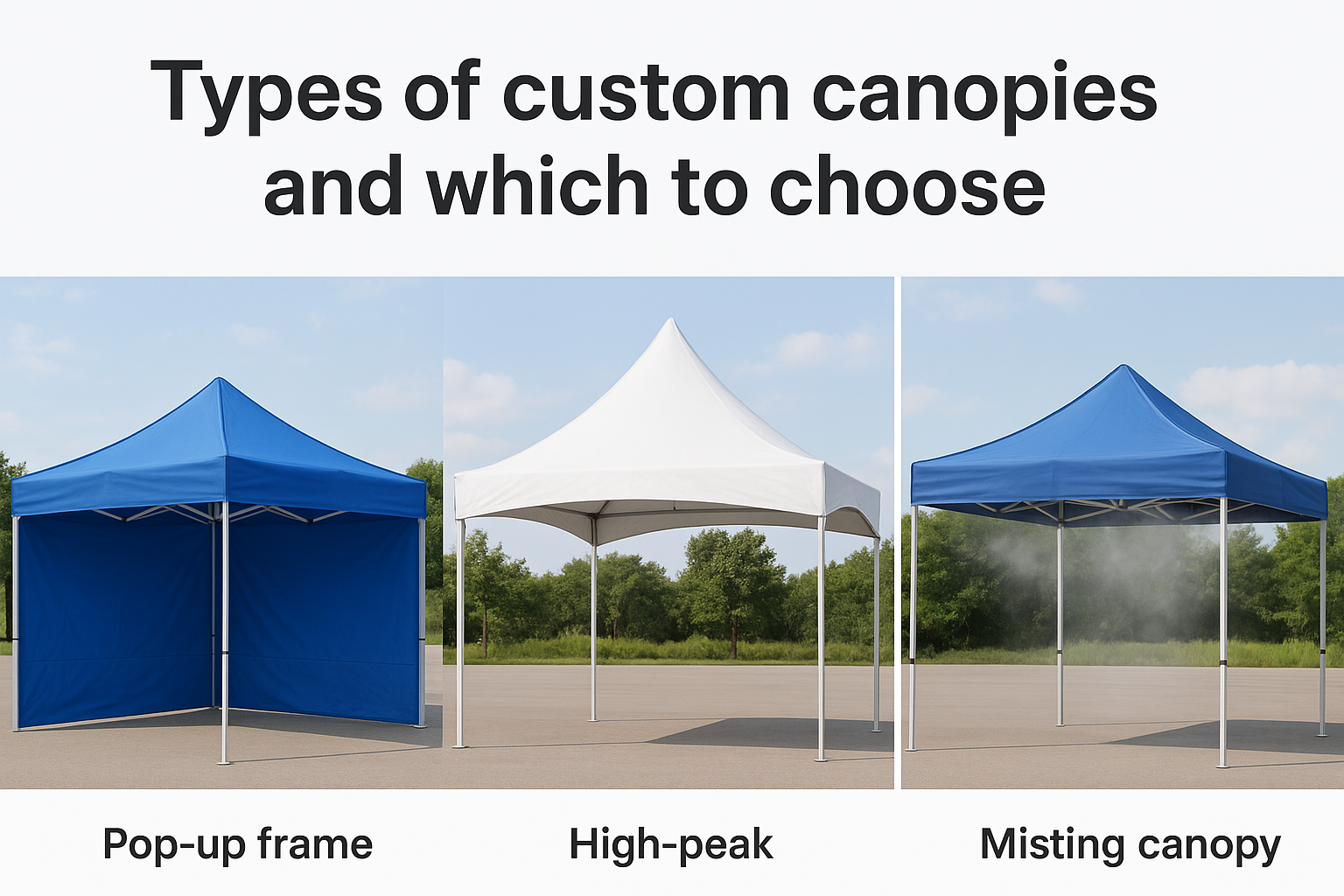
Custom Canopy & Pop-up frame canopies for trade shows and retail
Most custom canopy orders are pop-up frame units, built on a folding aluminum or steel skeleton that opens like an umbrella. These dominate trade show floors, farmers markets, and retail pop-ups because one or two people can set one up in under fifteen minutes without tools. Printed roof panels and optional walls give you a full branded box on all sides, which works well when your booth sits close to competitors and you need your logo visible from every angle.
Custom Canopy & High-peak canopies for larger footprints
When a standard 10×10 or 10×20 frame feels too small, a high-peak canopy stretches the roofline into a taller, more dramatic shape that reads well from a distance. Festivals, sports activations, and VIP hospitality areas favor this style because the extra height accommodates hanging signage, lighting, or AV equipment inside the tent. Setup takes longer and usually requires a small crew, so factor that into your event-day staffing plan.
Custom Canopy & Misting canopies for summer heat
Outdoor events running through July and August put a different demand on your tent, and a misting canopy answers it by building a cooling system directly into the frame. Attendees get relief from the heat while your branding stays visible overhead, which keeps foot traffic lingering at your booth instead of moving straight to the nearest shade. These units cost more upfront because of the plumbing and pump components, but for summer festivals, sports events, or outdoor retail activations, they solve a comfort problem no plain canopy can.
Choose your canopy type based on how people will actually use the space underneath it, not just how it looks folded up in the bag.
Matching custom canopy type to your event
| Canopy Type | Best For | Typical Size | Setup Crew |
|---|---|---|---|
| Pop-up frame | Trade shows, retail pop-ups | 10×10, 10×20 | 1-2 people |
| High-peak | Festivals, VIP areas | 20×20 and up | 2-4 people |
| Misting canopy | Summer outdoor events | 10×10, 10×20 | 2-3 people |
Running multiple event types across a season sometimes means owning more than one canopy style, and a supplier who builds all three can keep your branding consistent no matter which structure gets used.
Key features that affect quality and price for the Custom Canopy
Every custom canopy quote breaks down into the same handful of variables, and understanding them helps you spot a lowball price before it turns into a flimsy tent that fails at your third event. Fabric weight, frame material, printing method, and add-ons each move the price up or down, so knowing what you’re paying for keeps you from either overspending or cutting a corner that matters.
Fabric weight and denier for the Custom Canopy
Canopy fabric gets rated by denier, a measure of thread thickness, and that number tells you how the tent handles wind, sun, and repeated folding. Cheaper canopies use lightweight fabric that fades within a season, while heavier denier fabric resists tearing and holds color longer under direct sun.
| Denier Rating | Typical Use | Expected Lifespan |
|---|---|---|
| 300D | Occasional, indoor-leaning use | 1-2 seasons |
| 600D | Regular outdoor events | 3-5 seasons |
| 900D+ | Frequent, heavy-duty rotation | 5+ seasons |
Frame material and build
Aluminum frames cost more than steel but weigh less, resist rust, and hold up better if your canopy travels between cities on a regular schedule. Steel frames run cheaper and work fine for a canopy that stays local and gets stored indoors between uses, but they add weight to every shipment and dent more easily during transport.
Printing method matters more than people expect
Dye sublimation printing bonds ink directly into the fabric fibers, so the graphic won’t crack, peel, or fade the way screen printing does after repeated sun exposure. Suppliers cutting corners sometimes use vinyl overlays instead, which look sharp on day one but lift at the edges within a few months of outdoor use.
The printing method decides whether your logo still looks sharp in year two, not just at the unboxing photo.
Extras that add cost but often earn it back
Beyond the base structure, a few add-ons shift the price noticeably and deserve a spot on your budget checklist:
- Full walls or half walls for enclosed booths or weather protection
- Carrying case with wheels for teams checking canopies as luggage
- Sandbags or stake kits required at most outdoor venues for safety
- Extra printed valances if you’re branding all four sides instead of just the roof
Skipping these to save money upfront usually costs more later, either in venue fines for missing anchors or in a canopy that blows over mid-event.
Best uses for custom canopies at events
A custom canopy earns its keep across almost every event format a marketing team runs, but it shines brightest in a handful of specific settings where visibility and branding do the heaviest lifting. Matching the canopy to the right occasion keeps you from underusing an asset that could be working harder for your budget.
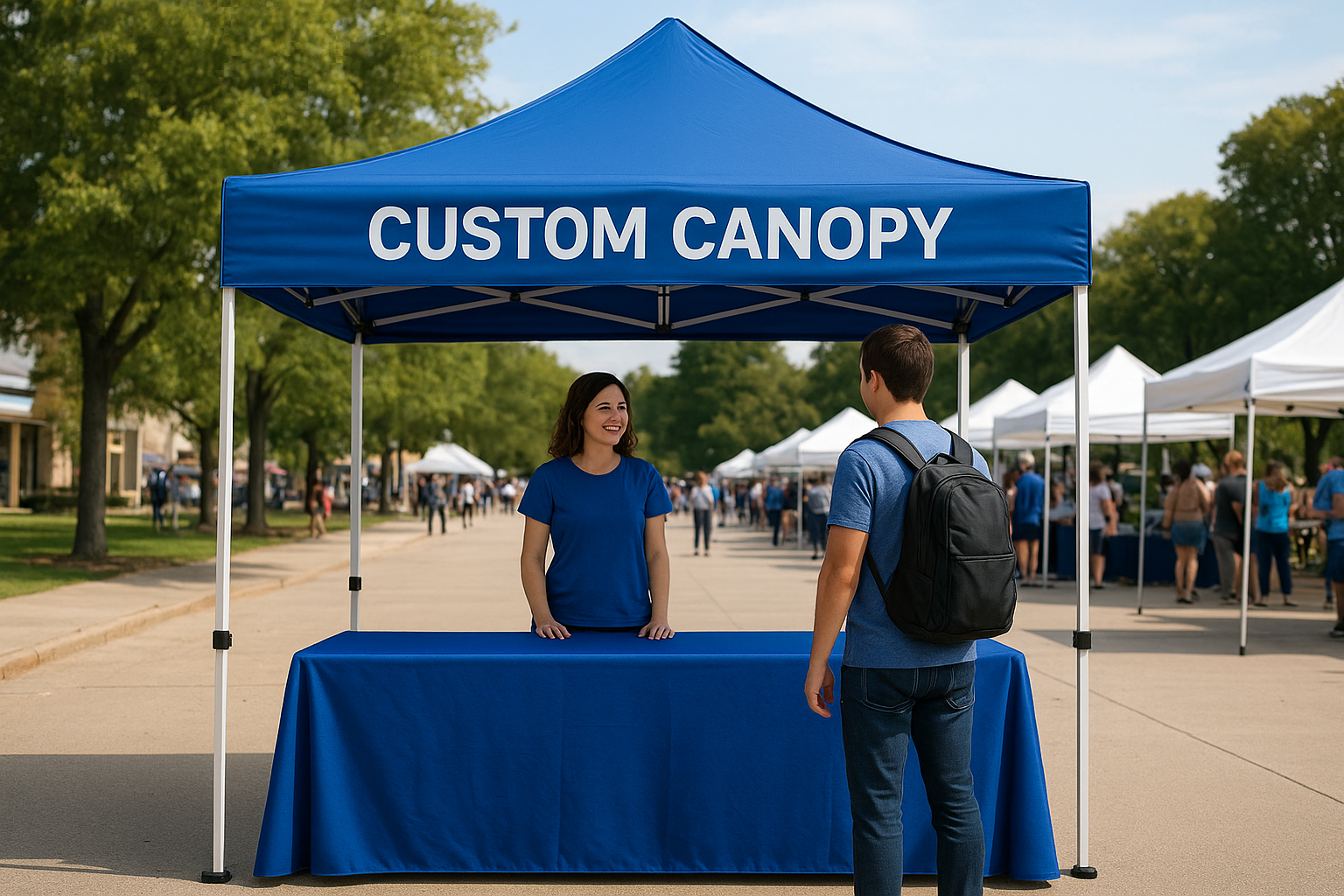
Trade shows and expos
Convention floors pack hundreds of booths into a single hall, and a branded booth canopy cuts through that noise the moment attendees walk the aisle. Exhibitors who print their logo across the roof and valances get spotted from three rows away, which matters when buyers are scanning fast and deciding where to stop based on a two-second glance. Trade show exhibitors also benefit from the enclosed feel a canopy with side walls provides, giving prospects a defined space to sit down and talk without competing booth noise bleeding in.
Outdoor festivals and street events
Festivals and street fairs run for hours in direct sun, and a canopy here does double duty as shelter and signage at the same time. Retail brands and community organizations use these activations to hand out samples, run contests, or collect leads, and a tent with clear branding gives foot traffic a landmark to find you again after they’ve wandered the rest of the grounds.
A canopy at a festival isn’t just shade, it’s the one landmark attendees remember when they decide to come back to your booth later.
Product launches and retail pop-ups
Launching a new product outdoors, whether in a parking lot, a mall entrance, or a downtown plaza, gives a brand a controlled space to make a first impression. A custom canopy anchors the whole setup, turning an otherwise bare stretch of pavement into a recognizable brand moment that photographs well for social media and press coverage. Product launch teams lean on this because the tent itself becomes part of the visual identity in every photo taken that day.
Sports sponsorships and community activations
Sports teams and venues set up canopies at tailgates, fan zones, and community days where the goal is building loyalty over a single transaction. A branded tent at these events signals sponsorship and presence without needing a hard sales pitch, which fits the tone fans expect at a game day activation. Real estate developers running open houses or neighborhood events use the same logic, placing a canopy at the entrance so visitors know exactly where to check in before touring a property.
Common questions about custom canopies
Buyers ordering their first branded tent tend to ask the same handful of questions, and getting straight answers upfront saves you from surprises once production starts. Here are the ones that come up most often from marketing teams and event planners.
How long does a custom canopy actually last?
A well-built custom canopy with heavier fabric and an aluminum frame typically holds up for three to five seasons of regular outdoor use, sometimes longer if it’s stored dry and away from direct sun between events. Lifespan depends less on brand name and more on the specifics covered earlier, fabric denier, frame material, and printing method, so ask your supplier for those numbers rather than taking “durable” at face value.
A canopy’s real lifespan gets decided by its fabric and frame specs, not by how good it looks in the sales photo.
Can I match my exact brand colors?
Yes, most suppliers use Pantone matching or CMYK color codes pulled from your brand guidelines to get printed colors as close as possible to your logo file. Slight shifts can happen between screen and fabric, which is exactly why the digital proof step matters so much before production locks in.
What size canopy fits a standard trade show booth?
Standard convention booth spaces run 10×10 feet, so a 10×10 canopy fits most trade show floor plans without spilling into a neighboring exhibitor’s space. Outdoor festivals and retail activations often size up to 10×20 or 20×20 when the footprint allows more room for foot traffic and staff.
Do custom canopies come with a warranty?
Reputable suppliers back their frames and printed fabric with a written warranty, usually covering frame defects for a year or more and print quality against fading or peeling under normal outdoor use. Ask for warranty terms in writing before you pay a deposit, since verbal promises don’t help you six months later when a panel starts fraying.
Can I order replacement panels instead of a whole new tent?
Most suppliers keep your printed panels on file and can produce replacements if your logo changes or a panel gets damaged, without rebuilding the entire frame. This matters for brands that rebrand periodically or run canopies hard enough that panels wear out faster than the aluminum structure underneath them.
Getting your custom canopy off the ground
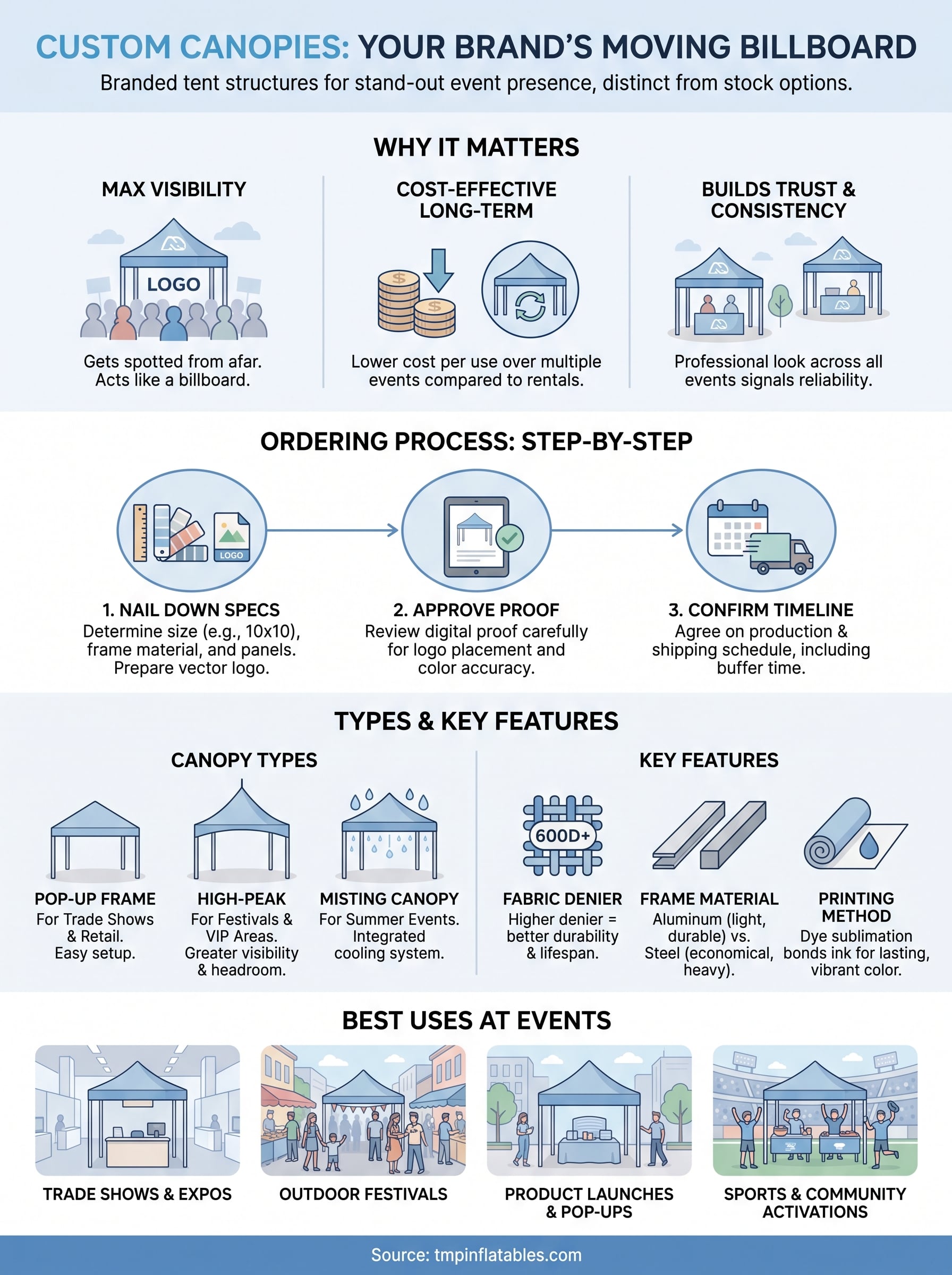
A custom canopy only pays off when the fabric, frame, and print quality match how hard your team actually uses it. Pick the wrong denier or a vinyl overlay to save a few dollars, and you’re reordering before the season ends. Get the specs right up front, sizing, frame material, printing method, and you end up with a tent that shows up looking sharp at every event for years, not just the first one.
Before you sign off on any quote, run through the checklist from this guide: confirm your logo files are vector, ask for a written warranty, and never skip the digital proof. Suppliers who won’t answer those questions plainly aren’t the ones you want holding your deposit.
Ready to see numbers for your event? Get a quote and our team will spec out a canopy built for your brand and your budget.
