
Most companies throw money at the same paid ads, sponsor the same conferences, and wonder why growth flatlines. Growth hacking takes a different approach, it’s the practice of finding unconventional, high-impact ways to acquire and retain customers without burning through massive budgets. Since Sean Ellis coined the term in 2010, it’s become the go-to framework for startups, marketing teams, and brand strategists who care more about results than tradition.
At TMP Inflatables, we’ve seen growth hacking play out firsthand. Our clients, experiential marketing agencies, event planners, product launch teams, come to us because a 20-foot inflatable product replica or a branded misting tent does something a banner ad can’t: it stops people mid-step and creates a memory. That’s growth hacking in physical form. Creative, measurable, and built to scale a brand’s visibility fast.
But growth hacking isn’t limited to giant inflatables or guerrilla stunts. It’s a structured process backed by data, rapid experimentation, and smart tool selection. Whether you’re scaling a SaaS product, launching a retail campaign, or planning an event activation, understanding how growth hacking works gives you a serious edge. This guide breaks down the core methodology, proven strategies, essential tools, and real-world examples so you can apply growth hacking principles to your own business, starting now.
Why growth hacking matters now
The marketing landscape has shifted faster in the last five years than in the previous twenty. Customer acquisition costs have climbed across nearly every paid channel, and organic reach on social platforms has narrowed to the point where spending money is almost a requirement just to reach your own followers. Growth hacking offers a way out of that cycle by prioritizing creativity, data, and speed over raw budget size.
The economics have changed
Running paid ads used to be a reliable shortcut to growth. Today, the cost-per-click on major platforms has risen sharply as more businesses compete for the same ad inventory. Small and mid-size marketing teams no longer have the budget to outspend the biggest players in their category, and simply putting more money into the same channels produces diminishing returns faster than most teams expect.
The teams that grow fastest aren’t necessarily the ones with the biggest budgets. They’re the ones who find leverage that money alone can’t buy.
Growth hacking flips that equation. Instead of asking “how much should we spend?”, you ask “where can we create disproportionate impact with what we have?” Rapid experimentation and iteration replace large, slow campaign cycles. That shift in thinking is what makes growth hacking not just relevant but necessary for any team working with real constraints.
Attention is harder to earn
The average person encounters hundreds of marketing messages daily across email, social media, search, video, and physical spaces. Brand recall and meaningful engagement have both dropped as the volume of content has exploded. Standing out requires more than a polished ad. It requires something genuinely surprising or useful enough to cut through the noise.
This is exactly where physical and experiential marketing tactics gain ground that digital-only strategies can’t reach. A branded inflatable arch at an outdoor event, or a misting tent at a summer festival with your logo on it, creates a moment that people photograph, share, and remember long after the event ends. Growth hacking isn’t only about software and conversion funnels. It’s about finding the fastest path to genuine attention, and sometimes that path runs directly through the real world.
Speed separates winners from everyone else
Markets move quickly. A product that fills an unmet need today might face five competitors within eighteen months. Your window to establish brand recognition and customer loyalty is narrower than it used to be, and traditional quarterly planning cycles simply don’t move fast enough to capitalize on it. Brands that plan slowly get outmaneuvered by leaner teams running faster.
Growth hacking introduces a faster operating rhythm. You test small, measure quickly, cut what fails, and scale what works. That cycle, when repeated consistently, compounds over time. Teams that run ten experiments a month learn far more than teams that run one big campaign per quarter, and that learning advantage translates directly into stronger growth outcomes. Brands that are winning right now didn’t get there by being cautious. They got there by being structured, fast, and completely focused on what the data told them to do next.
How growth hacking works step by step
Growth hacking follows a repeatable, structured loop rather than a series of one-off campaigns. The process gives your team a clear way to find what actually drives growth without committing large budgets to initiatives before you know they work. Understanding each step makes the difference between chaotic experimenting and a system that compounds results over time.
Define a single north star goal
Before running any experiment, you need one primary metric that reflects real, meaningful business growth. This might be monthly active users, revenue per customer, event signups, or trial conversions. Picking one forces your entire team to align around the same outcome instead of optimizing for vanity metrics that look good in a dashboard but don’t connect to actual results. Every experiment you run should tie directly to that number, so your team always knows whether an idea moved the needle or wasted your time.
Narrowing to one goal also forces you to say no to ideas that don’t connect directly to it. That constraint keeps your team focused rather than scattered across too many directions at once.
Generate and prioritize your experiments
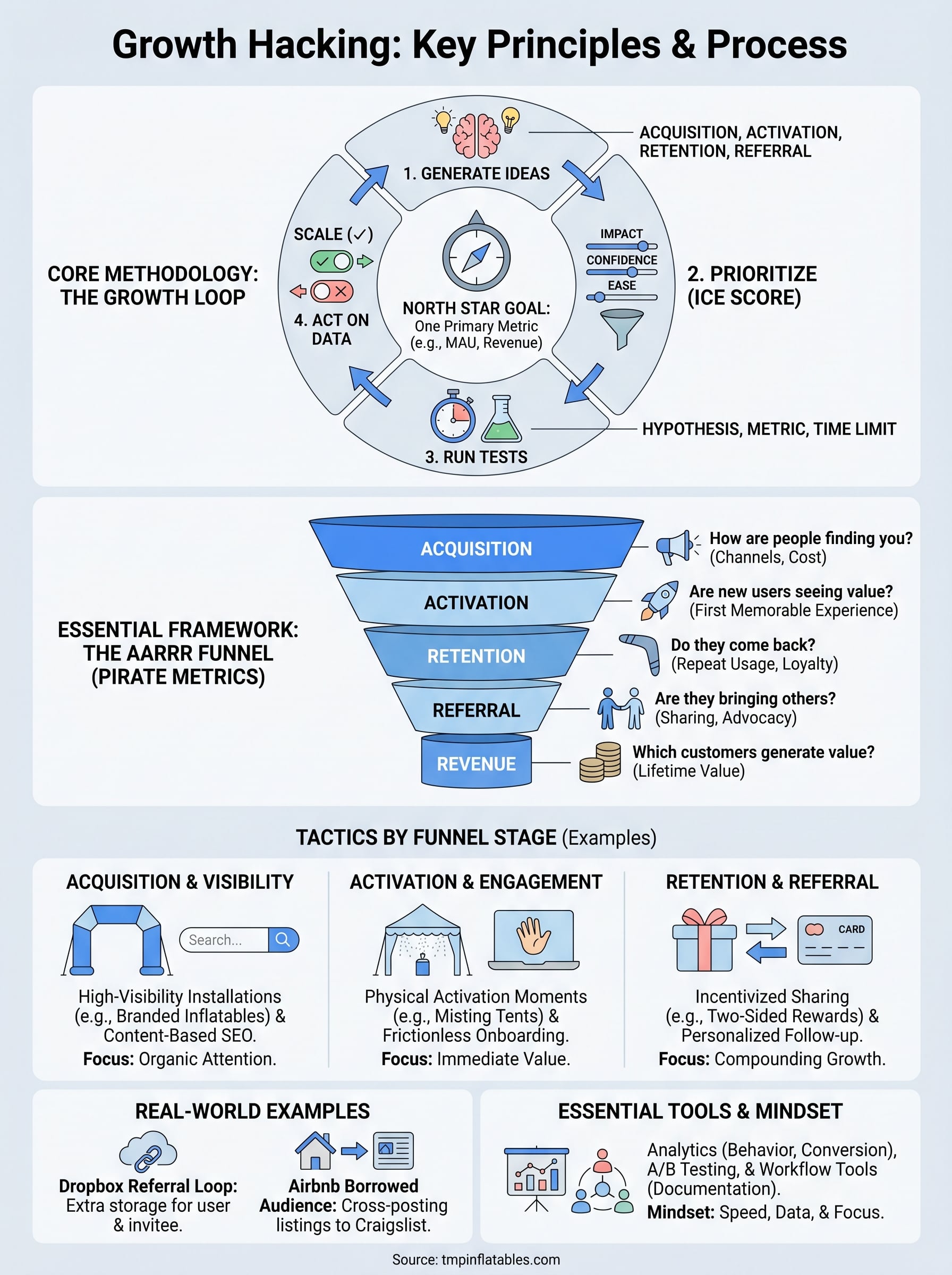
Once you have a clear goal, brainstorm every possible lever that could move it. Your team might surface ideas across acquisition, activation, retention, and referral. Then rank each idea using three criteria: estimated impact, confidence in the hypothesis, and ease of execution. This approach, often called ICE scoring, filters out ideas that sound exciting but require months of work for uncertain payoff. You want experiments you can run quickly and evaluate honestly before moving to the next one.
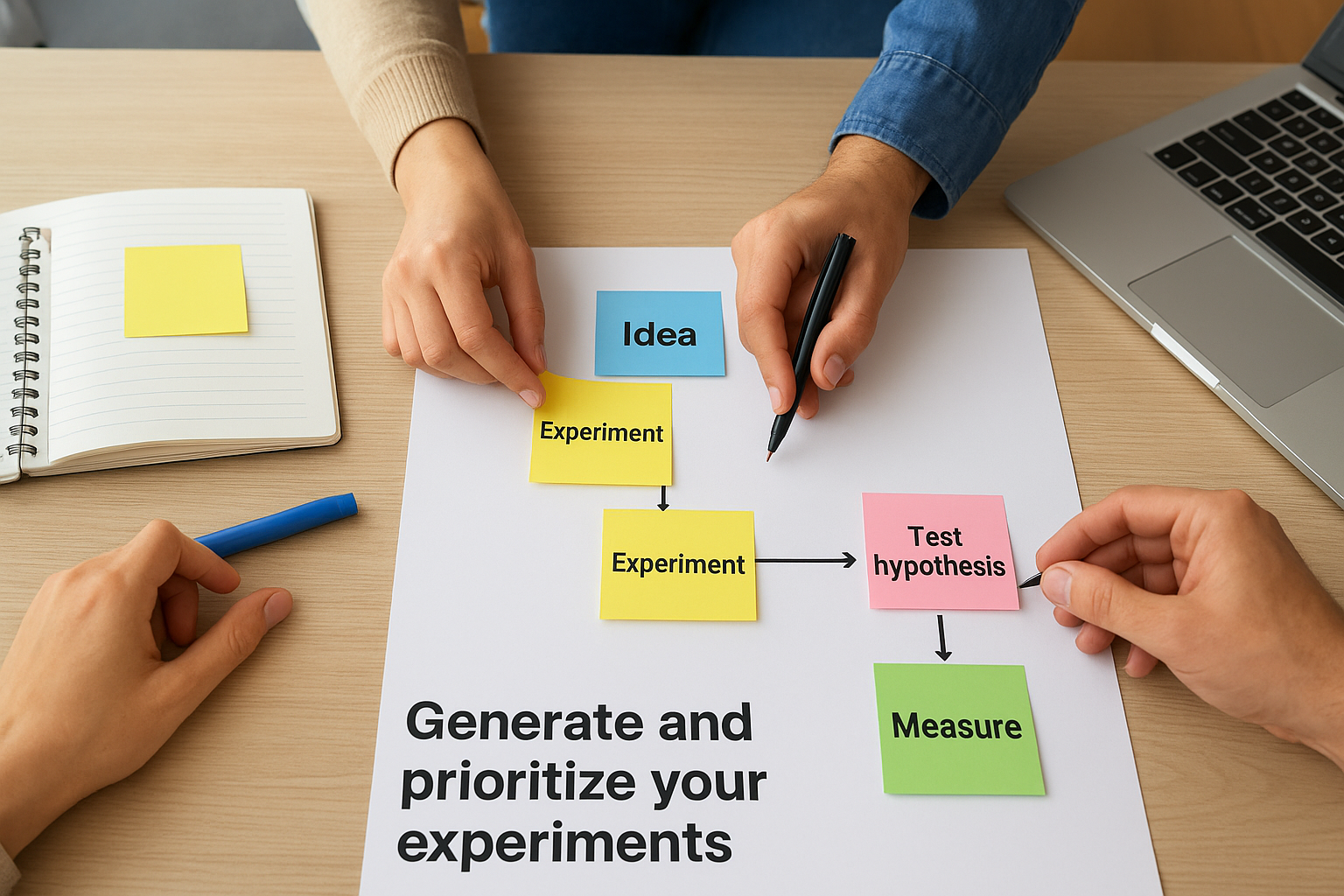
Score each idea across these three ICE factors:
- Impact: How significantly could this shift your north star metric?
- Confidence: How strong is the evidence behind the hypothesis?
- Ease: How fast can you build, launch, and measure the test?
The experiment you can run this week and measure by next week almost always teaches you more than the one you spend six months building.
Run tests and act on the data
Each experiment needs a clear hypothesis, a defined success metric, and a time limit. Without those three elements, you end up with results your team argues about rather than acts on. Run the test, collect the data, then make a binary call: scale it or cut it.
Iteration speed is your real competitive advantage in growth hacking. The teams that grow fastest run the most informed experiments, not necessarily the biggest ones. When you find something that works, document exactly what drove the result, then build the next round of experiments on top of that learning. That compounding cycle is what separates teams that consistently gain ground from those that plateau.
Core metrics and frameworks to use
Tracking the wrong numbers is one of the fastest ways to kill growth hacking momentum. Pageviews and follower counts feel satisfying, but they rarely connect to what actually drives revenue or retention. The frameworks below give you a structured way to measure what matters and organize your experiments around metrics that reflect real business outcomes rather than surface-level activity.
The AARRR funnel
AARRR, often called pirate metrics, breaks your customer journey into five measurable stages: acquisition, activation, retention, referral, and revenue. Each stage gives you a specific metric to track, which means you always know exactly where your funnel is leaking and where to focus your next experiment.
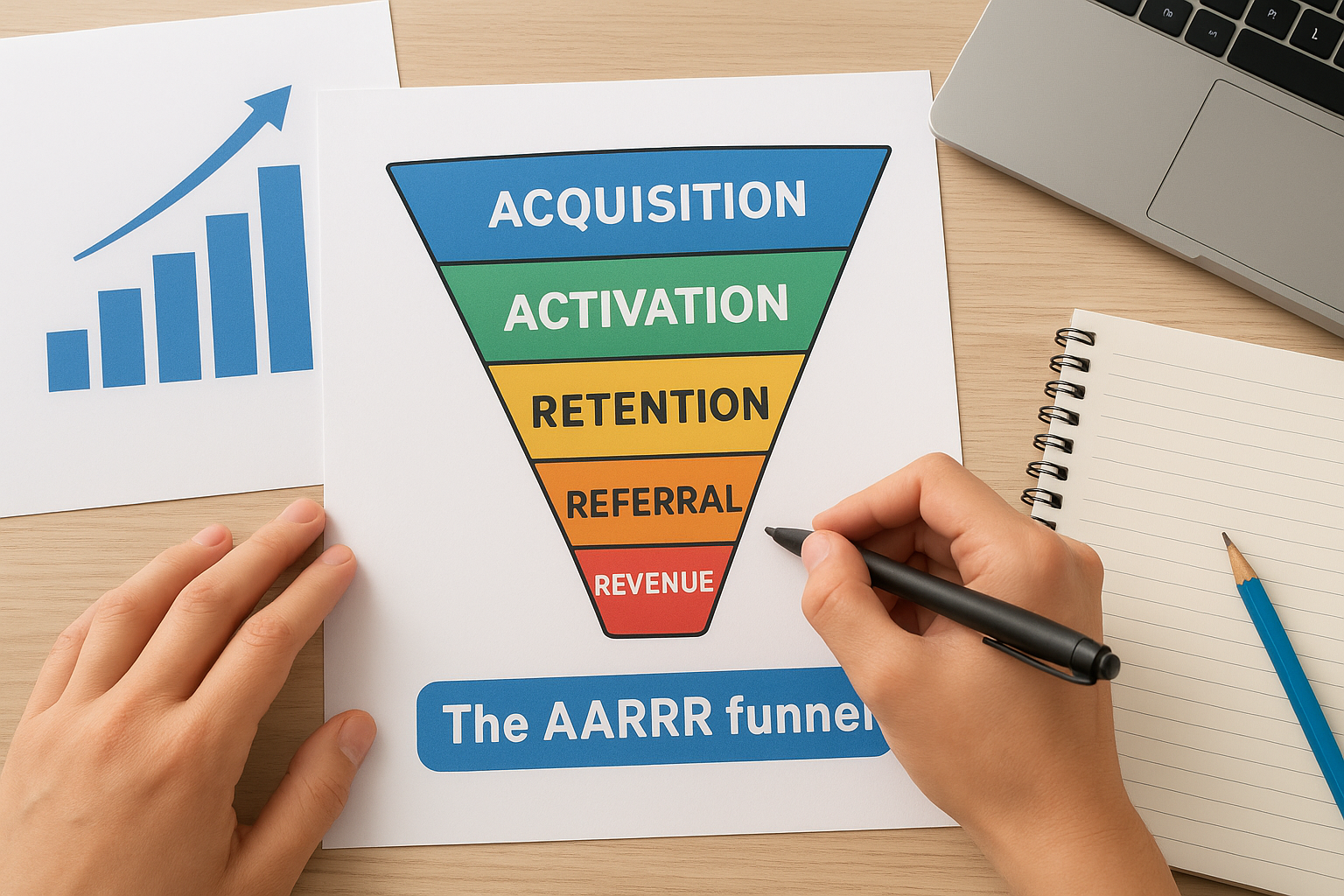
Fixing the wrong stage is the most common growth mistake. AARRR tells you which stage actually needs attention before you start building.
Here is what each stage measures:
- Acquisition: How are people finding you, and at what cost?
- Activation: Are new users reaching the moment where they see real value?
- Retention: Do people come back after their first experience with your product or event?
- Referral: Are satisfied customers bringing in new ones without paid incentives?
- Revenue: Which customers generate the most value over their lifetime?
Working through each stage systematically keeps your team from guessing and gives every experiment a clear home in the funnel.
North star metric and supporting KPIs
Your north star metric is the single number that best captures the value your product or service delivers to customers. For a SaaS tool it might be weekly active users. For an event marketing company it might be qualified inquiries generated per campaign. Picking one forces alignment across your team and prevents the common trap of celebrating activity that never translates into growth.
Supporting KPIs sit beneath the north star and help you diagnose what drives or blocks it. Think of them as diagnostic signals rather than goals in themselves. If your north star starts dropping, your supporting KPIs tell you which part of the system broke. This layered approach to measurement means your growth hacking process stays grounded in cause and effect rather than correlation, which makes your experiments faster to evaluate and your decisions easier to defend.
Common growth tactics by funnel stage
Knowing the AARRR framework is one thing. Knowing which specific tactics to apply at each stage is where growth hacking becomes genuinely actionable. The tactics below are organized by funnel position so you can match the right experiment to the right problem rather than applying a generic strategy and hoping it sticks.
Acquisition: get in front of the right people
Your acquisition tactics should focus on channels where your target audience already spends time and where you can stand out without simply outspending competitors. Content-based SEO, referral programs, and partnership campaigns with complementary brands all tend to generate qualified traffic at a lower cost per lead than broad paid advertising. For physical brands and event marketers, high-visibility installations like branded inflatables or custom arch displays function as acquisition engines because they generate organic social sharing and local press coverage that paid channels rarely produce.
The best acquisition tactics bring people to you through genuine interest, not just raw exposure.
Activation: turn visitors into engaged users
Activation is the moment a new visitor or attendee experiences enough value to want more. For digital products, this often means a frictionless onboarding flow, a personalized welcome sequence, or a free trial designed to demonstrate core value within the first session. For experiential campaigns, activation is a physical moment: someone steps inside a branded misting tent, photographs an inflatable product replica, or interacts with a mascot costume. That first memorable interaction determines whether they forget your brand or follow it.

Reducing friction at this stage matters more than most teams realize. Every unnecessary step between discovery and value is a place where you lose someone who was already interested. Audit your activation path regularly and remove anything that slows the journey down without adding something worth the delay.
Retention and referral: grow through your existing base
Retention tactics keep customers coming back, while referral tactics turn them into your acquisition channel. Loyalty programs, personalized follow-up campaigns, and re-engagement emails all support retention effectively. Referral mechanics work best when you make sharing easy and reward it clearly, whether through a discount for both parties, exclusive access, or public recognition at an event. Brands that master both stages reduce their dependence on paid acquisition over time, and that compounding efficiency is exactly where sustainable growth hacking produces its most durable results.
Tools stack for running experiments
Running growth hacking experiments without the right tools is like navigating without a map. You’ll burn time on manual processes and miss signals that should be driving your next decision. The tools you choose don’t need to be expensive, but they do need to cover three core functions: tracking what’s happening, running controlled tests, and keeping your team aligned on what to do next.
Your tool stack should serve your experiments, not the other way around. Start lean and add complexity only when the process genuinely demands it.
Analytics and testing tools
Tracking user behavior sits at the foundation of every effective experiment. Without reliable data on how people move through your funnel, you’re guessing rather than deciding. Google Analytics 4 gives you a solid baseline for web traffic, conversion tracking, and audience segmentation at no cost. Pair it with a dedicated A/B testing platform to run controlled experiments on landing pages, email subject lines, or onboarding flows. Most testing tools let you split traffic between variants, set statistical significance thresholds, and pull results automatically, so your team spends less time crunching numbers and more time acting on conclusions.
Here are the core categories your analytics stack should cover:
- Behavioral tracking: sessions, click paths, drop-off points, and time on page
- Conversion measurement: goal completions tied directly to your north star metric
- Cohort analysis: how different user groups perform over time
- Funnel visualization: where exactly you’re losing people between stages
Workflow and collaboration tools
Running experiments at speed requires more than good software. It requires a system your team actually uses to track hypotheses, assign ownership, and log results in one place. A simple project management tool keeps your experiment backlog visible and prevents promising ideas from getting buried between meetings. Pair that with a shared documentation process where every completed test gets a written summary covering what you tested, what the data showed, and what you plan to do next.
Keeping institutional knowledge organized matters more as your experiment volume grows. Teams that document results build a compounding advantage because they never repeat a failed test or lose a successful insight when someone changes roles. Your tool stack is only as useful as the habits your team builds around it, so invest time in the process before you invest money in new software.
Growth hacking examples you can learn from
Real examples make growth hacking principles far easier to apply to your own campaigns. The cases below aren’t just interesting history. They show specific decisions and mechanisms that drove outsized results, and each one contains a transferable insight you can adapt regardless of your industry or budget.
Dropbox’s referral loop
Dropbox faced a classic acquisition problem: converting free users into paying ones while keeping costs low. Instead of buying ads, the team built a two-sided referral loop that gave both the referrer and the new signup extra storage for a successful invitation. The reward matched exactly what users already wanted, which meant every incentive reinforced product usage rather than pulling attention away from it.
Signups increased by roughly 60% almost immediately, at a fraction of the cost paid acquisition would have required. The lesson isn’t “build a referral program.” It’s that the reward needs to align so tightly with your product’s core value that sharing feels like a natural extension of using it.
The best referral programs reward behavior that already aligns with why someone uses your product in the first place.
Airbnb and borrowed audiences
Airbnb needed to reach renters quickly but had no audience of its own. The team built a technical integration that let hosts cross-post their Airbnb listings directly to Craigslist, where millions of people were already searching for short-term rentals. This wasn’t a paid partnership. It was a growth hacking move that borrowed an existing, high-intent audience through a creative engineering solution most marketing teams would never consider.
Airbnb captured demand that competitors missed because the approach required technical effort that sat outside standard marketing playbooks. Your takeaway: the fastest path to a new audience is often through a platform that already has the attention you need, as long as you give people a clear reason to move.
Physical activations as growth engines
Not every growth hacking example lives inside software. Brands that deploy large-format inflatable displays at trade shows, festivals, and outdoor events consistently generate organic social sharing, local media coverage, and word-of-mouth that paid campaigns rarely match at the same cost per impression.
A branded archway, a giant product replica, or a custom inflatable mascot at a product launch turns every attendee with a phone into a distribution channel. Each photo posted online is earned media your team didn’t buy. That compounding visibility follows the same logic as a referral program: one real-world interaction generates multiple downstream impressions without additional spend.
Where to go from here
Growth hacking works when you treat it as a system, not a shortcut. Start with one clear north star metric, build your first experiment around it, and measure the result before moving on. Most teams fail at growth because they run too many initiatives at once rather than going deep on the ones with real potential. Pick your highest-priority funnel stage, run a focused test, and document what you learn so the next experiment builds on real data instead of assumptions.
If your growth strategy includes real-world brand visibility, the physical side of your campaign matters just as much as the digital one. Custom inflatables, branded arches, and large-format displays create the kind of organic attention that compounds across social sharing and word-of-mouth in ways paid ads rarely match. If you’re planning an event activation or product launch and want a display that stops people and earns earned media, request a custom inflatable quote and see what’s possible.
