

A ten-foot-tall inflatable product replica planted on a busy sidewalk stops more people in their tracks than a billboard ever could. That’s guerilla marketing at work, unconventional, impossible to ignore, and built to make people talk.
The concept isn’t new, but it’s more relevant now than it was when Jay Conrad Levinson coined the term back in 1984. Brands are competing for attention across dozens of channels, and traditional advertising alone rarely cuts through the noise. Guerrilla marketing flips the script by using creativity and surprise instead of massive media budgets to generate outsized results.
At TMP Inflatables, we’ve spent over 20 years designing and producing custom inflatables, inflatable costumes, branded arches, and oversized product replicas for exactly these kinds of campaigns. We’ve seen firsthand how experiential marketing agencies and brand teams use physical, larger-than-life activations to create moments people photograph, share, and remember. That experience gives us a front-row seat to what actually works, and what falls flat, when brands go the guerrilla route.
This article breaks down what guerrilla marketing really means, walks through the different types you should know about, and highlights real-world examples worth studying. Whether you’re planning a product launch, a trade show stunt, or a street-level activation, you’ll walk away with a clear understanding of how to build campaigns that punch well above their budget.
What guerrilla marketing is and is not
Guerrilla marketing is any unconventional, low-cost promotional tactic that uses creativity, surprise, or physical placement to capture attention in everyday spaces. The name comes from guerrilla warfare, where smaller forces use speed and surprise to outmaneuver larger opponents. In marketing, the same logic applies: you don’t need a massive budget to make a lasting impression, you need a sharp idea placed where your audience already is, in a form they can’t scroll past or tune out.
The core idea: surprise and context
The reason guerrilla marketing works so consistently comes down to two factors: the element of surprise and deliberate use of context. A standard ad asks people to look at it. A guerrilla activation places itself directly in the environment so that ignoring it becomes harder than engaging with it. When a brand wraps a city bus stop to look like a giant product, or parks an oversized inflatable replica on a busy pedestrian street, the surrounding space becomes part of the message.
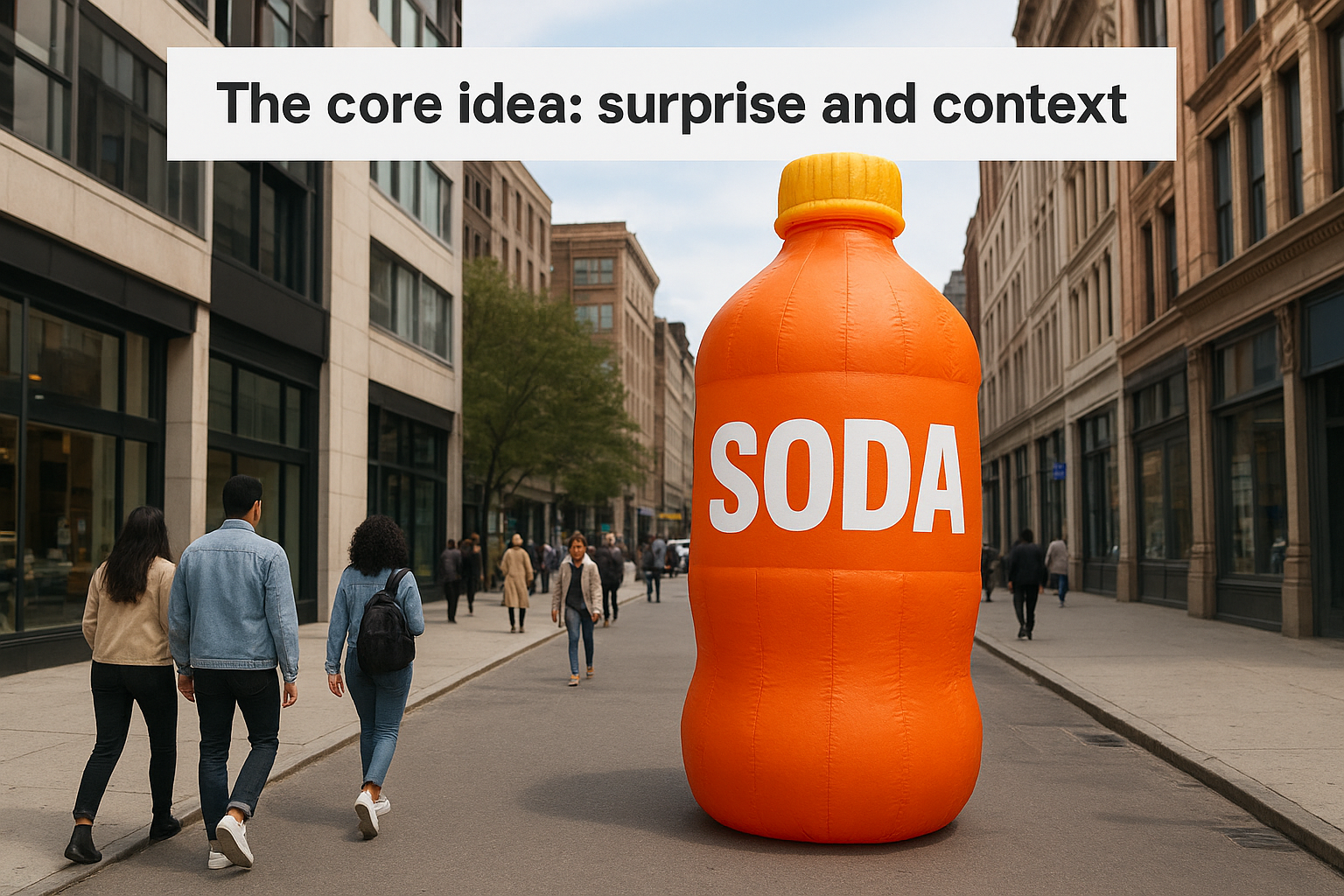
The best guerrilla campaigns don’t interrupt people’s day; they become the most interesting part of it.
Context matters just as much as the creative idea behind the activation. A campaign that works in a crowded downtown area during a lunch rush will fall flat in an empty parking lot at 8 a.m. You need to match the activation to the setting, and the setting to your audience’s daily habits and movement patterns. That alignment is what turns a clever concept into a genuine brand memory people share with others long after the campaign wraps up.
What guerrilla marketing is not
Understanding the boundaries of guerrilla marketing helps you avoid wasting budget on tactics that look bold on paper but miss the mark. First, guerrilla marketing is not simply cheap advertising. Printing flyers and stuffing them under windshield wipers is low cost, but it’s also forgettable and often resented by the people who find them. The defining feature of guerrilla marketing isn’t the price tag; it’s the intention to provoke a genuine, memorable reaction through an unexpected real-world experience.
Second, guerrilla marketing is not the same as viral marketing or stunt marketing, though people frequently confuse the three. Viral marketing is digital by nature and depends entirely on sharing behavior across online networks. Stunt marketing usually involves a single large-scale event engineered around earned media coverage. Guerrilla marketing is broader than both: it can be hyper-local, it can run continuously for weeks, and it often works best when it operates on a human scale, something a person encounters face-to-face rather than on a screen.
Finally, guerrilla marketing is not inherently risky or reckless. Many brands avoid it because they associate the format with illegal graffiti or disruptive flash mobs. While some past campaigns have pushed legal limits, most successful guerrilla activations follow a practical model: secure the right permits, select high-traffic locations, and build physical elements, like branded inflatable structures or large-scale product replicas, that are visually striking but entirely legal. The risk in most failed campaigns comes from poor planning and unclear objectives, not from the format itself. When you plan deliberately and execute with care, guerrilla marketing is one of the most controllable and measurable forms of experiential promotion available to your team.
Why guerrilla marketing works
Most marketing interrupts people. It shows up in their feed, their inbox, or between the content they actually came for. People have trained themselves to ignore it. Guerrilla marketing takes a fundamentally different approach: it places your brand inside the real world your audience already occupies, which means they can’t click away from it.
The psychology of unexpected encounters
When you encounter something genuinely surprising in your environment, your brain treats it as worthy of attention and storage. Research in cognitive psychology consistently shows that unexpected stimuli activate stronger memory encoding than familiar ones. Marketers refer to this as the von Restorff effect: items that stand out from their surroundings are remembered significantly better than items that blend in. A well-executed activation exploits this directly by placing something unusual in a mundane setting, guaranteeing a stronger recall signal than most paid media can produce.
The surprise itself does part of the marketing work for you, which is why the creative idea behind the activation matters more than the production budget.
This reaction also triggers social behavior. When something catches a person off guard in a positive way, their immediate instinct is to document and share it. That organic sharing extends your campaign reach far beyond the original activation site without adding to your media spend.
Why physical activations outperform digital alone
Digital advertising gives you scale, but it doesn’t give you presence. A three-dimensional brand experience that a person walks past, touches, or photographs creates a sensory memory that no banner ad can replicate. Experiential marketing research consistently shows that in-person brand encounters produce higher purchase intent and stronger brand affinity than equivalent digital exposures.
Physical guerrilla marketing also sidesteps the growing problem of ad fatigue. Consumers in the United States are exposed to thousands of digital ads daily, and most of those impressions register at a near-zero attention level. When your brand shows up as a ten-foot inflatable replica outside a busy venue, you’re not competing against other ads for the same screen real estate. You’re occupying physical space, and physical space is something people notice.
That combination of psychological surprise, social shareability, and physical presence is why guerrilla marketing continues to deliver strong returns for brands willing to invest in creative thinking over media spending.
Types of guerrilla marketing tactics
Guerilla marketing covers a wide range of tactics, and understanding the main categories helps you match the right approach to your specific goals, location, and budget. Each type draws on a different mechanism for capturing attention, but they all share one characteristic: they meet your audience in the real world rather than waiting for them to find you online.
Ambient marketing
Ambient marketing integrates your brand into existing physical environments in a way that feels like a natural extension of that space. Think of a coffee cup sleeve printed to look like a product container, or a building facade wrapped to match a campaign theme. The strength of ambient marketing is contextual placement: because the activation lives inside a space your audience already uses, the encounter feels organic rather than forced. This type works especially well for brands targeting specific urban zones or high-traffic consumer areas where the environment itself reinforces the message.
Street and experiential activations
Street-level activations put your brand directly in front of people as they move through their day. This includes pop-up experiences, product sampling stations, live demonstrations, and interactive installations placed in pedestrian zones, transit hubs, or near retail locations. Experiential tactics go a step further by inviting your audience to participate rather than just observe, which significantly increases the emotional impact and the likelihood that they’ll share the experience with their own networks.
When someone physically interacts with your brand in the real world, they remember it far longer than any passive ad exposure can produce.
Large-scale physical installations
Oversized physical installations are among the most effective formats available to brand teams and experiential agencies working within guerrilla marketing frameworks. Custom inflatables, towering product replicas, branded archways, and inflatable costumes command attention in a way that two-dimensional media simply cannot. These structures occupy real space, which means bystanders react to them viscerally rather than filtering them out the way they filter digital ads.
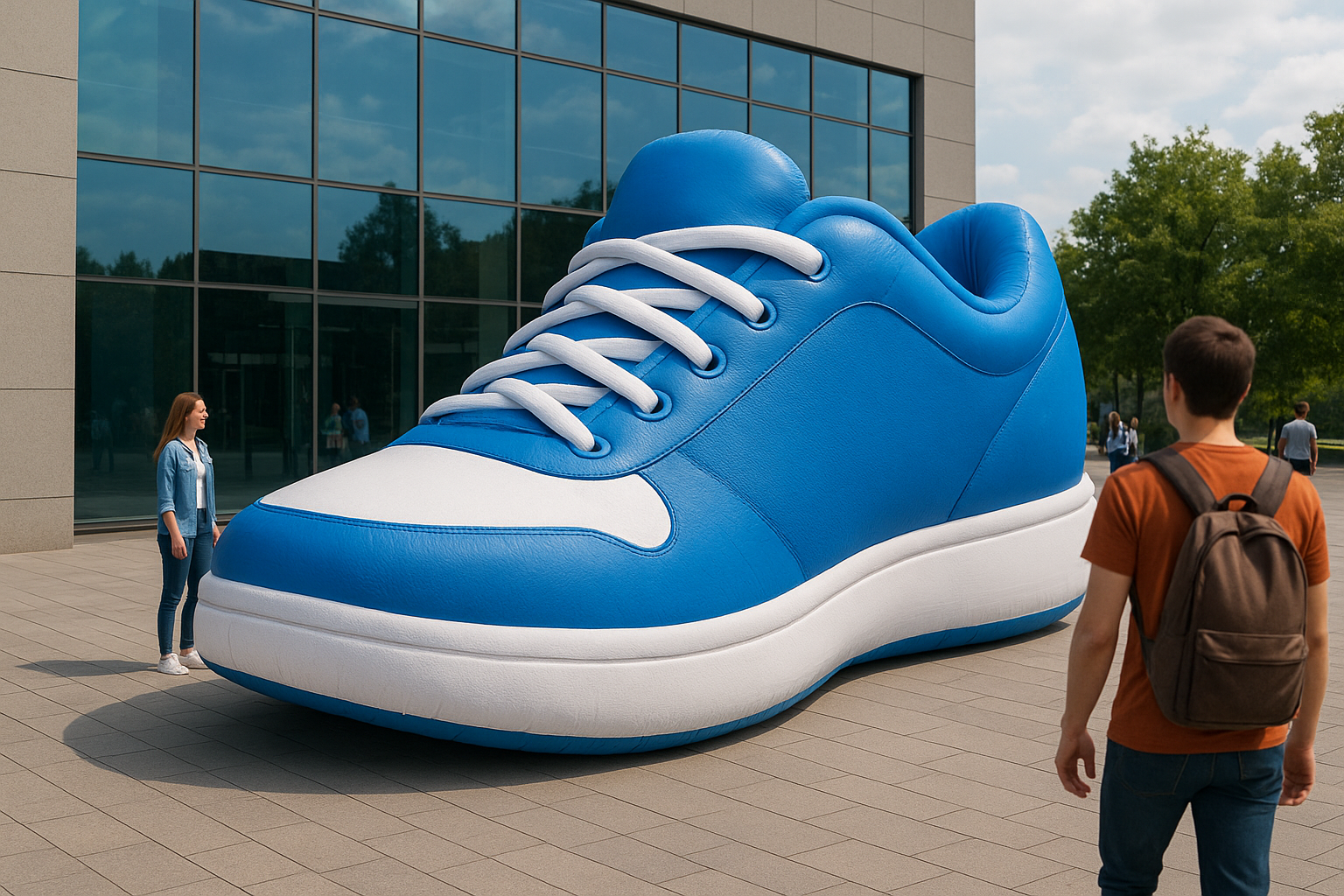
Large-scale installations also generate a second wave of reach because people photograph them and post the content across their own networks. A well-designed inflatable brand activation outside a sports venue or trade show entrance can generate hundreds of organic social posts in a single day, extending the campaign’s visibility well beyond the physical footprint of the installation itself.
Real examples of guerrilla marketing
Studying real campaigns gives you a much clearer picture of what works in practice versus what sounds clever in a brainstorm. The examples below represent different scales and budgets, but each one illustrates a core principle of guerrilla marketing: show up somewhere unexpected and give people a reason to stop.
Kit Kat’s bench campaign
Kit Kat placed chocolate-bar-shaped benches in public spaces across several cities, styled to look exactly like an unwrapped Kit Kat bar. The execution required no paid media and no complicated technology. Anyone who sat down became part of the campaign, and the benches generated substantial organic photography and social sharing simply because they were clever and out of place. The concept connected directly to the brand’s long-running "Have a Break" messaging, which gave the physical installation instant context for anyone who encountered it.
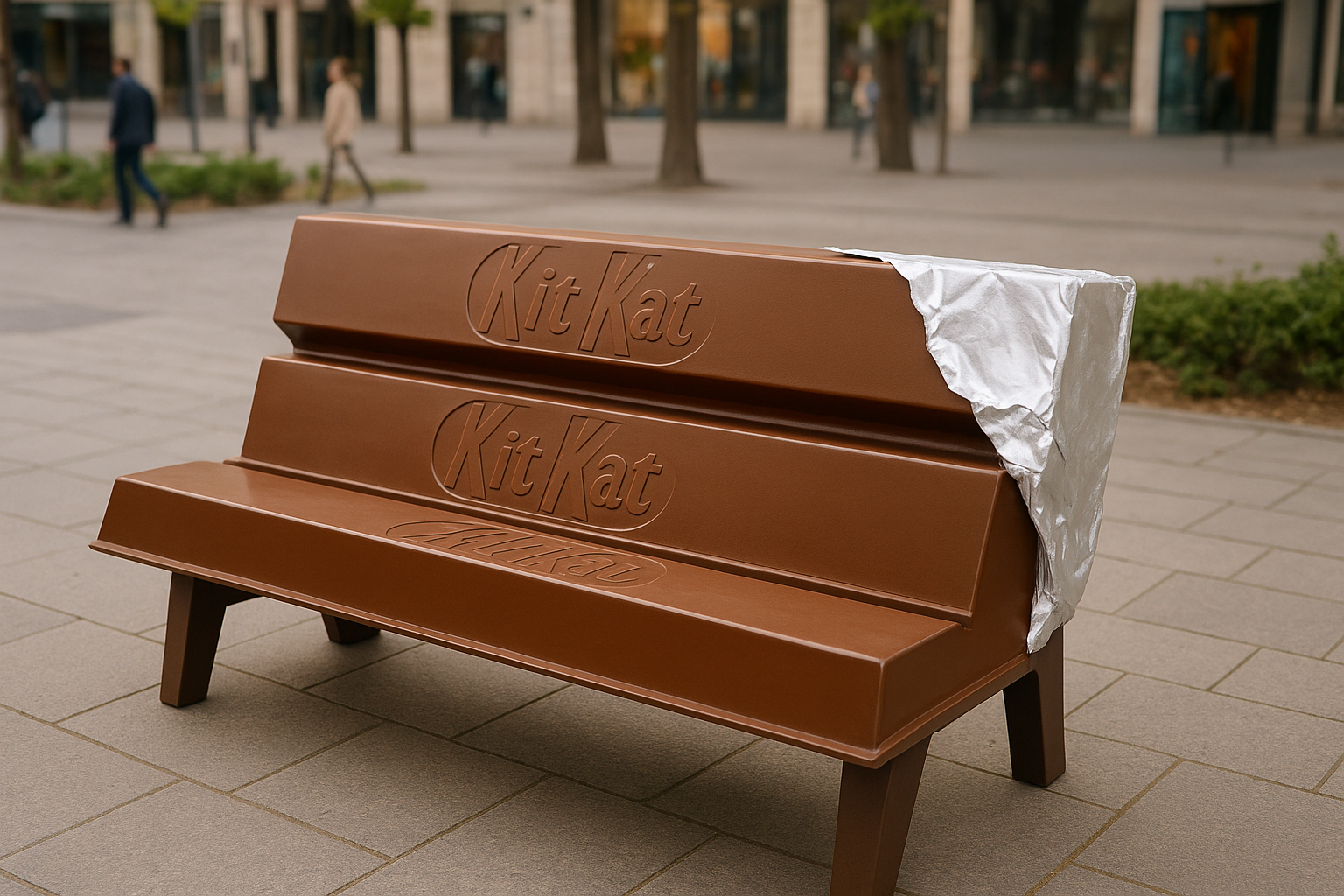
When the activation ties directly to your brand’s core message, the impression it leaves is far stronger than a clever stunt that has no clear connection to what you actually sell.
Red Bull’s branded can cars
Red Bull bolted oversized replica cans onto custom-modified vehicles and drove them through high-traffic areas, parking outside concerts, sporting events, and college campuses. The cars functioned as moving billboards that could stop, park, and draw crowds in ways that static signage never could. Because the vehicle itself was the product replica, every location it visited became a brief activation site. The format was scalable: the brand could deploy multiple vehicles across different cities simultaneously, multiplying the campaign’s physical footprint without requiring a centralized event structure.
Large inflatable product replicas at live events
Brands across industries have used oversized inflatable product replicas positioned outside stadiums, trade show entrances, and retail locations to create immediate visual impact. A ten-foot replica of your product placed at the entrance to a sporting event or conference will stop attendees, prompt photographs, and generate organic content that circulates well after the event ends. Unlike the previous examples, this format works especially well for companies that need a repeatable, reusable asset: a high-quality custom inflatable can be deployed across multiple events throughout a season, giving you consistent visual presence at each activation without rebuilding the installation from scratch every time. It also scales easily from small regional events to major national venues depending on how your campaign grows.
How to plan a guerrilla marketing campaign
A successful guerilla marketing campaign doesn’t start with a creative concept; it starts with a clear objective. Before you sketch a single idea, you need to know what specific outcome you’re building toward and which audience you need to reach to get there. Without that foundation, even the most visually striking activation will produce scattered results that are difficult to justify to your stakeholders.
Define your objective and audience
Your objective shapes every decision that follows, from the type of activation you build to the locations you target. Brand awareness, event attendance, product trial, and social media reach all require different approaches, and trying to serve all of them equally will dilute your results. Pick the single outcome that matters most for this campaign, then build your activation around delivering that outcome as efficiently as possible.
Once you have a clear objective, map it against your target audience’s actual daily movement patterns. Ask where they spend time, what routes they travel, and when they’re most open to new experiences. That information drives location selection far more reliably than gut instinct alone.
Choose your location and format
High foot traffic and contextual relevance are the two criteria that should drive every location decision you make. A busy transit hub gives you volume, but a location adjacent to your specific audience’s workplace, gym, or event venue gives you volume and relevance together, which is a much stronger combination. Scout locations in person at the same time of day your activation will run to assess real traffic patterns and sightlines.
The format of your activation should amplify the location, not fight against it.
Match your physical format to the scale and character of the space. A large inflatable structure works well in an open plaza or outside a stadium entrance. A more intimate experiential setup suits a narrower pedestrian street or a market environment. Getting this alignment right is what separates activations that feel natural from ones that feel out of place.
Secure permissions and logistics
Most public spaces in the United States require permits for commercial activations, and skipping this step creates real legal and reputational risk. Contact the relevant city or property authority well in advance, and build the permit timeline into your campaign schedule from the start. For large physical installations, also confirm load-in access, power requirements, and anchor points before you finalize your production specs. Solving logistics early prevents last-minute problems that derail otherwise well-conceived campaigns.
How to measure impact and avoid trouble
Running a guerilla marketing activation without a measurement plan means you’ll have no reliable way to justify the spend or improve future campaigns. Before your activation goes live, decide which specific metrics you’ll track and set up the systems to capture them. Measurement doesn’t have to be complicated, but it does have to be intentional.
Metrics that actually reflect campaign performance
Most guerrilla campaigns generate impact across several dimensions, so relying on a single number gives you an incomplete picture. Foot traffic counts, social media mentions, and branded hashtag volume give you a sense of reach and organic engagement. Direct response indicators, such as a spike in website visits, promo code redemptions, or product page views during the activation window, tell you whether attention translated into action.
Tie your metrics back to the original campaign objective you set during planning, and measure only what connects directly to that outcome.
Build a simple before-and-after comparison by pulling your baseline data for the two weeks prior to the activation. Then compare those numbers against the same metrics during and after the campaign window. This approach gives you a defensible way to quantify the lift your activation produced without requiring complex attribution modeling or expensive research tools.
| Metric | What it measures |
|---|---|
| Social mentions and photo posts | Organic reach and shareability |
| Website traffic spikes | Audience action after the encounter |
| Promo code or QR code redemptions | Direct response and conversion |
| Foot traffic counts | Physical audience volume at the site |
Staying on the right side of legal and safety requirements
Permits, liability insurance, and structural safety checks are non-negotiable for any physical activation. Most cities require commercial activation permits for any branded installation on public property, and the application process takes time. Submit your paperwork at least four to six weeks before your activation date to give yourself room to handle revisions or additional requirements from the relevant authority.
Physical installations, including large inflatables and branded structures, need to meet weight, anchoring, and clearance requirements. Work with your production supplier to get the full technical specifications in writing before you select your location. Sharing those specs with the permitting office upfront reduces the back-and-forth that delays approvals and costs you time you likely don’t have on a tight campaign timeline.
Final takeaways
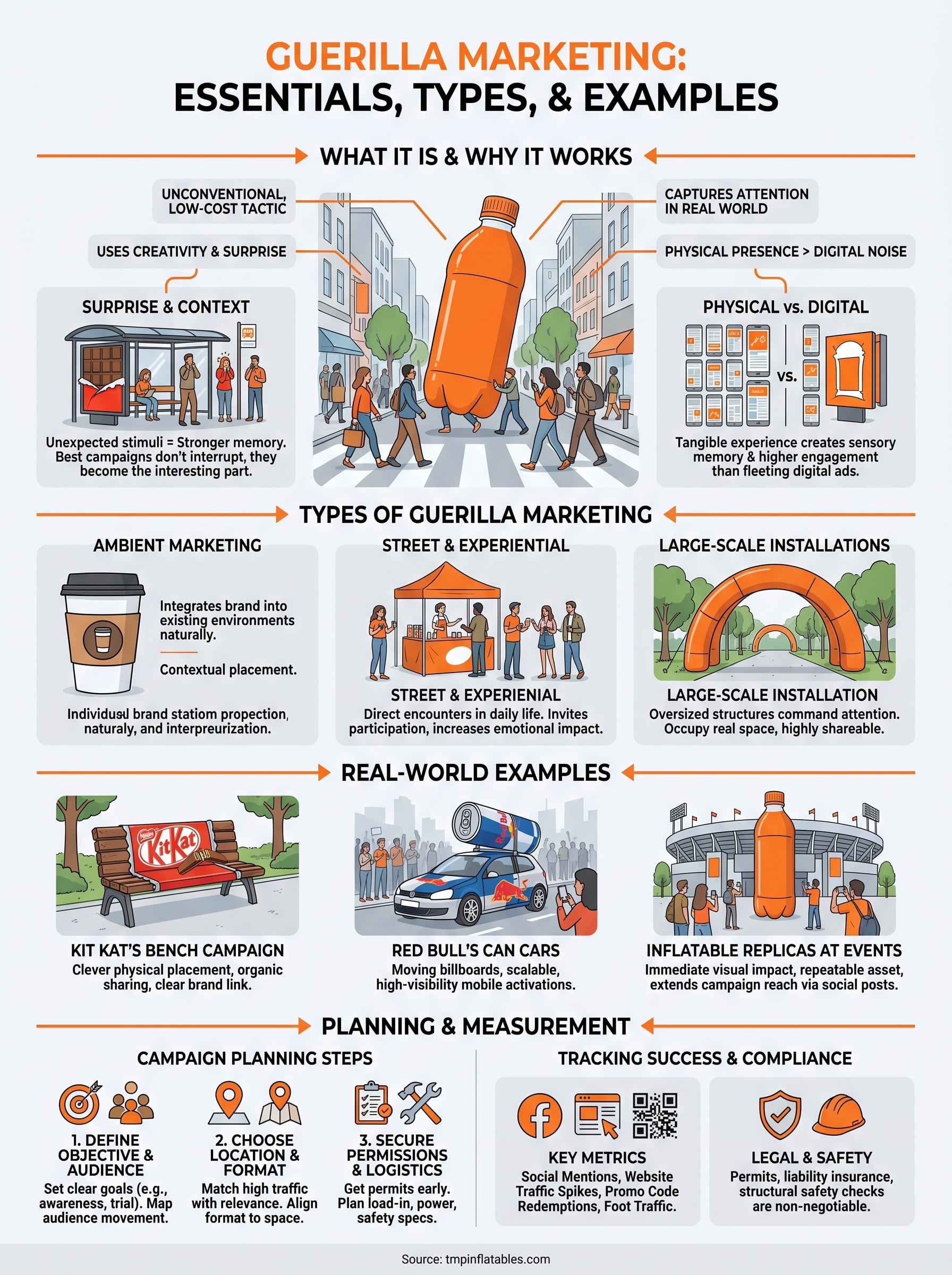
Guerilla marketing works because it meets your audience where they already are, and gives them something worth stopping for. The tactics that produce the strongest results share three qualities: a clear objective set before any creative work begins, a location chosen for relevance not just foot traffic, and a physical format that fits the space and scales with your campaign goals. You don’t need a massive budget to pull off something memorable. You need a sharp idea, the right placement, and execution you’ve planned carefully enough to measure.
Physical activations, including large-scale inflatables and branded structures, remain one of the most reliable formats for generating attention and organic reach at live events and street-level campaigns. If you’re ready to build a campaign around a custom inflatable activation, request a quote from TMP Inflatables and we’ll help you design something your audience won’t walk past.