

You’ve spent months (maybe years) developing a new product. The packaging is ready, the supply chain is locked in, and your team is excited. But none of that matters if nobody knows your product exists on launch day. Knowing how to market a product launch isn’t just a nice-to-have skill, it’s the difference between a product that gains momentum and one that quietly disappears from the shelf.
Most launch failures aren’t caused by bad products. They’re caused by scattered marketing efforts, unclear messaging, and poor timing. A strong launch strategy brings all your channels, digital, experiential, paid, earned, into a coordinated push that builds anticipation before day one and sustains attention long after. It requires research, planning, and a willingness to measure what actually worked versus what just felt busy.
At TMP Inflatables, we’ve been part of product launches since 2004, supplying custom inflatable displays, giant product replicas, and branded structures that give brands a physical, impossible-to-ignore presence at launch events, retail locations, and trade shows. We’ve seen firsthand what separates a launch that packs a venue from one that falls flat, and it almost always comes down to strategy behind the spectacle.
This guide walks you through every stage of a product launch marketing plan, from early audience research and positioning, through channel selection and content creation, all the way to post-launch analysis and KPIs. Whether you’re launching locally or nationally, you’ll leave with a clear, repeatable framework to make your next launch count.
What product launch marketing includes
Product launch marketing is not a single campaign; it’s a coordinated system of activities that runs across three distinct phases: pre-launch, launch day, and post-launch. Each phase has its own objectives, its own audience touchpoints, and its own set of assets. When you understand how to market a product launch as a full cycle rather than a single event, you stop treating launch day as the finish line and start treating it as the midpoint of a longer story.
A product launch is a system, not a moment. Brands that treat it as a moment almost always leave revenue on the table.
The three phases every launch goes through
Every successful launch follows the same basic arc, even if the tactics differ by industry or budget.
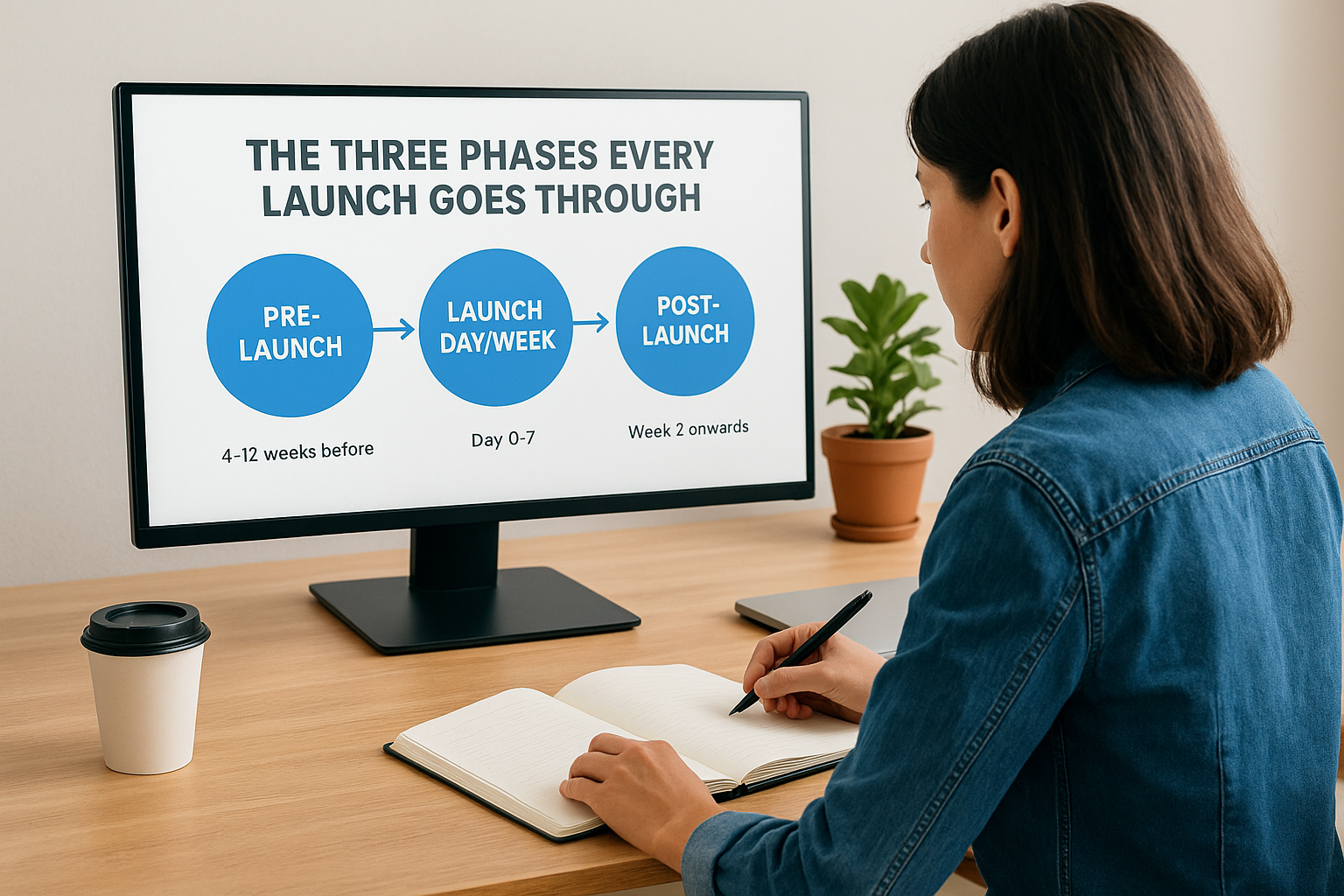
| Phase | Timeframe | Primary Goal |
|---|---|---|
| Pre-launch | 4-12 weeks before | Build awareness, generate demand, collect leads |
| Launch day/week | Day 0-7 | Drive conversions, create buzz, maximize reach |
| Post-launch | Week 2 onwards | Retain customers, gather data, sustain momentum |
During the pre-launch phase, your job is to make sure the right people already know your product exists before it hits the market. This includes teaser content, waitlist campaigns, influencer seeding, and physical activations at events or retail locations. The launch week then converts that built-up anticipation into sales, signups, or whatever your primary conversion goal is.
What makes launch marketing different from regular marketing
Ongoing marketing is designed to sustain and optimize. Launch marketing is designed to create a concentrated moment of attention that you can convert before it fades. The pressure is higher, the timeline is compressed, and the stakes are real because a weak launch can set a negative first impression that takes months to undo.
Launch marketing also requires tighter coordination across teams. Your PR, social, paid media, events, and sales teams all need to execute on the same message at roughly the same time. A delay in your press release while your paid ads are already running can dilute the impact of both. This is why a documented launch plan with clear ownership for each task is not optional.
The assets and channels a launch typically needs
Understanding what product launch marketing includes means taking inventory of every asset type and channel you need before you build your timeline and budget. Most product launches require some combination of the following:
- Owned content: landing pages, email sequences, blog posts, product videos
- Paid channels: search ads, social ads, display, sponsored content
- Earned media: press coverage, influencer reviews, user-generated content
- Experiential elements: launch events, trade show presence, in-store displays, and custom branded physical installations that create visible, shareable moments in real-world spaces
- Sales enablement materials: one-pagers, demo decks, and FAQs for your sales team
Not every launch needs every channel. A B2B software launch will lean heavily on webinars, LinkedIn ads, and email nurture sequences. A consumer product launch might prioritize influencer seeding, retail displays, and paid social. What matters is matching your channel mix to where your buyers actually spend their time and make purchasing decisions.
Step 1. Set goals and pick launch KPIs
Before you build any campaign, you need to know what success looks like in numbers. Without a clearly defined goal, every channel feels equally important, every tactic competes for budget, and you end up measuring activity instead of outcomes. The first step in figuring out how to market a product launch is committing to a specific, measurable objective that every downstream decision can point back to.
Your KPIs don’t just measure success; they shape every resource and budget decision you make before launch day.
Define your launch goal first
Not all product launches share the same primary objective. A new SaaS tool might launch to capture trial signups. A consumer packaged goods brand might care about retail sell-through rate in the first 30 days. A B2B product might define success as a set number of qualified sales conversations booked. Before you pick a single KPI, write one clear goal statement using this template:
Launch goal statement:
"We want to [action] [number] [unit] by [date] because [business reason]."
Example:
"We want to generate 500 qualified leads by the end of launch week because
our sales team closes 20% of leads within a 60-day follow-up cycle."
That one sentence keeps your entire team aligned and gives you a direct filter for every tactic you consider. If a proposed activity doesn’t move the needle on that goal, cut it.
Choose KPIs that match your goal
Once your goal is set, map specific KPIs to each phase of the launch so you know whether you’re on track before the final numbers come in. Use leading indicators during pre-launch (email signups, waitlist growth, social engagement) and lagging indicators after launch (revenue, conversion rate, customer acquisition cost).
| Launch Goal | Pre-launch KPI | Launch Week KPI | Post-launch KPI |
|---|---|---|---|
| Drive product sales | Waitlist signups | Units sold, revenue | 30-day repeat purchase rate |
| Generate B2B leads | Demo requests | SQLs created | Pipeline value |
| Build brand awareness | Reach, impressions | Share of voice, PR mentions | Unaided brand recall |
| Grow an email list | Opt-in rate | List growth rate | Open and click-through rate |
Pick two to four KPIs maximum for your launch. More than that dilutes focus and makes post-launch analysis harder than it needs to be. Narrow metrics force clearer decisions.
Step 2. Know your audience and buying path
Setting goals tells you where you’re going; knowing your audience tells you who you’re going with and how they’ll get there. Many teams skip this step or treat it as a box to check, but shallow audience knowledge leads to mismatched messaging that burns your launch budget on the wrong people. Before you write a single headline or choose a single channel, you need a clear picture of who your buyer is and what path they take from first awareness to purchase.
The more specifically you can describe your buyer’s decision process, the less you waste on tactics that miss them entirely.
Map who your buyer actually is
Start by building a single, focused buyer profile for your launch. Keep it practical rather than abstract. You need to know what specific problem or desire drives them toward a product like yours, what they already use to solve it, and what would make them switch. Use this template to pull those answers into one place:
Buyer Profile Template
Name/role:         [Job title or customer type]
Primary problem:   [What frustration or goal brings them to you?]
Current solution:  [What do they use now?]
Decision trigger:  [What would make them act?]
Key objection:     [What holds them back?]
Where they spend:  [Channels, publications, events]
Fill this in with real data from customer interviews, sales calls, or CRM records, not assumptions. One grounded profile beats five generic personas every time.
Trace the steps they take before buying
Once you know your buyer, trace the specific steps they take from first realizing they have a problem to handing over payment. This is your buying path, and it tells you exactly where to show up with the right message at the right moment.
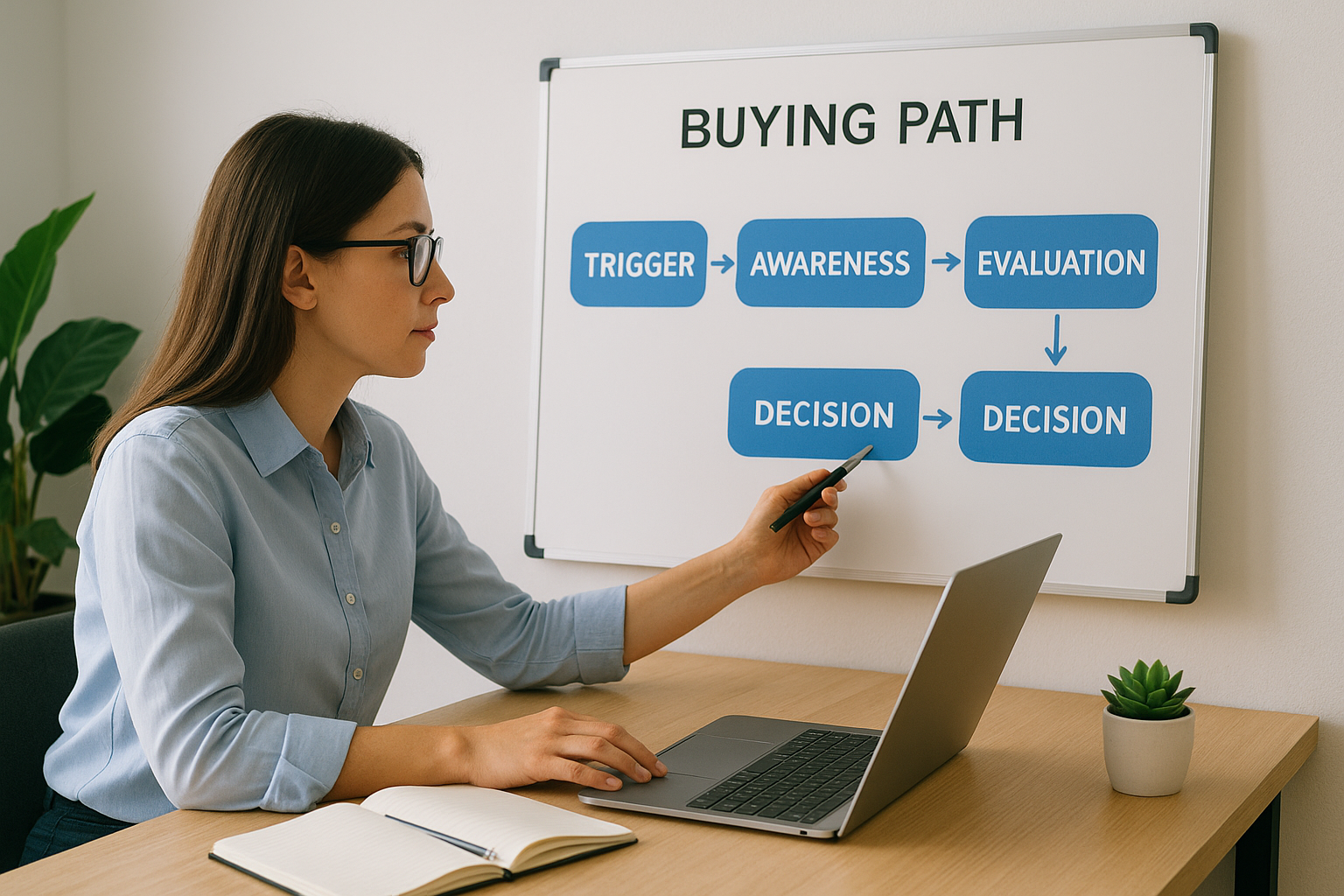
A typical buying path looks like this:
- Trigger: Something creates urgency, such as a deadline, a pain point, or a competitor move
- Awareness: They search, scroll, or ask a peer for options
- Evaluation: They compare shortlisted solutions against their criteria
- Decision: They confirm trust and commit to a purchase
Knowing this path is central to how to market a product launch effectively, because each stage needs a different type of content and a different channel to move your buyer forward rather than stall them.
Step 3. Nail positioning, message, and offer
Your goals are set and your buyer is mapped. Now you need to figure out exactly what to say and why your product deserves attention over every alternative in the market. Positioning, messaging, and your launch offer are the three inputs that determine whether your campaign resonates or gets ignored. Get them wrong and it doesn’t matter how much you spend on distribution.
Positioning is not a tagline. It’s the logical argument for why your product is the right choice for a specific person in a specific situation.
Define your positioning
Positioning answers one question: why should your buyer choose you over every other option available to them? That includes direct competitors, indirect alternatives, and the option of doing nothing at all. Strong positioning is specific, defensible, and grounded in what your buyer actually values, not what your team thinks sounds impressive.
Use this framework to lock in your position before you write a single word of copy:
Positioning Statement Template
For [target buyer], who [has this specific problem],
[Product name] is a [category] that [primary benefit].
Unlike [alternative or competitor], we [key differentiator].
Example:
"For retail marketing managers who need immediate street-level visibility,
our custom rooftop inflatables deliver a branded presence that stops foot traffic.
Unlike printed banners or static signage, our inflatables are three-dimensional,
weather-resistant, and impossible to overlook from a distance."
Craft your core message
Your core message is a single, clear claim that communicates your positioning in language your buyer already uses. Every headline, ad, email subject line, and sales script should trace back to this one statement. If your team can’t agree on what the product does and for whom, your audience definitely won’t agree either.
Write your core message in one sentence, under 20 words, focused on the outcome your buyer gets rather than the features your product has. "Helps retail brands double foot traffic with a custom inflatable display in under three weeks" beats "high-quality custom inflatables with fast production timelines" every time because it speaks to a result, not a specification.
Build your launch offer
Understanding how to market a product launch means recognizing that your offer is what converts attention into action. Your offer is more than price. It includes launch-only incentives, urgency triggers, and guarantees that reduce the buyer’s risk of committing early. A limited-time bundle, a free consultation, or a same-day quote promise can meaningfully lift your conversion rate during the critical first week.
Step 4. Build a launch plan and timeline
With your goals, audience, positioning, and offer in place, you now need a single document that tells every person on your team what to do, when to do it, and who owns it. Without a shared launch plan, tasks fall through gaps, deadlines slip, and your carefully built message hits different channels at different times with different wording. A written plan is what turns strategy into coordinated execution.
A launch plan is only useful if every person who owns a task can open it and immediately know what they need to do next.
Work Backward from Launch Day
The most reliable way to build a launch timeline is to start at launch day and work backward. Set your launch date first, then map every dependency in reverse order. If your press release needs to go out on launch morning, your PR team needs the draft approved three days before. If the draft needs approval, the copy needs to be written a week before that. This backward-mapping approach surfaces hidden bottlenecks before they become last-minute emergencies.
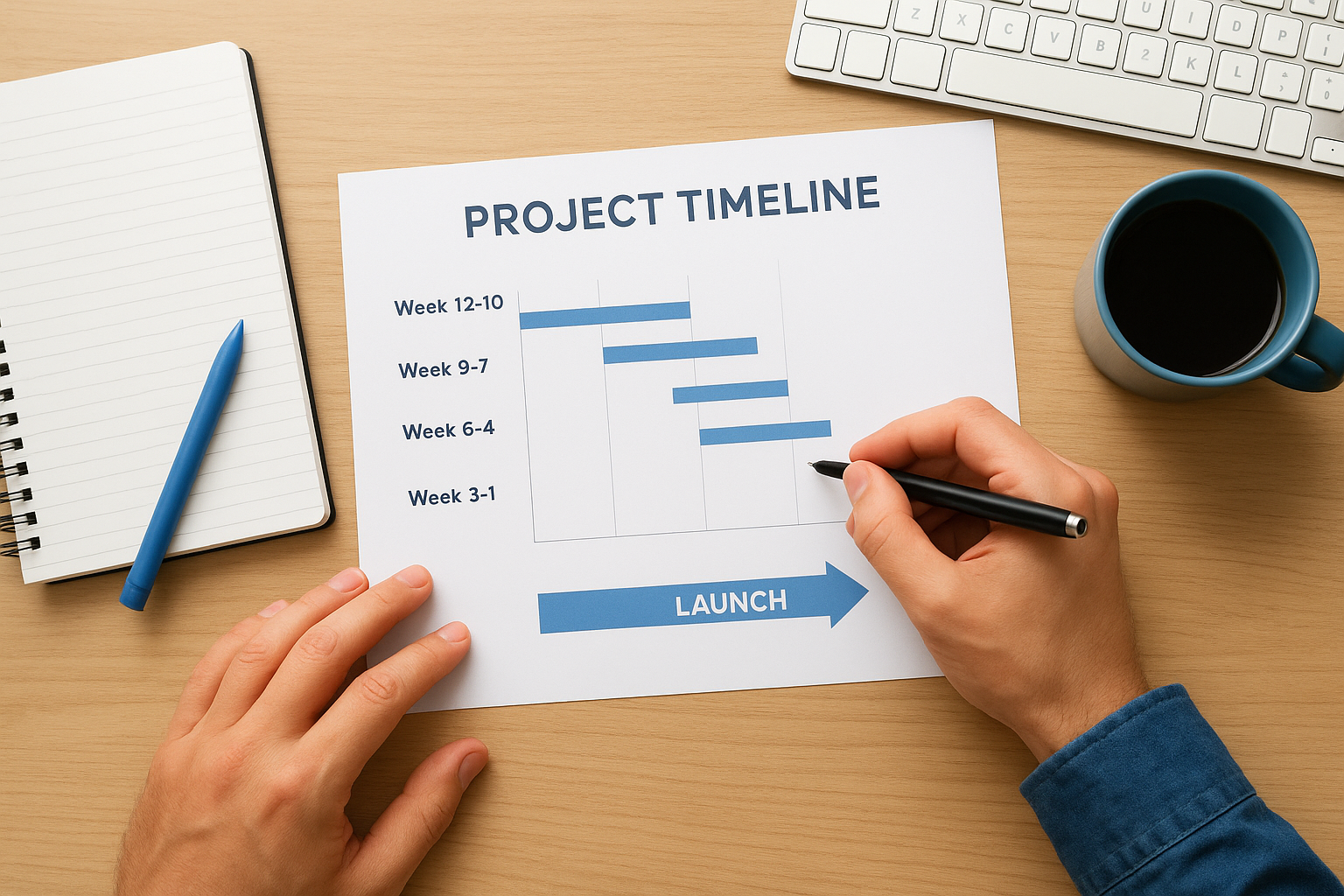
Use this timeline template to organize your pre-launch milestones:
Launch Timeline Template (12-week example)
Week 12-10: Strategy complete
 - Launch goal and KPIs finalized
 - Buyer profile and buying path documented
 - Positioning statement approved
Week 9-7: Assets in production
 - Landing page copy and design briefed
 - Email sequences drafted
 - Paid ad creative in review
 - Physical assets (displays, inflatables, banners) ordered
Week 6-4: Demand generation begins
 - Teaser content published
 - Waitlist or pre-order page live
 - Influencer and PR outreach sent
Week 3-1: Final checks
 - All assets approved and scheduled
 - Sales team briefed
 - Launch day run-of-show confirmed
Week 0: Launch
Assign Ownership to Every Task
A timeline without clear ownership is a wishlist. Every row in your plan needs a single named person responsible for it, a due date, and a status field. Shared ownership almost always means no ownership.
Knowing how to market a product launch at this level means treating your plan as a living document, not a one-time outline. Review it weekly with your core team, update statuses in real time, and flag blockers early. The teams that execute cleanest are the ones that check the plan daily rather than the ones with the most budget.
Step 5. Create the core launch assets
Your strategy is only as strong as the assets that carry it into the market. Goals, positioning, and timelines all exist on paper until you build the actual materials that buyers will see, read, and respond to. This is the step where your launch becomes tangible, and the quality of what you produce here directly determines whether your message lands or gets ignored.
Weak assets waste strong strategy. Build each piece to carry your core message without the context of everything else your team knows about the product.
Build your digital asset stack
Digital assets are the backbone of every modern product launch. You need a dedicated landing page that captures attention and converts it into a measurable action, whether that’s a purchase, a signup, or a demo request. Keep the page focused on one goal, one offer, and one call to action. Every additional option you add reduces conversion.
Use this checklist to confirm your digital asset stack is complete before launch week:
Digital Asset Checklist
Landing page
 - Hero headline matches your core message
 - Single, clear call to action above the fold
 - Social proof (testimonials, logos, or press mentions)
 - Mobile-optimized layout
Email sequence (minimum 3 emails)
 - Pre-launch teaser: builds anticipation, no hard sell
 - Launch day: full offer with urgency trigger
 - Follow-up: handles objections, reinforces value
Paid ad creative
 - At least 3 headline variations for A/B testing
 - Static image and short video formats ready
 - Copy matches landing page message exactly
Content assets
 - One blog post or article explaining the problem your product solves
 - Short product demo video (60-90 seconds)
Create physical and experiential assets
Physical assets matter more than most digital-first teams assume, especially when you’re launching at an event, in a retail environment, or in any space where real-world presence drives attention. A giant custom inflatable replica of your product, a branded arch at a venue entrance, or an oversized rooftop display creates a visual moment that no social ad can replicate. These are the assets people photograph, share, and remember.
Knowing how to market a product launch means recognizing that experiential elements anchor your brand in a specific place and moment. Order physical assets early since production timelines for custom items typically run two to four weeks, and a late delivery cancels the impact before launch day even starts.
Step 6. Pick channels for pre-launch demand
Knowing how to market a product launch requires you to resist the urge to be everywhere at once. Every channel you add splits your budget, your team’s attention, and your message. The goal during pre-launch isn’t maximum coverage; it’s concentrated presence in the places your specific buyer actually looks when they’re solving the problem your product addresses.
Spreading your budget across six channels at launch is almost always weaker than owning two channels completely.
Match Your Channel to Your Buyer’s Location
Your channel selection should come directly from the buyer profile you built in Step 2. If your buyer is a B2B marketing director, LinkedIn organic posts and targeted LinkedIn ads will outperform Instagram every time. If your buyer is a retail consumer who discovers products through short-form video, TikTok and YouTube Shorts are where you need to build pre-launch momentum. Use the table below to match your audience type to the channels that historically drive the strongest pre-launch awareness:

| Buyer Type | Strongest Pre-launch Channels |
|---|---|
| B2B decision-maker | LinkedIn, email, industry newsletters, webinars |
| Consumer (visual product) | Instagram, YouTube, influencer seeding, in-store displays |
| Local/event audience | Physical activations, Google Business, local PR, experiential |
| High-consideration buyer | Search ads, long-form content, email nurture, demo offers |
Physical channels belong on this list alongside digital ones. A giant branded inflatable or custom product replica at a high-traffic location generates organic awareness and social sharing that no paid ad budget can replicate at the same cost-per-impression.
Build a Simple Channel Priority List
Once you know where your buyer lives, rank your channels by expected return and assign a budget and owner to each. Limit yourself to three primary channels for pre-launch. Use this template to force the prioritization:
Pre-launch Channel Priority Template
Channel 1 (primary):   [Channel name]
Budget:                [Dollar amount or % of total]
Owner:                 [Name]
Goal:                  [Specific pre-launch KPI this channel drives]
Channel 2 (secondary): [Channel name]
Budget:                [Dollar amount or % of total]
Owner:                 [Name]
Goal:                  [Specific pre-launch KPI this channel drives]
Channel 3 (support):   [Channel name]
Budget:                [Dollar amount or % of total]
Owner:                 [Name]
Goal:                  [Specific pre-launch KPI this channel drives]
Filling in a specific goal for each channel keeps you from running activity for its own sake. If a channel doesn’t have a clear pre-launch KPI attached to it, cut it or fold its budget into a channel that does.
Step 7. Run launch week across teams
All the planning you’ve done in the previous steps only delivers results if your team executes in sync during launch week. This is where understanding how to market a product launch moves from strategy into daily coordination. Launch week is compressed, high-pressure, and exposes every gap in your planning. Your job this week is to keep every team member on message, on schedule, and informed about what’s changing in real time.
A strong pre-launch plan executed loosely will always underperform a simpler plan executed tightly.
Set a Daily Standup and Run-of-Show
Start each day of launch week with a short standup, no longer than 15 minutes, that covers three things: what went live yesterday, what’s going out today, and what’s blocked. This keeps every team, from paid media to events to PR, operating on the same current picture rather than the plan you wrote three weeks ago. Pair that standup with a written run-of-show document that lists every timed action for the week.
Launch Week Run-of-Show Template
Day 1 (Launch Day)
 08:00 - Press release distributed (Owner: PR lead)
 09:00 - Landing page goes live (Owner: Web team)
 09:00 - Email #1 sends to full list (Owner: Email lead)
 10:00 - Paid ads activated across all channels (Owner: Media buyer)
 12:00 - Social posts published (Owner: Social lead)
 All day - Physical installation live at [location] (Owner: Events lead)
Day 2
 09:00 - Monitor ad performance, pause underperformers (Owner: Media buyer)
 11:00 - Follow-up email to non-openers (Owner: Email lead)
 EOD  - Daily standup recap sent to leadership
Centralize Communication and Flag Blockers Fast
During launch week, scattered communication kills speed. Use a single shared channel, whether that’s a group thread, a project management board, or a shared document, where every team posts updates, flags issues, and confirms completions. When something breaks, and something always does, the team that solves it fastest is the one that hears about it immediately.
Assign one person the role of launch coordinator for the week. This person doesn’t need to own any single channel; they own the overall picture. Their job is to spot gaps, escalate blockers, and make sure nothing sits unresolved for more than a few hours. One clear coordinator prevents the chaos that multi-team launches are prone to when everyone assumes someone else caught the problem.
Step 8. Keep momentum after the launch
Launch week ends, but your marketing does not. Most teams make the mistake of treating the post-launch period as a cooldown, when it’s actually the window where you convert initial buzz into lasting revenue and learn everything you need to run a smarter second launch. Knowing how to market a product launch means planning for what happens on day eight just as carefully as you planned for day one.
The brands that sustain post-launch momentum are the ones that treat week two as a second launch, not a wind-down.
Analyze Your KPIs Before You Change Anything
Your first move after launch week is a structured performance review against the KPIs you set in Step 1. Pull your numbers before you adjust any channels, pause any ads, or redirect any budget. Changing things before you understand what drove results is how teams kill tactics that were quietly working.
Use this post-launch review template to structure your analysis:
Post-launch KPI Review Template
Review date:          [Date]
Launch goal:          [Original goal statement from Step 1]
KPI 1: [Metric]
 Target:              [Number]
 Actual:              [Number]
 Gap:                 [+ or -]
 Likely cause:        [What drove the result?]
KPI 2: [Metric]
 Target:              [Number]
 Actual:              [Number]
 Gap:                 [+ or -]
 Likely cause:        [What drove the result?]
Top-performing channel:   [Channel name + why]
Underperforming channel:  [Channel name + what to cut or change]
Biggest surprise:         [One thing you didn't predict]
Next 30-day priority:     [One focus area based on the data]
Complete this review within 72 hours of launch week closing, while context is still fresh for everyone on the team.
Turn Early Buyers Into Amplifiers
Your first customers are your most credible marketing asset. They bought without waiting for social proof to accumulate, which means they believed in your product before the crowd did. Reach out to them directly within the first two weeks and ask for a testimonial, a short video review, or permission to feature their results in your next campaign.
Give them a specific, easy ask rather than a vague request for feedback. For example: "Would you write two or three sentences on what made you decide to buy?" is far more likely to get a response than "Let us know what you think." Those responses become the social proof that lowers acquisition costs for every campaign you run after this one.
Next steps
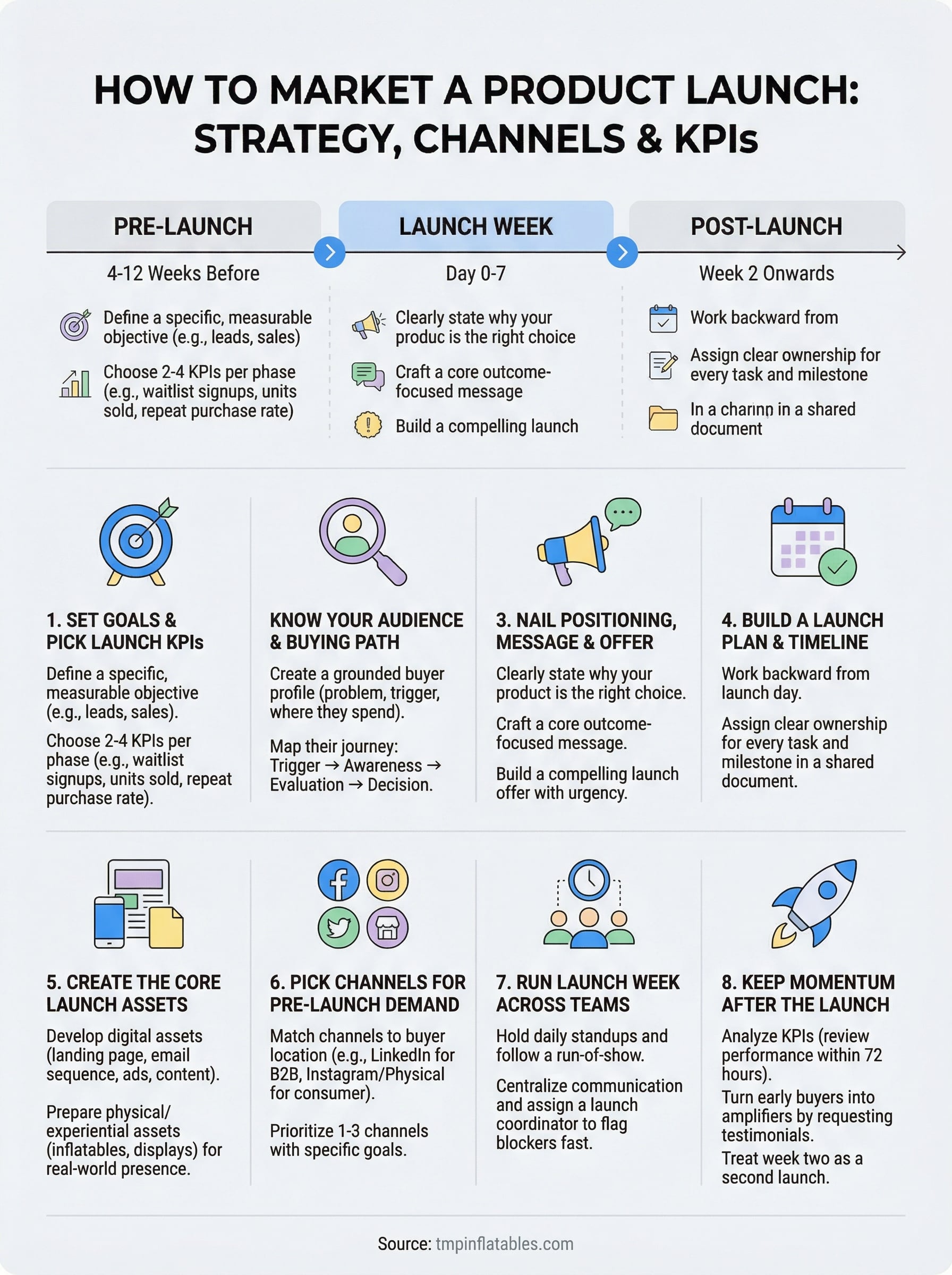
You now have a complete framework for how to market a product launch, from setting measurable goals and mapping your buyer’s path, to running a tight launch week and converting early customers into lasting advocates. The eight steps in this guide work as a system. Skipping one weakens the others, so treat the framework as a sequence rather than a menu.
Your immediate next step is to open a document and write your launch goal statement using the template from Step 1. Everything else, your KPIs, your channel selection, your asset checklist, flows from that one sentence. If you already have a launch date on the calendar, work backward from it and assign ownership to every milestone before the week is out.
If your launch includes a live event, retail activation, or trade show presence, custom inflatable displays and branded structures give your brand a physical presence that stops people before they ever see your digital campaign.
