

Successful corporate events don’t happen by accident. Whether you’re organizing a product launch, a company milestone celebration, or an annual conference, knowing how to plan corporate events from start to finish is the difference between a forgettable gathering and one that actually moves the needle. The problem? Most planning guides skip the practical details and leave you scrambling two weeks before the big day.
This guide breaks the process into clear, manageable steps, from setting goals and locking down a budget to nailing the logistics that make everything run smoothly. You’ll get a step-by-step checklist you can adapt to virtually any corporate event, plus straightforward advice on the decisions that trip up even experienced planners. No fluff, no generic tips you’ve already heard a hundred times.
At TMP Inflatables, we’ve spent over 20 years helping companies make their corporate events impossible to ignore. Custom inflatable arches, branded tents, giant product replicas, we’ve seen firsthand what goes into events that leave a lasting impression, and we know the planning that has to happen behind the scenes to pull them off. That experience is baked into every recommendation here. So whether you’re a seasoned event planner or tackling your first corporate event, you’re in the right place. Let’s get into it.
What planning corporate events includes
Corporate event planning covers a lot more ground than booking a room and sending out invites. When you think through how to plan a corporate event properly, you’re managing several distinct workstreams at the same time: strategic planning, logistics, vendor coordination, communications, and post-event analysis. Miss one of those areas, and you’ll feel the gap on the day.
The decisions you make in the first week of planning set the ceiling for everything that follows, so getting the full picture early is not optional.
Planning is not a checklist you run through once and set aside. Each phase of the process feeds directly into the next, which means choices you make early, like your budget cap or your venue capacity, shape every decision that comes after. Understanding the full scope upfront is what separates events that run clean from events that unravel in the final stretch.
The core components of corporate event planning
Every corporate event, regardless of size or format, involves the same fundamental categories of work. These are the pillars you’ll return to at every stage of the planning process. Here’s a breakdown of what each one covers:
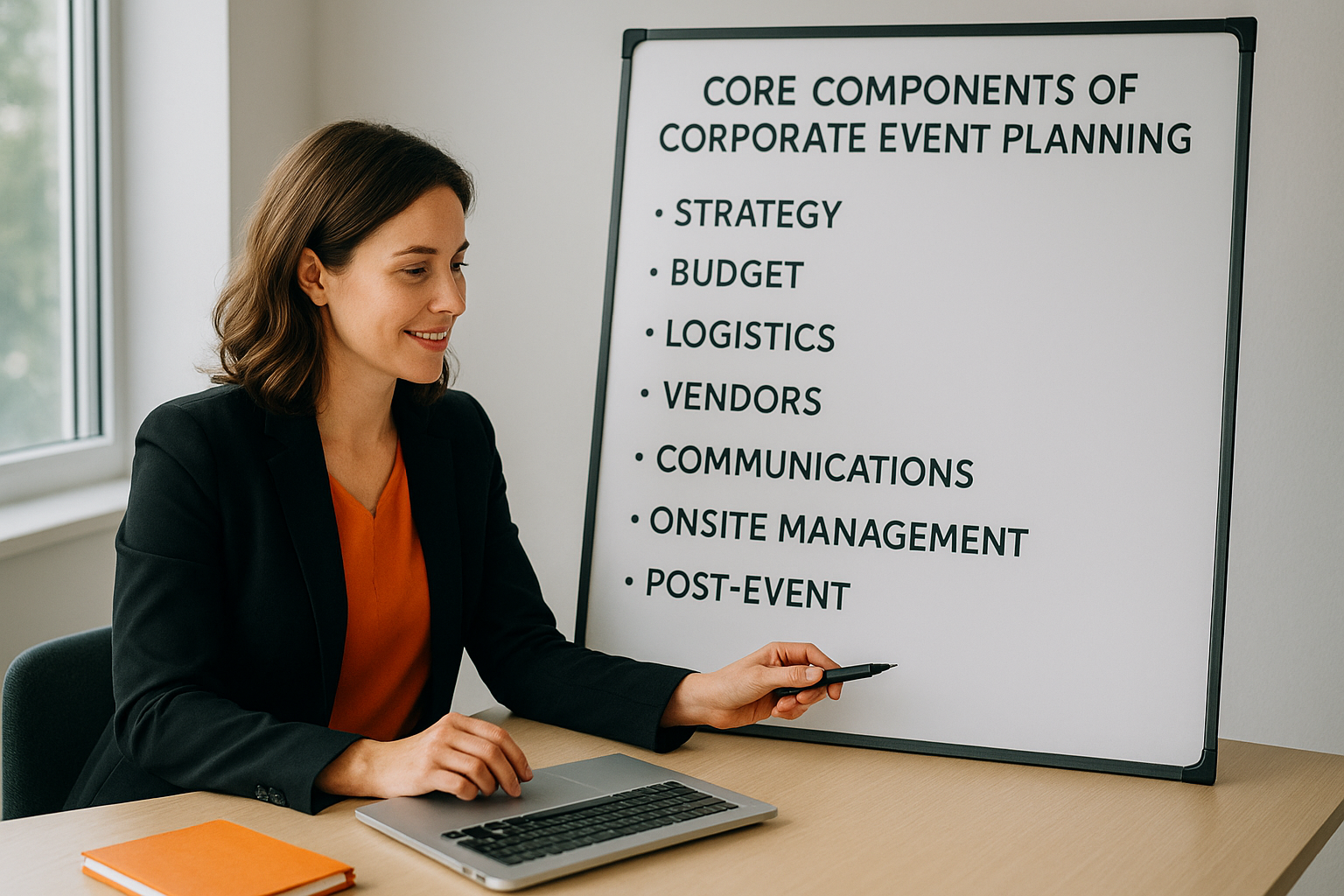
| Component | What it covers |
|---|---|
| Strategy | Goals, audience, success metrics, event format |
| Budget | Total spend, cost breakdown, contingency fund |
| Logistics | Venue, timeline, transportation, accommodations |
| Vendors | Catering, AV, decor, entertainment, promotional items |
| Communications | Invitations, registration, internal updates, attendee comms |
| Onsite management | Staffing, run-of-show, troubleshooting |
| Post-event | Surveys, reporting, debrief, follow-up actions |
Knowing these categories keeps you organized and makes it easier to assign clear ownership across your team. Each component needs a designated owner, a realistic deadline, and a documented status. When everyone knows what they’re responsible for, things stop falling between the cracks.
Types of corporate events you may be planning
Not all corporate events carry the same complexity or objective. A product launch demands very different logistics than an internal town hall, and a trade show appearance requires a completely different vendor mix than a client appreciation dinner. Knowing your event type early helps you allocate time and energy to the planning areas that matter most for your specific situation.
Here’s a quick overview of the most common types:
- Conferences and summits – Multi-session events with speakers, sponsors, and large attendee counts
- Product launches – High-visibility events focused on generating buzz and media attention
- Trade shows – Exhibitor-heavy events where brand presence and booth design drive results
- Team building events – Internal gatherings focused on culture, morale, and cross-team connection
- Client appreciation events – Relationship-building gatherings for existing clients or key prospects
- Award ceremonies – Formal or semi-formal events celebrating individual or team achievements
- Annual general meetings (AGMs) – Stakeholder-facing events with formal reporting requirements
Your event type directly shapes which planning steps carry the most weight. A trade show puts heavy emphasis on vendor selection and onsite branding. A leadership summit might prioritize speaker logistics and content programming above everything else. A product launch often hinges on experiential elements, from branded structures to hands-on activations, that create a visual moment worth talking about. Get clear on your event type before you move into the step-by-step planning process, and you’ll make sharper decisions at every turn.
Step 1. Set goals, audience, and success metrics
Before you book a single vendor or send one invite, you need to know exactly what this event is supposed to accomplish. This is the most critical step in how to plan a corporate event, because every decision you make from here forward, from venue size to vendor mix, connects back to your stated goals. Without clear goals, you’re making expensive guesses.
Define your event goals
Your goals determine the entire shape of the event. A product launch has a fundamentally different goal structure than a team offsite, and your planning priorities should reflect that. Start by writing a single goal statement: what does success look like on the day the event ends? Then break that into two to three supporting objectives that are concrete and achievable within your constraints.
For example: “Generate 50 qualified leads from the product launch” is a goal. “Increase brand awareness” is not, at least not without a measurable benchmark attached to it. Vague goals produce vague results.
Know your audience
Your attendees shape the format, tone, logistics, and even the budget allocation of your event. A room full of senior executives expects a very different experience than a gathering of frontline sales teams. Get specific about who is attending: their role, their relationship to your brand, their expectations, and how far they’re traveling to attend.
The clearer your picture of your audience, the fewer surprises you’ll encounter on the day of the event.
Build a quick audience profile before you move into logistics:
- Who they are: job title, seniority, industry
- Why they’re attending: their motivation or expectation
- What they need: accessibility, accommodations, content format
- How many: confirmed headcount range, not a rough estimate
Set measurable success metrics
Every goal needs a number attached to it. Measurable metrics give your team a shared definition of success and make your post-event debrief far more useful. Here’s a simple template you can adapt for any corporate event:
| Goal | Metric | Target | How to measure |
|---|---|---|---|
| Attendee engagement | Session attendance rate | 85% or higher | Badge scans or sign-in sheets |
| Lead generation | New contacts captured | 75 leads | CRM entries post-event |
| Brand visibility | Social mentions on event day | 200+ mentions | Social listening tool |
| Attendee satisfaction | Post-event survey score | 4.2 out of 5 | Email survey within 48 hours |
Lock in your metrics before the event, not after. Defining what success looks like in advance keeps your team aligned and gives you a clean baseline for improving the next one.
Step 2. Build your budget, timeline, and team
Once your goals and audience are defined, your next move when figuring out how to plan a corporate event is getting your resources aligned before anything gets booked or committed. This step covers three interconnected decisions: how much you’ll spend, when you’ll do everything, and who owns what. Documenting all three early prevents the disorganization that derails even well-intentioned planning efforts.
Build your event budget
Your budget is not just a spending cap. It’s a decision-making tool you’ll use at every stage of the planning process. Start with your total approved figure, then allocate it across categories before you start collecting vendor quotes. This way, you walk into every negotiation knowing exactly what you can spend.
Here’s a baseline budget breakdown you can adapt:
| Category | Typical % of Total Budget |
|---|---|
| Venue | 25-30% |
| Catering and beverages | 20-25% |
| AV and technology | 10-15% |
| Decor and branding | 10-15% |
| Entertainment or speakers | 5-10% |
| Marketing and communications | 5-8% |
| Contingency fund | 10% |
Always reserve 10% of your total budget as a contingency. Unexpected costs appear in almost every event, and that buffer keeps you from making reactive decisions under pressure.
The contingency fund is not optional. Build it in from day one, and resist the urge to reallocate it to other line items before the event wraps.
Set your planning timeline
Your timeline gives every team member and vendor a shared deadline structure to work against. Build it backward from your event date and assign hard deadlines to each major milestone. A compressed timeline forces trade-offs, so the earlier you map this out, the more options you preserve.
Use this template as your starting point:
| Milestone | Timeline Before Event |
|---|---|
| Goals, budget, and team confirmed | 16+ weeks |
| Venue selected and contracted | 12-14 weeks |
| Key vendors booked | 10-12 weeks |
| Invitations and registration live | 8-10 weeks |
| Run-of-show drafted | 4-6 weeks |
| Final headcount confirmed | 2-3 weeks |
| Onsite logistics locked | 1 week |
Assemble your planning team
Even small events need clear role assignments to run smoothly. Define your core team before the planning work begins and document who owns each workstream. Without explicit ownership, critical tasks get missed and accountability becomes impossible to enforce.
Assign at least one owner to each of these roles:
- Event lead: overall accountability and final decisions
- Logistics coordinator: venue, transportation, and accommodations
- Vendor manager: contracts, timelines, and day-of coordination
- Communications lead: invitations, attendee updates, and registration
- Onsite manager: run-of-show execution and real-time troubleshooting
Step 3. Book the venue, vendors, and event tech
With your goals, budget, and team locked in, the next phase of how to plan a corporate event is where most of your confirmed commitments happen. This step involves three parallel tracks: securing a venue that matches your event profile, contracting vendors who can deliver within your budget, and building the technology infrastructure that keeps everything running smoothly on the day. Move through all three systematically, because delays in one area typically create pressure in the others.
Choose and contract your venue
Your venue selection sets the physical constraints for everything else, including maximum capacity, catering policies, layout options, and accessibility. Before you tour any space, write down your non-negotiables: minimum square footage, parking or transit access, in-house AV availability, and any branding restrictions the venue enforces. Spaces that cannot meet those baseline requirements come off your list immediately.
When you evaluate your shortlisted venues, compare them against a consistent set of criteria:
| Criteria | Questions to ask |
|---|---|
| Capacity | Does it comfortably fit your confirmed headcount? |
| Location | Is it accessible for your attendee base? |
| AV infrastructure | In-house AV included, or do you bring your own? |
| Exclusivity | Can you brand the space, including exterior signage? |
| Catering policy | Open vendor policy, or preferred vendors only? |
| Cancellation terms | What are the penalties and notice deadlines? |
Once you identify your top choice, move to contract review quickly. Popular venues book out months in advance, and a verbal hold rarely protects your date.
Select and brief your vendors
Most corporate events need at minimum catering, AV production, and branding or decor, but your exact vendor mix depends on the event format. Collect two to three quotes per category before signing anything, and send each shortlisted vendor a brief document before your first call. This cuts down on back-and-forth and keeps every supplier working from the same information.
Include these details in every vendor brief you send:
- Event date, time, and venue address
- Estimated headcount and attendee profile
- Specific scope of work for that vendor category
- Setup window, teardown window, and load-in restrictions
- Your budget range for that line item
Lock in your event technology
Registration platforms, event apps, and check-in tools are easy to underestimate until they cause problems on the day. Decide early whether you need a dedicated registration system, a mobile event app, or a live-streaming solution for hybrid attendees, and give your tech vendors enough lead time to configure, test, and troubleshoot everything before the event goes live.
Step 4. Execute onsite, manage risks, and follow up
The final phase of how to plan a corporate event is where every decision you made in the previous steps gets tested in real time. Onsite execution demands a different mindset than planning: you shift from making decisions to enforcing the decisions already made. Your job on event day is to keep the run-of-show moving and intercept problems before they reach your attendees.
Run the day with a locked run-of-show
Your run-of-show is the single document that governs the entire event timeline, and every team member and vendor should have a copy the night before, not the morning of the event. Structure it in minute-by-minute increments for high-stakes transitions, including keynote starts, meal service, and speaker handoffs.
| Time | Activity | Owner | Notes |
|---|---|---|---|
| 7:00 AM | Venue access, vendor load-in begins | Logistics lead | Confirm with venue contact |
| 8:30 AM | AV tech check complete | AV vendor | Test all mics and slides |
| 9:00 AM | Registration desk opens | Comms lead | Badge stock confirmed |
| 10:00 AM | Opening session begins | Event lead | Speaker briefed night before |
| 12:00 PM | Lunch service starts | Catering vendor | Dietary flags communicated |
Manage risks before they escalate
Every corporate event carries risk, and your job is to decide how you’ll respond before problems appear. Walk the venue the morning of the event and flag anything that could create friction: delayed vendors, missing signage, or technical failures at the main stage. Assign a dedicated troubleshooter who has no other responsibilities during the event so your event lead can stay focused on the overall program.
A 30-minute pre-event briefing with your full onsite team, held before doors open, surfaces most last-minute issues before they touch your attendees.
Follow up within 48 hours
The event ends, but your post-event responsibilities do not. Send your attendee satisfaction survey within 48 hours, while the experience is still fresh. Use a three-question minimum: an overall experience rating, one thing that worked well, and one thing to improve next time. Then compare your results against the success metrics you defined in Step 1 and document the findings in a short debrief report before your team moves on to the next project.
Make the next one easier
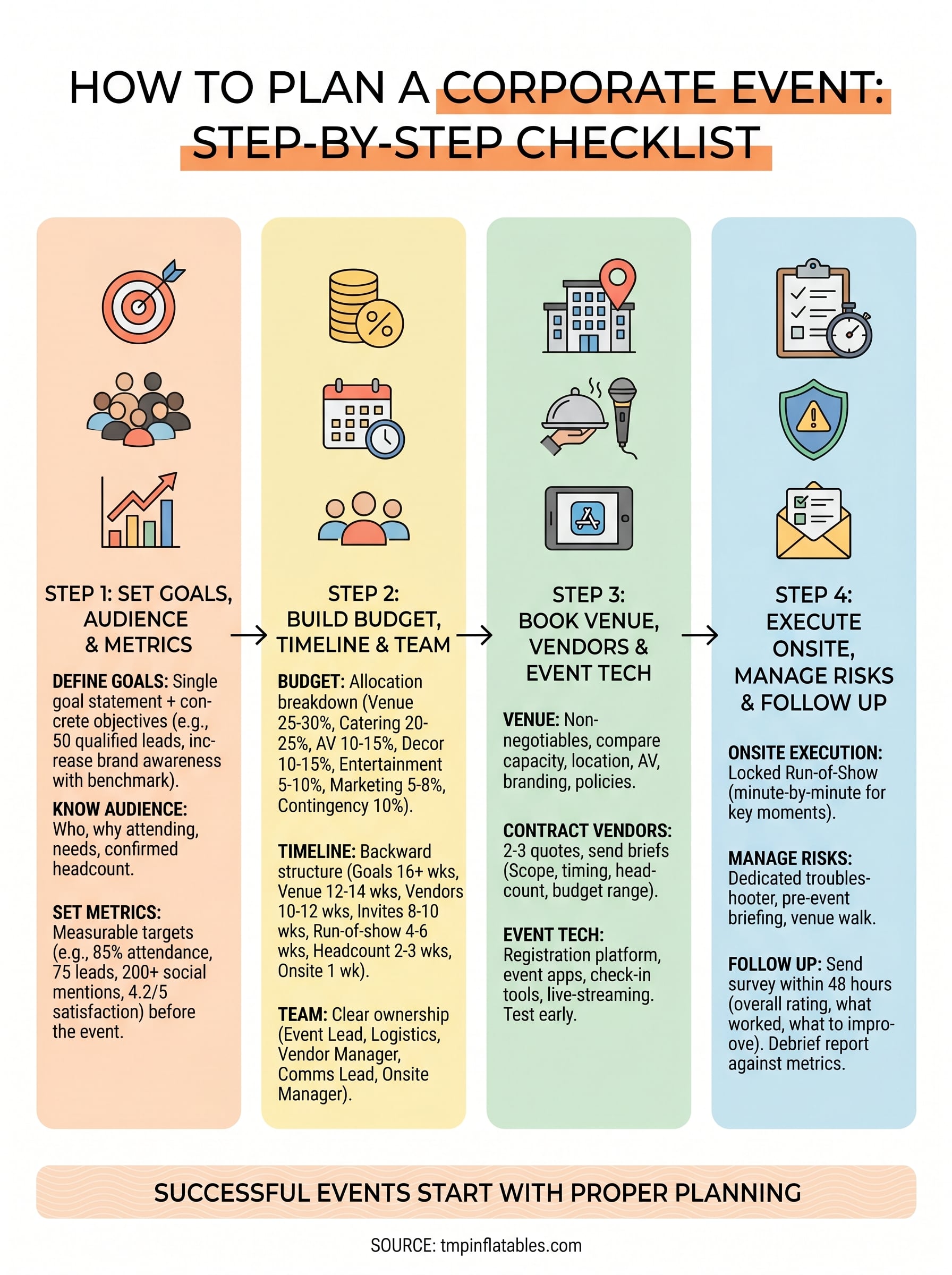
Now you know exactly how to plan a corporate event from the first goal-setting conversation to the post-event debrief report. The steps covered here work for any event type, any size, and any budget level. The difference between a stressful event and a smooth one is almost always how early you start and how clearly you document each decision along the way. Run every event against the checklists in this guide, then save your debrief notes in a shared folder your team can reference before the next one kicks off.
If your next event calls for high-visibility branding that stops people in their tracks, custom inflatables are one of the fastest ways to create a visual centerpiece that attendees actually remember. Branded arches, giant product replicas, and inflatable tents can all be fully customized to your campaign. Request a quote for your next event and our team will walk you through the options.
