

Welcome to the #1 Inflatable Arches Canada Wonder Guide. Type arches into a search bar and you’ll land in three different places: a red rock national park in Utah, a curved structural element in a building, or the free-standing entryways you see at weddings and trade shows.
Within this Inflatable Arches Canada Wonder Guide, the range of meanings is exactly why this term gets confusing fast, especially if you’re trying to figure out which kind of arch actually applies to your project or use case
This Inflatable Arches Canada Wonder guide sorts out the differences. We’ll cover natural rock formations, classic architectural designs, and the modern, portable structures businesses now use for events, so you know exactly which category you’re dealing with before you plan around it.
At TMP Inflatables, we build many types of inflatables arches and branded inflatable archways used at races, festivals, and product launches across North America.
So while this Inflatable Arches Canada Wonder Guide covers the geological and architectural definitions, we’ll spend real time explaining how event arches work, what they’re made of, and why they’ve become a go-to tool for marketers who need a structure that’s fast to set up and impossible to miss.
Inflatable Arches Canada & Why arches matter in architecture and design
An arch does one job better than almost any other shape: it turns weight into a curve, sending force outward and down instead of straight onto a single point. Builders figured this out thousands of years ago, and that principle still explains why arches show up everywhere from ancient aqueducts to the entrance banner at your local 5K.
Inflatable Arches Canada & The physics that makes an arch work
Picture a straight lintel, a flat beam laid across two columns like the ones at Stonehenge. That beam resists gravity through pure strength alone, and it eventually sags or snaps under its own weight. An arch solves the problem differently. Each wedge-shaped block, called a voussoir, pushes against its neighbors, channeling the load sideways along the curve until it reaches the ground through the arch’s base, or abutment. That sideways push, known as thrust, is why Roman engineers could span far wider gaps in stone than any post-and-lintel system allowed.
An arch doesn’t fight gravity, it redirects it.
This is the same reason a cardboard box holds more weight when you fold its top into a curve instead of leaving it flat, and it’s why a well-engineered inflatable arch, held rigid by air pressure inside its tube frame, can stand upright in wind without needing a heavy steel skeleton.
Inflatable Arches Canada & The shape that shaped history
Long before arches became a marketing tool, they were a status symbol. Roman triumphal arches celebrated military victories. Gothic cathedrals stretched the pointed arch upward to pull the eye toward heaven and let in more light through taller windows. Islamic architecture refined the horseshoe and multifoil arch into decorative art as much as structural support. Each culture used the same basic geometry to say something different about power, faith, or beauty, and that’s part of why the shape still reads as significant today. Place an arch over a doorway, a stage, or a race finish line, and people instinctively treat it as a threshold worth noticing.
Inflatable Arches Canada & Why the shape still matters commercially
Modern builders rarely need arches to hold up a roof anymore; steel beams and reinforced concrete do that job more efficiently now. But the visual weight of an arch hasn’t gone away, and that’s exactly why event marketers borrowed it. A branded arch at an entrance signals “this is where the event starts” the same way a cathedral door signaled “this is where the sacred space begins.” It creates a natural photo backdrop, funnels foot traffic in one direction, and gives sponsors a highly visible spot for logos.
A few reasons arch-shaped structures keep earning their spot in modern design:
- Instant recognition. People know what an arch means without being told, thanks to centuries of cultural repetition.
- Efficient framing. The curve draws the eye toward the center, which is exactly where you want a logo or a race clock.
- Scalability. The same basic shape works at cathedral scale or as a 20-foot round inflatable arch at a finish line.
- Structural honesty. Unlike a flat banner, an arch has depth and form, so it reads as a real structure rather than a printed sign.
That last point matters more than it sounds. A flat banner blows around and looks flimsy by the second hour of an outdoor event. An arch, whether built from stone, steel, or reinforced vinyl and air, holds its shape and keeps looking intentional from setup to teardown. That durability under real-world conditions is exactly why TMP Inflatables designs our inflatable arches and tents around the same load-bearing logic architects have relied on for two thousand years, just swapping stone voussoirs for air-filled tubes.
Inflatable Arches Canada & How to identify the different types of arches
Once you understand why arches hold weight, spotting the differences between them gets a lot easier. Every arch style boils down to three things: the shape of its curve, the era it came from, and the job it’s meant to do. Round arches look nothing like pointed Gothic arches, and a modern inflatable event arch shares almost nothing with either except the basic idea of a curved opening. Learning to tell them apart takes minutes once you know what to look for.
Inflatable Arches Canada & Reading the curve
The fastest way to identify an arch is to trace its curve from one base to the other. A semicircular arch forms a perfect half-circle, the kind Romans used in aqueducts and doorways. A pointed arch meets at a peak instead of a smooth top, a hallmark of Gothic cathedrals built to stretch the eye upward. Horseshoe arches curve past a semicircle before narrowing again, common in Islamic and Moorish design. Parabolic arches, like the one under the Gateway Arch in St. Louis, distribute weight so evenly that engineers still use the shape for modern bridges.
| Arch type | Shape | Common era/origin | Typical use today |
|---|---|---|---|
| Semicircular (Roman) | Half-circle | Ancient Rome | Bridges, aqueducts, doorways |
| Pointed (Gothic) | Meets at a peak | Medieval Europe | Cathedrals, church windows |
| Horseshoe | Curves past a half-circle | Islamic/Moorish | Mosques, decorative facades |
| Parabolic | Wide, evenly curved | 19th-20th century engineering | Bridges, monuments |
| Inflatable/event | Round or custom-shaped | Modern marketing | Race finish lines, trade shows, entrances |
Inflatable Arches Canada Looking at Structural vs decorative arches
Not every arch you see is holding anything up. Stone and brick arches in old buildings are load-bearing; remove one and the wall above it comes down.
Decorative arches, on the other hand, exist purely to frame a space or draw attention, and that category is where most people encounter arches today without realizing it.
If an arch isn’t holding up a wall, it’s holding your attention instead.
That distinction matters when you’re planning a project. If you need an arch to support real structural weight, you’re working with an architect or engineer, and the shape has to follow strict load calculations. If you need an arch to mark an entrance, frame a stage, or give sponsors a place to put a logo, the engineering requirements are completely different. Custom inflatable arches only need to hold their own shape against wind and weather, which is why they can be produced in weeks instead of months and shipped anywhere instead of poured in place. That practical difference is exactly why event planners reach for an inflatable arch instead of trying to build a permanent one every time they need a memorable entrance.
Inflatable Arches Canada looking at Arches beyond buildings: feet, nature, and parks
Buildings and event structures don’t own the word. The human foot has an arch too, and geology carved thousands more out of solid rock long before anyone poured concrete. If you searched “arches” hoping for hiking trails or a diagnosis for foot pain instead of a wedding backdrop, this is the section for you.
The arch in your foot
Anatomically, your foot has a medial longitudinal arch running along the inner edge from heel to big toe, held up by tendons, ligaments, and the shape of the bones themselves. It works on the exact same principle as a building arch: it spreads the force of your body weight outward across the whole foot instead of letting it crush straight down through one point. When that arch collapses, doctors call it flat feet, or pes planus, and it can lead to plantar fasciitis, shin splints, and knee pain over time. Podiatrists treat this with arch support inserts or custom orthotics, which do for your foot what a keystone does for a doorway: give the curve something to push against so it doesn’t flatten under load.
Natural stone arches and Arches National Park
Geology builds arches without an engineer in sight. Wind and water slowly cut through weak points in sandstone fins over millions of years, eventually punching a hole clean through the rock. Arches National Park in Moab, Utah, protects more than 2,000 of these formations, the highest concentration on Earth, including Delicate Arch, the freestanding sandstone arch that appears on Utah license plates.
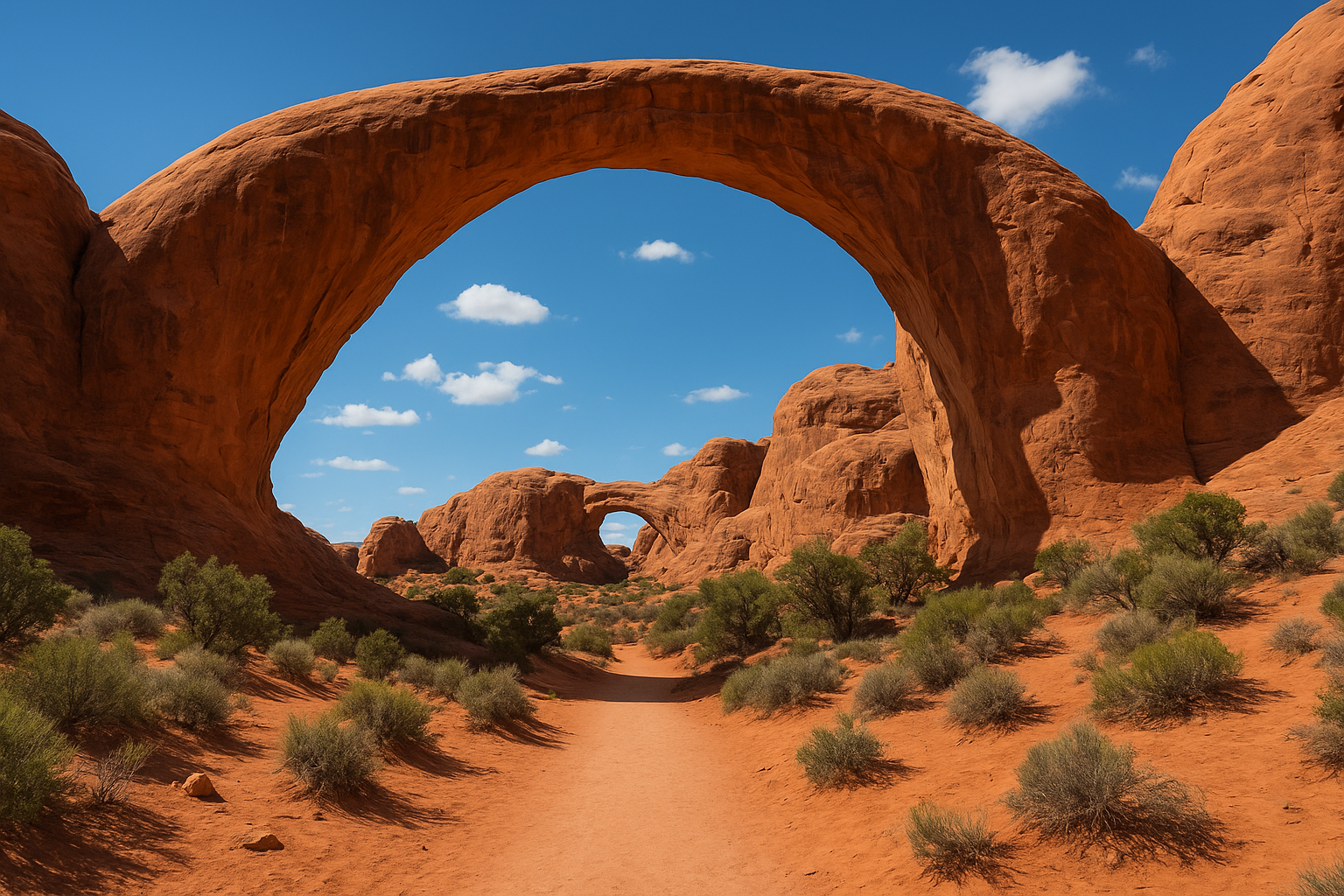
A building arch is engineered in months; a natural one takes millions of years and no blueprint.
If you’re planning a visit rather than a project, a few practical details save you from a wasted trip:
- Timed entry reservations are required from April through October and book up weeks in advance through the National Park Service.
- Delicate Arch is a 3-mile round-trip hike with real elevation gain, best started early to avoid summer heat that regularly tops 100°F.
- Windows Section offers shorter, easier hikes if you want multiple arches without a full-day commitment.
- Moab has the closest lodging, with campgrounds inside the park filling up months ahead.
| Feature | Delicate Arch Trail | Windows Section |
|---|---|---|
| Distance | 3 miles round trip | Under 1 mile each |
| Difficulty | Strenuous | Easy |
| Best time | Early morning or sunset | Any time, less shade needed |
| Crowds | Heavy at sunset | Moderate |
Worth noting: this natural version of the word has nothing to do with structural engineering or event marketing, but it explains why “arch” carries such weight as a shape. Nature spent millions of years proving the curve works before humans ever copied it into a doorway or a finish line.
Inflatable Arches Canada & Using arches for events and brand experiences
Every definition covered so far, the physics, the history, the foot anatomy, the sandstone formations, sets up the version most marketers actually search for: the branded inflatable arch you see at a 10K finish line, a car dealership grand opening, or a trade show entrance. This is where the ancient load-bearing shape gets repurposed as a marketing tool, and understanding why it works commercially makes the buying decision a lot easier.
Inflatable Arches Canada & Why brands choose inflatable arches
Outdoor events have three problems a flat banner never solves well: wind, setup time, and visibility from a distance. A custom event arch answers all three at once. Air pressure keeps the structure rigid enough to handle open-field gusts that would flatten a vinyl sign, a blower inflates most arches in under fifteen minutes, and the curved shape reads clearly from a hundred yards away, which matters when you’re trying to funnel a crowd toward a registration table or a stage. Sponsors also like arches because the surface area for logos is huge compared to a banner stand, and the shape itself signals “important entrance” before anyone reads a single word printed on it.
An inflatable arch does a stone arch’s job in fifteen minutes instead of fifteen years of quarrying.
Inflatable Arches Canada & What goes into a custom build
Most inflatable arches use reinforced oxford fabric, dye-sublimation printing for full-color branding that won’t peel or fade, and a continuous-run blower that keeps the structure firm for the length of an all-day event. Specs vary by use case, so here’s a quick comparison of what typically gets chosen for different event types:
| Event type | Typical arch width | Print approach | Setup time |
|---|---|---|---|
| 5K/10K finish line | 20-30 ft | Full sponsor logo wrap | 10-15 min |
| Trade show entrance | 10-15 ft | Single brand focus | 5-10 min |
| Grand opening | 15-20 ft | Company colors + tagline | 10-15 min |
| Festival/parade | 20-40 ft | Multi-sponsor panels | 15-20 min |
Inflatable Arches Canada & Planning your arch around the event, not the other way around
Every definition covered so far, the physics, the history, the foot anatomy, the sandstone formations, sets up the version most marketers actually search for: the branded inflatable arch you see at a 10K finish line, a car dealership grand opening, or a trade show entrance.
Getting the shape right matters less than getting the logistics right. Before ordering, confirm these details so the arch actually fits the day:
- Ground surface: asphalt, grass, and sand all need different anchoring or weight systems.
- Wind exposure: open fields need a higher-rated blower and secure stakes or water barrels.
- Print turnaround: rush jobs are possible, but locking artwork early avoids last-minute compromises.
- Shipping distance: TMP Inflatables ships across North America, the Caribbean, and Latin America, so international events need extra lead time.
Questions like these are exactly what our team walks through on every inflatable archway order, because the right arch for a downtown marathon or a soccer activation looks nothing like the right one for an indoor trade show floor.

Inflatable Arches Canada and how to See arches in a new light
One word, four completely different meanings, and now you know how to tell them apart. Structural arches carry weight through curved thrust, natural arches in Utah took millions of years of wind and water, your foot has one holding you up with every step, and event arches borrow that same ancient shape to mark an entrance and grab attention in under fifteen minutes. Next time someone mentions arches, you’ll know instantly which conversation you’re actually in.
Consult the Inflatable Arches Canada Wonder Guide. If you’re planning an event and need the branding version rather than a hiking trip, that’s exactly where TMP Inflatables comes in. We’ve spent two decades building custom inflatable arches for races, festivals, and product launches across North America. We handle everything from artwork to shipping.
Ready to put a memorable entrance on your next event? Request a custom arch quote and we’ll help you figure out the right size, print, and setup for your specific space.
