
You’ve seen them outside car dealerships, retail stores, and grand openings, those tall, flailing, colorful figures dancing against the sky. The inflatable tube man goes by many names (air dancer, skydancer, tube guy, wacky waving inflatable arm flailing tube man), but the purpose is always the same: grab attention from anyone within eyeshot. And it works. Few advertising tools match the sheer stopping power of a 20-foot figure thrashing around in the breeze.
But once you decide to buy one, the questions start piling up. How much does an inflatable tube man actually cost? Can you put your logo on it? What sizes are available? Is there a difference between a cheap one from an online marketplace and a custom-built unit designed for your brand? These are fair questions, and the answers vary more than most people expect.
At TMP Inflatables, we’ve been designing and producing custom inflatables since 2004, including air dancers built specifically for brand promotion and experiential marketing campaigns. We work with marketing teams, agencies, and event planners across North America, the Caribbean, and Latin America, so we’ve fielded just about every question on this topic you can think of.
This article breaks down exactly what an inflatable tube man is, what it costs, how customization works, and what to look for when choosing one for your business or event. No fluff, no filler, just the practical information you need to make a smart purchasing decision.
What an inflatable tube man is and what to call it
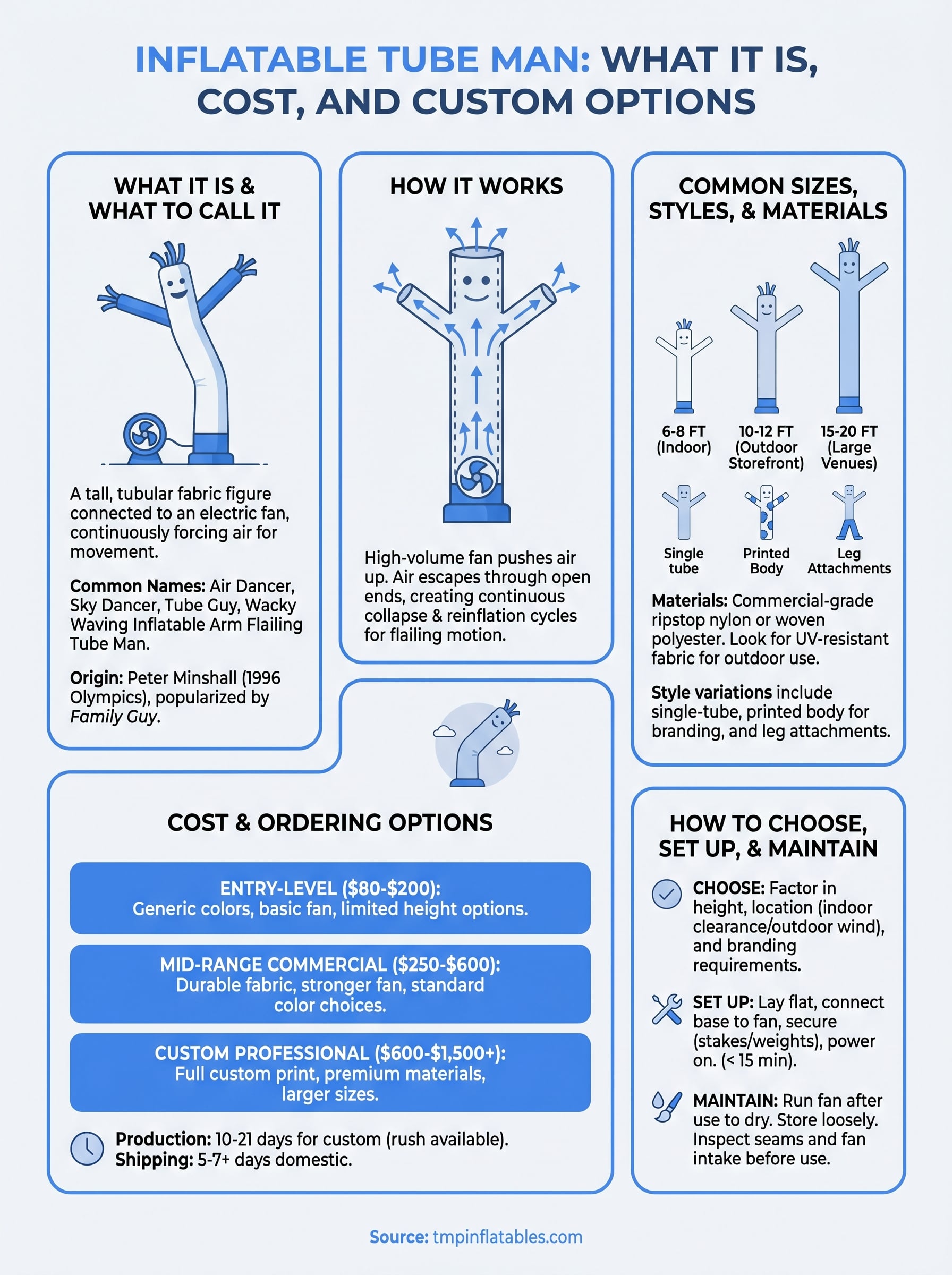
An inflatable tube man is a tall, tubular figure made from lightweight nylon or polyester fabric that connects to an electric fan at its base. The fan continuously forces air up through the tube body, inflating the arms, torso, and head while creating that signature wild, flailing motion. The whole thing can stand anywhere from 6 feet to over 20 feet tall depending on the model, and it runs on a standard power outlet. Simple concept, but the visual result is hard to ignore, especially at high-traffic locations where you need something to cut through the noise.
The many names for the same product
If you search online for one of these products, you’ll quickly run into a pile of different terms that all describe the same basic thing. Knowing these names matters if you plan to request a quote, search for suppliers, or brief a vendor on what you need. Using the wrong term won’t get you the wrong product, but it can slow down conversations with suppliers who organize their inventory differently.
The product is the same regardless of what you call it. The name you use often depends on your region, your industry, and whether you grew up watching a specific TV show.
Here are the most common names you’ll encounter:
- Air dancer – the most widely used trade name in North America; many manufacturers label their product lines this way
- Sky dancer or skydancer – used interchangeably with air dancer in many markets
- Inflatable tube man – the most descriptive and commonly searched term among buyers new to the product
- Tube guy or tube man – informal shorthand used by event planners and rental companies
- Wacky waving inflatable arm flailing tube man – the pop culture nickname that gained mainstream traction through television
- Wind dancer – a less common regional variation, mostly used in parts of Canada and the UK
For practical purposes, “air dancer” and “inflatable tube man” are the terms most suppliers recognize and use in their product catalogs, so either will get you where you need to go when reaching out for quotes or browsing product lines.
Where the “wacky waving” nickname came from
The phrase “wacky waving inflatable arm flailing tube man” became part of pop culture through a recurring joke on the animated television show Family Guy, where a character repeatedly shouts the phrase with uncontainable enthusiasm. The bit resonated widely because it perfectly captured how ridiculous and lovable these products actually look in practice. Anyone who has ever driven past one understands the joke immediately.
The original product predates that reference by decades. Peter Minshall, a Trinidad and Tobago carnival artist, is widely credited with inventing the design in the early 1990s for the opening ceremony of the 1996 Atlanta Olympics, where his creation called “Tall Boy” debuted in front of a global audience. From there, the design was commercialized, adapted for roadside advertising, and eventually became a fixture on commercial strips across North America.
Understanding that history gives you one useful piece of context: it tells you that this product has been tested, refined, and proven across more than 30 years of real-world use. You’re not buying an experimental marketing gimmick. You’re buying a format that businesses have relied on consistently because it delivers visible results at a reasonable cost, whether you’re running a weekend sale or building out a full experiential marketing activation.
How an inflatable tube man works
The mechanics behind an inflatable tube man are straightforward. A high-volume electric fan sits at the base of the unit and pushes a continuous stream of air upward through the tube body. The fabric inflates, the arms lift, and as the air escapes through open sleeves and the top, the entire figure collapses and reinflates repeatedly, creating that flailing motion you see from the road. There are no complex mechanisms involved, which is a big part of why these units are durable and easy to operate at almost any venue.
The fan and power setup
The fan unit is the core component of the system, and most standard models plug directly into a 120V household outlet, which means you can run one from virtually any indoor or outdoor location with access to standard power. The fan draws between 150 and 400 watts depending on the size of the unit, comparable to running a small appliance. Larger units built for taller figures require more airflow and a more powerful fan, but the power requirements stay manageable for most event setups.
Most fans include a simple on/off switch, and some commercial-grade models offer speed controls that let you adjust how aggressively the figure moves. If you’re setting up outdoors, confirm that your power source can handle the load before the event, especially if you plan to run multiple units at the same time.
How the fabric creates movement
The body is cut and sewn into a tube shape with open ends at the arms and top that allow air to escape continuously. That constant escape forces the fan to keep pushing air in to maintain the inflated shape, and the imbalance between incoming air and outgoing air is what drives the movement. The figure never stays fully inflated because air is always escaping, and it never fully collapses because the fan keeps refilling it.
The movement isn’t random. It’s a direct result of airflow physics, which means wind conditions, temperature, and fan speed all affect how the figure performs on a given day.
Heavier fabric tends to produce slower, more deliberate motion, while lighter materials create faster and more erratic movement. Understanding this helps you choose the right unit for your environment, whether you need something controlled for an indoor display or aggressive visual movement for a high-traffic roadside location.
Common sizes, styles, and materials
When you start shopping for an inflatable tube man, you’ll find that size, style, and fabric choices vary considerably across the market. These aren’t cosmetic decisions; they affect how visible the unit is, how long it lasts, and how well it performs in your specific environment. Getting clear on the options before you order saves you from buying something that underdelivers on the day you actually need it.
Sizes available
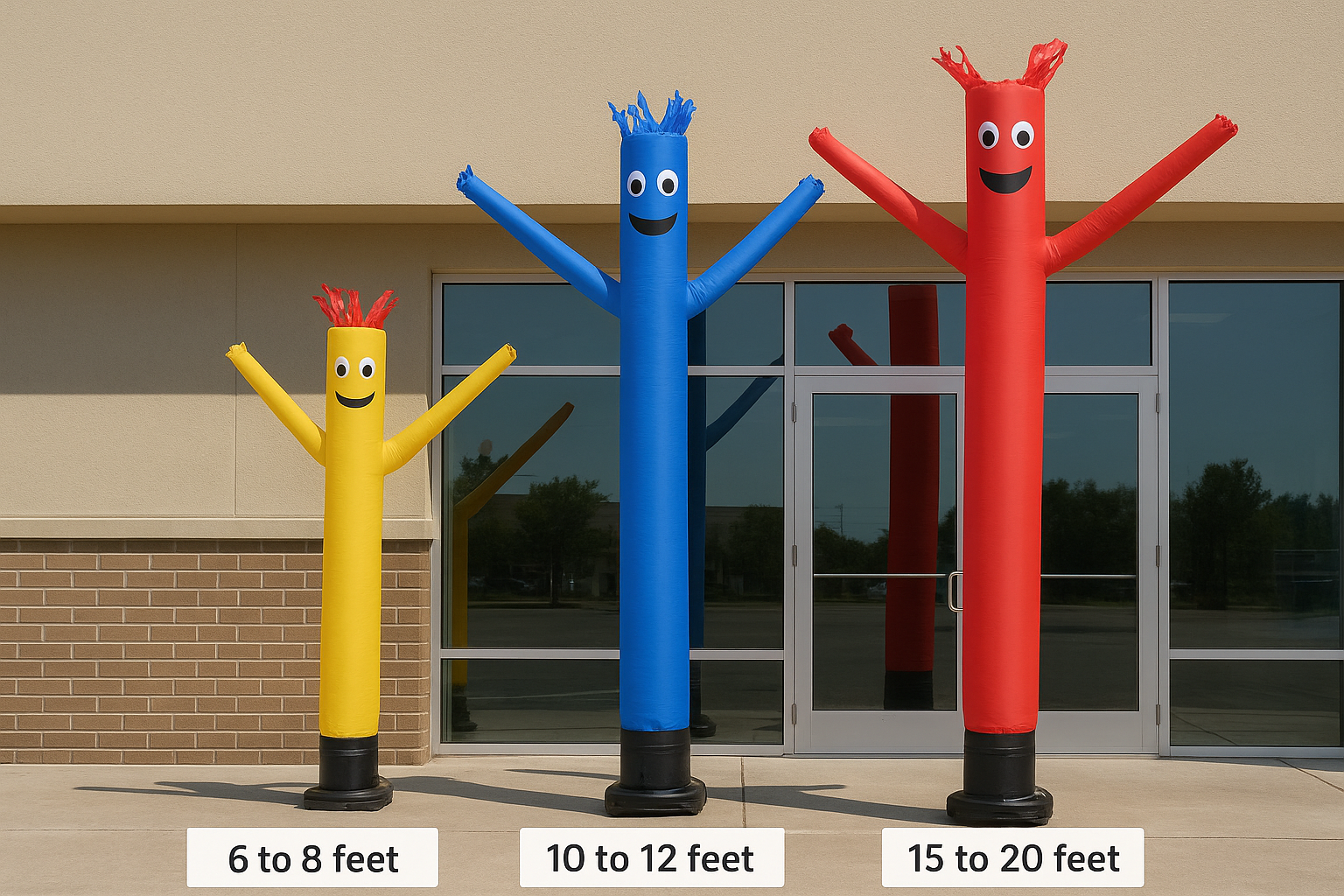
Standard units come in a range of heights to suit different settings. Here’s a practical breakdown:
| Height | Best Use |
|---|---|
| 6 to 8 feet | Indoor events, trade shows, retail interiors |
| 10 to 12 feet | Outdoor storefronts, car lots, strip mall signage |
| 15 to 20 feet | Large venues, stadiums, high-traffic roadside locations |
Taller units require a more powerful fan and may need staking or weighted bases to stay stable in wind. Before selecting a height, factor in your venue’s ceiling clearance for indoor setups, or your local average wind speeds for outdoor installations. A unit that’s too tall for the environment is harder to manage and more likely to underperform.
Styles and configurations
Beyond height, you can choose from several structural variations. Single-tube models are the classic format, built with two arms and a rounded head shape. Wider-body versions create a broader visual footprint and work well for larger venues where a narrow figure might get visually lost. Some models feature printed panels across the body, which turns the entire tube into a branded surface displaying your logo, color scheme, or campaign imagery rather than functioning as a plain solid-color prop.
A printed-body style with your brand’s colors and logo gives you far more advertising value than a standard unit at a similar price point.
Leg attachments are another option, giving the figure a more humanoid appearance. These tend to work well for character-driven brand campaigns or mascot-style activations. You can also find models with adjustable fan speeds for situations where you want visual presence without aggressive movement, such as indoor brand activations or upscale retail environments.
Materials and fabric quality
Most commercial-grade units use ripstop nylon or woven polyester, both of which handle repeated inflation and deflation cycles without tearing at the seams. Lighter fabrics produce faster, more erratic movement, while heavier materials generate slower and more controlled motion. For outdoor use, look specifically for UV-resistant fabric treatments that prevent color fading after extended exposure to direct sunlight. Cheaper units frequently skip this treatment, and the color degradation becomes visible within a single season of regular outdoor use.
How much an inflatable tube man costs
Pricing for an inflatable tube man varies widely based on size, quality, and whether you need custom branding. A basic unit from an online marketplace might run $200, while a commercial-grade custom-printed model from a professional supplier typically falls in the $800 to $1,500+ range. Understanding what drives those numbers helps you compare quotes accurately instead of defaulting to the cheapest option and regretting it before your event.
Standard pricing ranges by tier
The market breaks down into three broad tiers, each serving a different use case and budget.
| Tier | Price Range | What You Get |
|---|---|---|
| Entry-level | $200 | Generic colors, limited height options |
| Mid-range commercial | $250 to $600 | Durable fabric, stronger fan, standard color choices |
| Custom professional | $600 to $1,500+ | Full custom print, premium materials, larger sizes |
Entry-level units work for occasional use, but the fans and seams on cheaper models wear out faster under regular operation. If you plan to run the unit daily or across multiple events per month, a mid-range or professional unit pays for itself through longevity alone.
Buying the cheapest unit available often costs more over time when you factor in replacement costs after a single busy event season.
What drives the price up
Size is the single biggest cost factor after customization. Moving from a 10-foot unit to a 20-foot unit typically adds $200 to $400 to the base price because the fan requirement scales up significantly alongside the larger fabric body. Full-body custom printing adds cost as well, but it also converts the unit from a generic attention-grabber into branded advertising, which changes the value calculation entirely for most marketing budgets.
Shipping weight matters more than most buyers anticipate. Larger units with commercial-grade fans are heavier, and if you’re ordering from outside your region, shipping costs can add $50 to $150 or more to your total. Always request a shipping estimate before finalizing your order, especially for units above 15 feet.
Rental vs. purchase of an Inflatable Tube Man
Renting a unit for a single event typically runs $150 to $400 per day depending on your market, which makes sense if you only need one for a weekend promotion. For ongoing brand use across multiple events or a permanent storefront installation, purchasing outright is almost always the more cost-effective path within the first few uses. Run the numbers based on your event frequency before committing to either option.
Custom options and ordering timeline for the Inflatable Tube Man
When you order a custom inflatable tube man from a professional supplier, you’re not just choosing a color from a dropdown menu. Full customization typically covers fabric color, printed graphics, logo placement, body shape, and height, giving you a unit that functions as a direct extension of your brand rather than a generic prop. That level of control is what separates a professional supplier from a marketplace listing, and it directly affects how useful the product is at your event or storefront.
What you can customize on the Inflatable Tube Man
Most professional suppliers work from your existing brand assets, meaning you provide your logo files, brand color codes, and any campaign graphics, and their design team maps those onto the unit before production begins. Printed panels across the body are the most common customization request, and they let you display a logo, slogan, or promotional message on a surface that’s constantly moving and pulling attention. Color matching to your brand’s Pantone or CMYK specs is standard at most reputable suppliers and does not typically carry an additional charge beyond the base custom print cost.
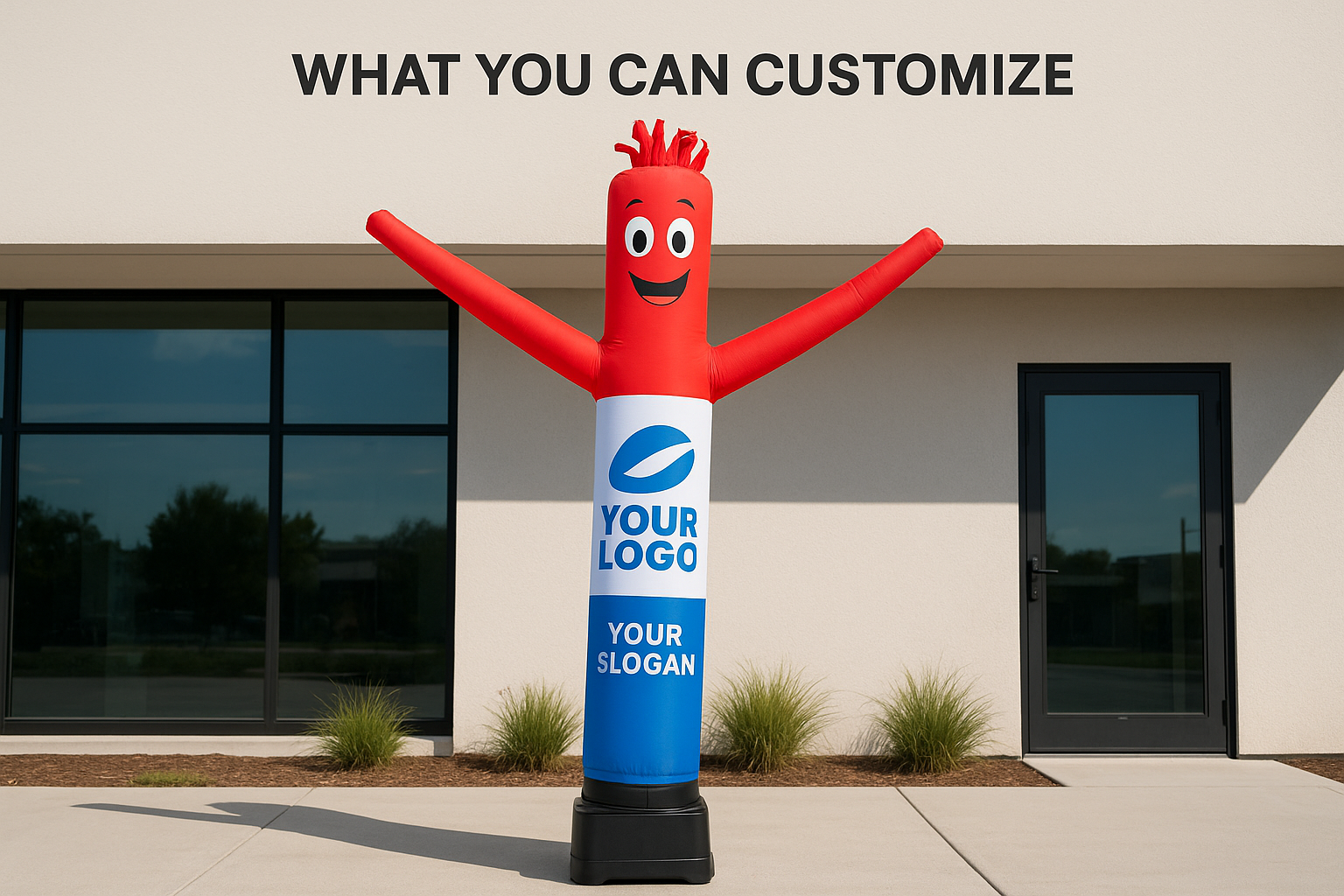
Beyond graphics, you can often request structural customizations like leg attachments, specific arm angles, or wider body configurations to match a mascot or character design. If you have an existing brand mascot, a skilled supplier can translate that character into a full inflatable format that reinforces your brand identity at live events.
Custom units require print-ready artwork files. Sending low-resolution images delays production, so confirm file specifications with your supplier before you finalize the order.
Production and shipping timelines for the Inflatable Tube Man
Standard production time for a custom-printed unit runs between 3-5 weeks from the point when you approve the final design proof. Rush orders are available at most professional suppliers but typically add 20 to 40 percent to the base cost, so building lead time into your event planning calendar saves you money. If your event has a fixed date, work backward from that date and place your order at least four to six weeks out to give production and shipping enough room.
Shipping timelines vary based on your location and the supplier’s production facility. Domestic orders within the United States typically arrive within five to seven business days after production completes. International shipments to the Caribbean or Latin America may require an additional one to two weeks depending on customs clearance. Always request a tracking number and confirm delivery estimates well before your event date.
How to choose, set up, and maintain the Inflatable Tube Man
Picking the right inflatable tube man comes down to matching the product to your specific environment and goals. A unit that performs well at a rooftop event will behave differently than one placed on a windy sidewalk or inside a convention center. Taking stock of your location, power access, and branding requirements before you contact a supplier saves time on both ends and helps you land on the right spec the first time.
Choosing the right Inflatable Tube Man unit for your situation
Start with height and location. Indoor environments with standard ceiling heights cap out around 8 feet, so confirm your clearance before requesting anything taller. For outdoor roadside placement, a 12- to 15-foot unit offers strong visibility without the stability challenges that come with very large models in gusty conditions. Wind-exposed locations genuinely benefit from a wider-base or staked setup, so factor in your local weather patterns when selecting a model.
Match the style to your campaign as well. If you need the unit to carry branding and function as part of a larger marketing push, a printed-body model with your logo and brand colors will outperform a plain single-color version every time. For a one-time promotional event, a standard commercial unit may cover your needs without the added cost of full custom printing.
Setting the Inflatable Tube Man Up correctly
Setup for most units takes under 15 minutes once you’ve done it once. Lay the fabric body flat, connect the base to the fan housing, and secure the base using the included stakes or sandbags before powering on. Never run the fan without first checking that the air intake is clear of debris, as blockages can overheat the motor and shorten the fan’s lifespan significantly.
Always test the unit at least 24 hours before your event so you have time to address any issues without pressure.
For outdoor installations, anchor the base firmly regardless of current wind conditions since conditions can shift quickly during an event. For indoor setups, weighted bases work better than stakes on hard flooring.
Keeping the Inflatable Tube Man in good condition
After each use, run the fan for a few extra minutes to dry out any moisture inside the fabric before packing it away. Folding damp fabric and storing it sealed leads to mildew and fabric degradation faster than almost any other cause of early unit failure. Store the fabric loosely in its carry bag rather than forcing tight folds, which stress the seams over time. Inspect the fan intake and seams briefly before each use, and address small tears with fabric repair tape immediately before they spread.
Next steps
You now have a complete picture of what an inflatable tube man is, what it costs, how customization works, and what it takes to run one reliably. The next move is straightforward: figure out your height requirement, confirm your power access, and decide whether you need custom branding or a standard commercial unit. Those three decisions will define your order specs and give any supplier the information they need to put together an accurate quote.
TMP Inflatables has been building custom inflatables for marketing teams, agencies, and event organizers across North America, the Caribbean, and Latin America since 2004. Whether you need a single branded unit for a grand opening or a set of air dancers for a larger event rollout, the process starts with a conversation. Request a custom inflatable quote and a member of our team will follow up directly with pricing and timeline details specific to your project.