

Planning an event that people actually remember takes more than good food and a playlist. Inflatables for events, from bounce houses and giant slides to branded arches and interactive obstacle courses, give organizers a proven way to draw crowds and keep them engaged for hours.
But not all inflatables for events serve the same purpose. Some are built purely for entertainment, while others double as high-visibility marketing tools that put your brand front and center. Knowing the difference matters, especially when you’re working with a budget and a deadline. At TMP Inflatables, we’ve spent over 20 years designing and producing inflatables for events for agencies, event planners, and brands across North America, so we’ve seen firsthand what works and what falls flat (literally).
This article breaks down seven types of inflatables for events worth considering, from classic bounce house rentals to promotional structures that do serious brand work. Whether you’re organizing a neighborhood festival or a corporate activation, you’ll find options here that fit.
1. Custom branded inflatables for events
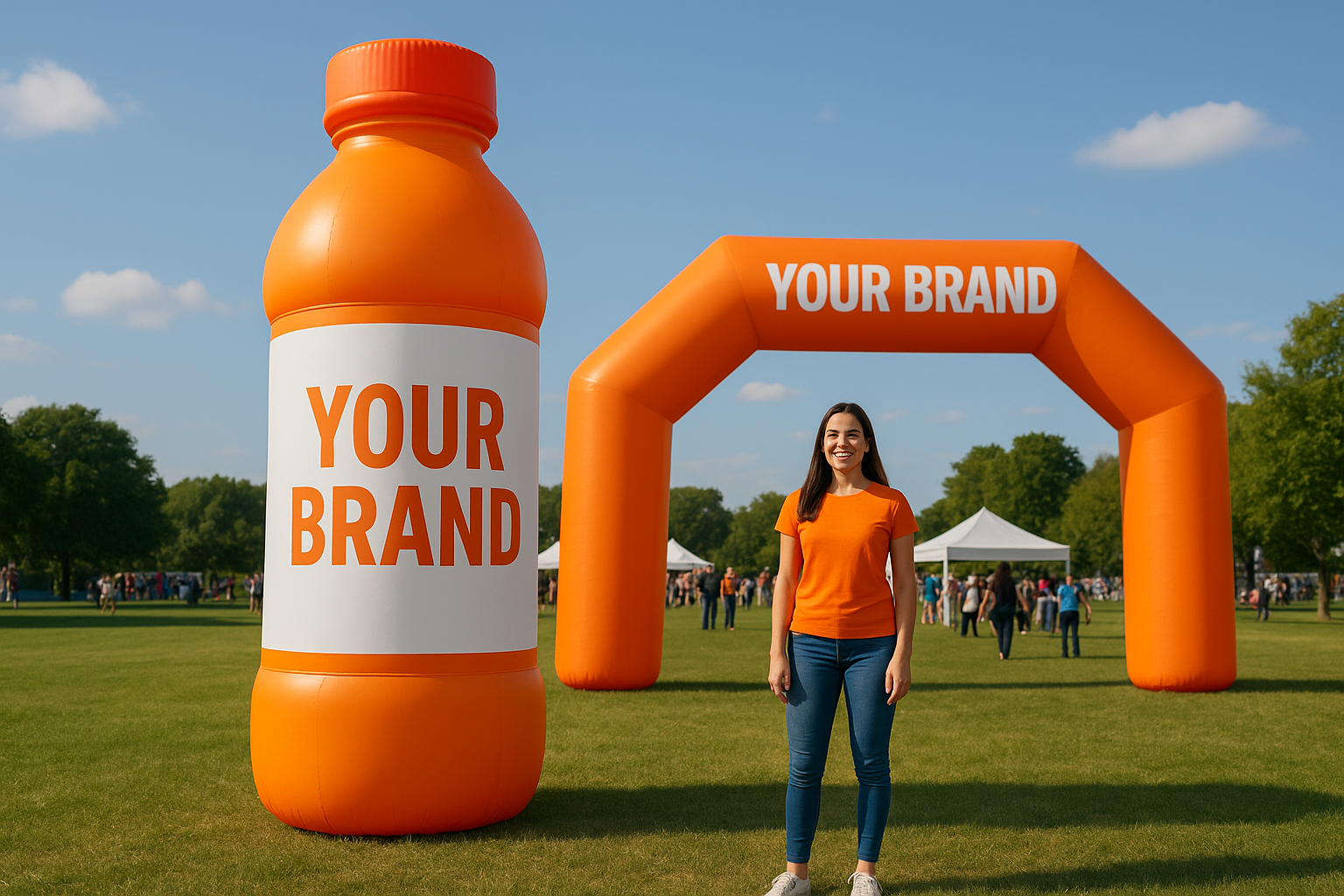
Custom branded inflatables for events give your brand three-dimensional visibility at events that flat signage simply cannot match. Unlike rental units you share with other clients, a custom-built inflatable carries your logo, colors, and messaging exclusively, turning every square foot into a brand impression that competitors cannot replicate at the same venue.
What you can build and brand
The range here goes well beyond slapping a logo on a bounce house. You can build giant product replicas, branded archways, inflatable tents, mascot costumes, and towering air dancers, all with full custom printing. Material choices range from PVC tarpaulin for large outdoor structures to lighter nylon for wearable costumes.
- Giant product and packaging replicas (bottles, cans, branded characters)
- Inflatable arches and branded entrance tunnels
- Custom tents and domed structures
- Air dancers and tube men with logo panels
- Walkable inflatable mascot costumes
Best event uses
Custom inflatables for events perform best at product launches, trade shows, and outdoor festivals where you need instant brand recognition from a distance. Sports sponsorships and retail grand openings also benefit from large-format branded structures that naturally attract foot traffic and double as photo opportunities for guests.
Inflatables for Events Production and logistics timeline
Most producers require two to three weeks for design and sampling, followed by another two to three weeks for production. Rush timelines are available but cost more. Factor in shipping lead times as well, especially for international events, since freight for large inflatables typically moves by air or sea freight rather than standard courier.
Plan for at least four to six weeks from design approval to delivery for most custom inflatables.
Budget ranges and what drives cost
Custom branded inflatables range from roughly $2600 for a small branded arch up to $20,000 or more for a large structure or full mascot costume. The main cost drivers are size, design complexity, material grade and print resolution, quantity ordered, and whether you need rush production.
What to ask a custom inflatable partner
Before committing to a quote, confirm your supplier’s production capacity and sample review process. Ask to see previous work in a similar industry, request a physical or digital prototype before full production runs, and clarify who owns the design files after delivery so you can reorder or modify without starting from zero.
2. Bounce house rentals
Bounce houses are the most recognized inflatables for events on the market, and for good reason. They require minimal setup time, fit most outdoor venues, and keep younger guests occupied for extended periods without requiring staff to run structured activities.
Why bounce houses stay popular
Bounce houses succeed because they are universally understood and immediately appealing to children. Parents recognize them instantly, which removes the friction of explaining what the attraction is. Rental companies carry them in abundance, making availability and pricing more competitive than most other inflatable options.
A standard bounce house typically holds six to eight children at a time, making throughput easy to manage without dedicated supervision staff.
Best event uses
Birthday parties, school and community festivals, church carnivals, and family fun days are the strongest fits. Corporate family days also benefit from a bounce house when attendees are bringing children, since it gives parents a clear drop-off point while they engage with other activities.
Inflatables for Events Space, power, and surface requirements
Most standard bounce houses need a flat area of roughly 15 by 15 feet, though larger units require more. You will need a standard 110V outlet within 100 feet or a generator. Grass and hard, level surfaces both work, but gravel and slopes create anchoring and safety issues.
Typical rental pricing and add-ons
Rentals typically run $500-$1,000 for a day, depending on size and your region. Common add-ons include delivery and setup, extended rental hours, and themed artwork panels.
Safety and supervision checklist
- Limit occupancy to the unit’s rated capacity
- Remove shoes, glasses, and sharp objects before entry
- Assign at least one adult supervisor to monitor the entrance
- Stake or sandbag all anchor points before use
- Check the blower connection every 30 minutes during the event
3. Bounce house slide combo rentals
Combo units combine a bounce chamber and an attached slide into a single rental, giving you more activity per square foot than two separate units would. They are popular inflatables for events where space is limited but you still want multiple points of engagement for kids.
What makes combos different
A combo unit integrates bouncing, climbing, and sliding into one enclosed structure, so kids move through a natural progression rather than bouncing in place indefinitely. This reduces crowding inside the bounce section and gives each child a clear exit path through the slide, which keeps the line moving.
Unlike a standalone bounce house, a combo unit holds attention longer per child because the activity cycle has a defined beginning and end.
Best event uses
School carnivals, birthday parties, and family festivals are the strongest matches for combo rentals. They also work well for corporate family days where organizers want one unit that keeps children occupied longer than a basic bounce house would on its own.
Space, power, and water hookup needs
Most combos need a flat footprint of at least 15 by 20 feet. Dry combos require only a standard 110V outlet or generator within 100 feet, while wet combo slides add a garden hose connection and a clear drainage path away from the unit.
Confirm with your venue that water use is permitted before booking a wet combo.
Typical rental pricing and add-ons
Inflatables for events dry combos typically rent for $500-$1,000. Wet combos usually run $1,000-$2,000, with additional charges for delivery, extended hours, and setup.
Safety and throughput tips
- Allow one child on the slide ladder at a time
- Cap the bounce chamber at six to eight occupants
- Post a supervisor at both the entrance and slide exit
- Check anchor points and the blower connection every 30 minutes
4. Inflatable water slide rentals
Inflatable water slides are among the most popular inflatables for events held during summer months. They deliver a higher level of excitement than a standard bounce house and give guests an activity with a clear payoff at the end of each run.
Water slide types to know
Rentals generally fall into three categories: single-lane slides, dual-lane racing slides, and pool slides that deposit riders into a small inflatable splash pool at the base. Dual-lane units let two riders compete side by side, which naturally draws a crowd and keeps the line moving faster.
Best event uses
Water slides perform best at outdoor summer festivals, school field days, and community block parties. Corporate picnics and neighborhood association events are also strong fits, since the slide becomes a natural gathering point for both participants and spectators.
Space, water, drainage, and power needs
Most water slides require a flat grass area between 20 and 40 feet long, depending on height. You will need a garden hose connection with steady water pressure and a standard 110V outlet or generator to run the blower. Plan a clear drainage path so pooling water does not create a slip hazard around the base.
Avoid setting up on slopes or near gravel, as uneven ground affects anchoring and drainage significantly.
Safety rules for wet inflatables
- No running on the approach or landing area
- Allow one rider at a time on the slide lane
- Post a supervisor at both the top platform and the base exit
- Check all anchor stakes and the blower connection every 30 minutes
5. Inflatable obstacle course rentals
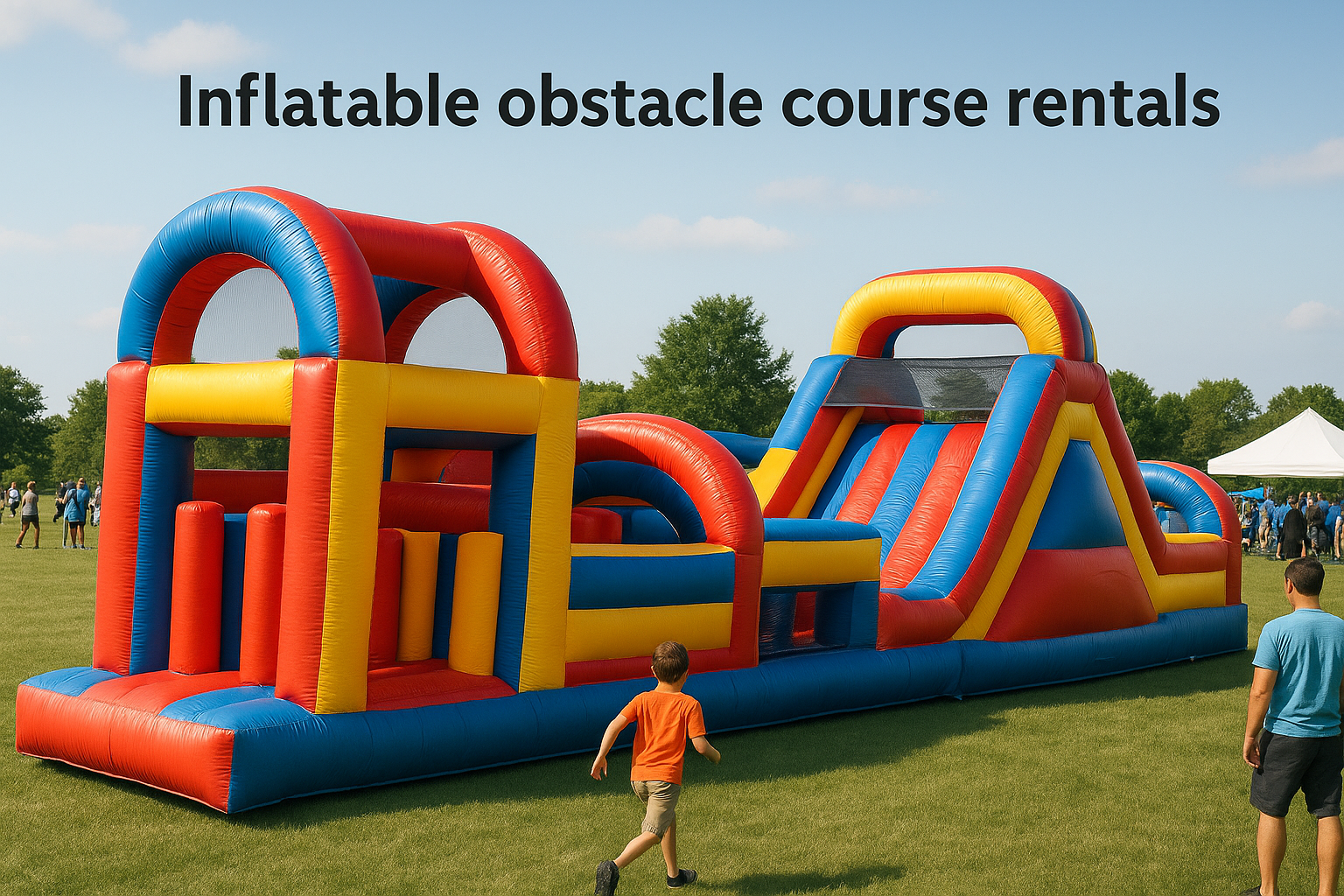
Obstacle courses add competitive energy to events that bounce houses and slides simply cannot match. Participants race through tunnels, climb walls, and crawl under barriers, making them one of the most engaging inflatables for events across mixed age groups.
Common obstacle course formats
Courses come in linear and dual-lane formats. Linear units send one participant through at a time, while dual-lane versions let two people race side by side, which draws spectators and creates natural crowd moments. Lengths typically run 20 to 80 feet, with longer units incorporating more obstacles and extended run times per participant.
Best event uses
Corporate team-building days, school field days, and large outdoor festivals are the strongest fits. Company picnics where staff compete in groups also work well, since the format supports bracket-style competitions that sustain engagement across several hours without requiring additional entertainment.
Layout planning and staffing needs
Most courses require a flat footprint of 30 to 80 feet depending on unit length. Plan for at least 10 feet of clear space on each side for crowd management. You will need one attendant at the entrance to pace participants and another at the exit to keep the lane clear between runs.
Assign a dedicated timer or scorekeeper if you are running timed competitions, since it noticeably improves the participant experience.
Safety and crowd-flow tips
- Remove shoes and loose jewelry before entry
- Allow one participant per lane at a time
- Keep spectators at least five feet from the unit walls
- Check anchor points and the blower connection every 30 minutes
6. Interactive inflatable game rentals
Interactive inflatable games shift the focus from passive rides to direct participation, making them one of the most versatile inflatables for events where guests actively compete rather than wait in line. Options range from bungee runs and jousting platforms to climbing walls and inflatable boxing rings.
Popular interactive inflatable options
Interactive rentals cover a wide range of game formats that work for both kids and adults:
- Bungee run: two participants race while tethered to bungee cords
- Inflatable jousting: padded poles, two competitors
- Human foosball: team-based court with fixed player positions
- Climbing wall: soft padded walls with grip holds
- Carnival-style target games in inflatable enclosures
Best event uses
Corporate events, college orientation days, and large public festivals get the most out of interactive games. These formats naturally generate spectator crowds around the activity, which amplifies energy across the broader event footprint.
Space, power, and participant limits
Most units need a flat footprint of 15 to 30 feet and a standard 110V power source within 100 feet. Participant limits vary by unit, but most cap at two to four active players at a time, with a supervised waiting line managed by a staff member.
Keep your participant rotation under two minutes per turn to maintain line flow and sustain energy throughout the event.
Typical rental pricing and add-ons
Rentals typically run $300 to $700 for a half-day, depending on unit type and your region. Add-ons include delivery, setup, and supervision staff.
How to run games smoothly
Assign one dedicated attendant per unit to enforce turn limits and manage the line. Running bracket competitions with a visible scoreboard significantly improves engagement and gives guests a clear reason to stay near the unit between turns.
7. Inflatable tents, domes, and arches
Inflatable structures go well beyond entertainment units. Tents, domes, and arches function as genuine event infrastructure, offering branded shelter, entrance framing, and enclosed activation spaces that traditional pole tents cannot match on setup speed or visual impact.
When an inflatable structure beats a pole tent
Pole tents require staking, rigging, and skilled crew to install safely. An inflatable tent or dome deploys in minutes with a blower and a small team, making it the stronger choice when setup windows are tight or venue access is limited.
Best event uses
Branded archways work as event entrances and finish lines for races and marathons. Among inflatables for events, domes suit product launches, trade show activations, and outdoor pop-up spaces that need weather protection and high visibility at the same time.
Site needs, anchoring, and weather limits
You need a flat surface, a continuous power source for the blower, and anchor points suited to your surface, whether stakes for grass or weighted sandbags for hard ground. Most inflatable structures carry a wind rating between 25 and 35 mph, so plan to deflate during storms.
Confirm your venue’s power supply and anchoring options before finalizing your structure rental or purchase.
Branding and permitting considerations
Custom printing on inflatable tents and arches requires lead time, so order at least four weeks ahead. Check with your venue or local authority on permit requirements for temporary inflatable structures, particularly for enclosed domes over a set square footage.
Next steps for planning, booking and buying
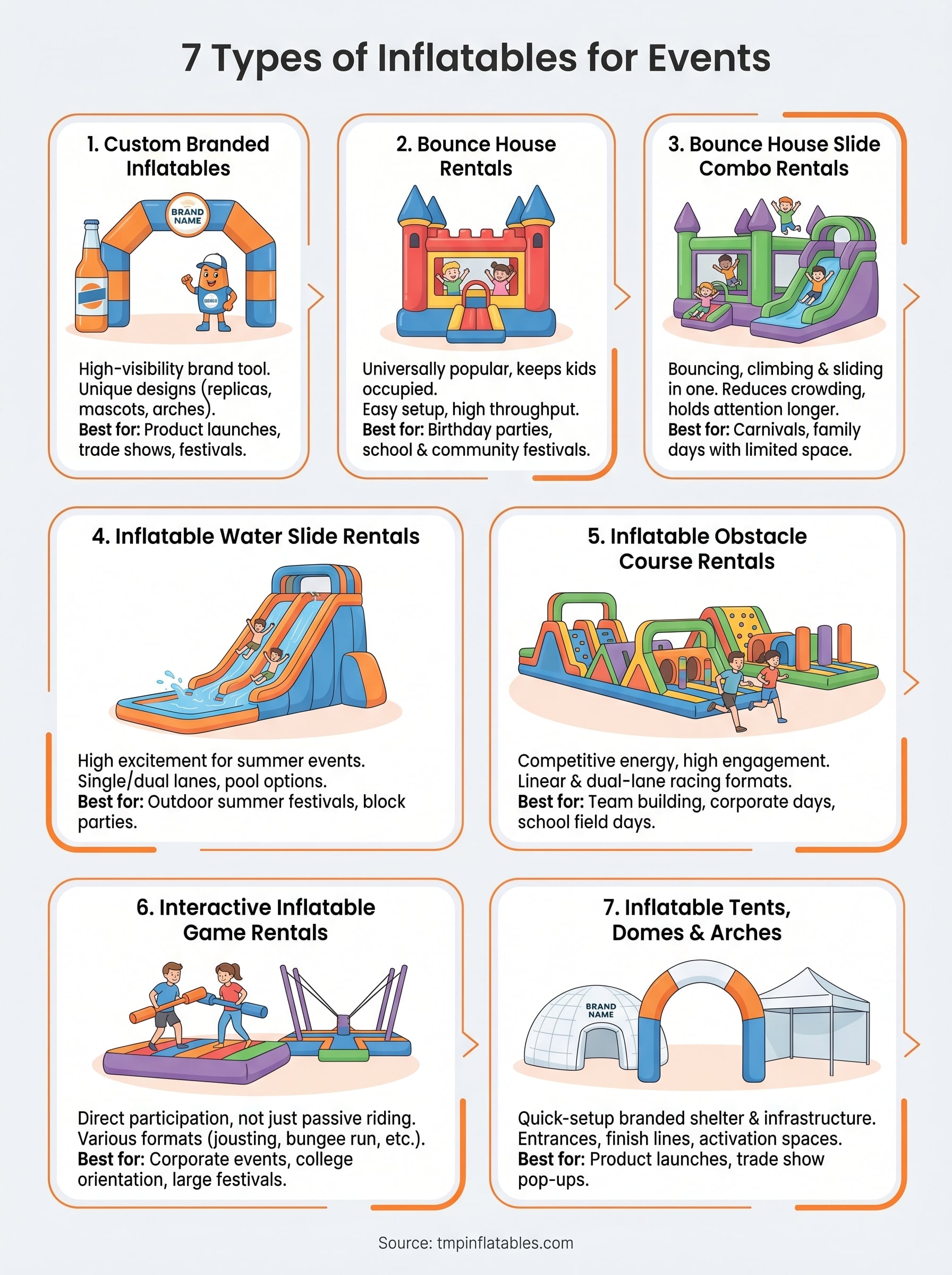
You now have a clear picture of the seven main types of inflatables for events, from rental bounce houses and water slides to custom branded structures built around your marketing goals. The right choice depends on your audience, venue, budget, and whether you need a one-time rental or a reusable asset that pays for itself over multiple activations. If you need assistance in event planning, checkout https://canspep.ca/
Rental units suit events with short lead times and straightforward entertainment needs. Custom inflatables make more sense when brand visibility and long-term ROI matter, particularly if you plan to activate the same structure at three or more events per year. Before you commit, confirm your site dimensions, power access, and any local permit requirements so there are no surprises on event day.
When you are ready to move forward, request a custom inflatable quote and our team will walk you through design options, production timelines, and pricing that fits your budget and schedule.
