

Mascots have been grabbing attention and building loyalty for centuries, from medieval family crests to the giant foam characters patrolling NBA sidelines. Whether it’s a costumed bear firing up a stadium crowd or an oversized inflatable product replica outside a grand opening, mascots do something no billboard or banner ad can: they create an emotional, face-to-face connection between a brand and its audience.
That connection is exactly why mascots remain a go-to strategy for sports teams, universities, corporations, and event organizers alike. A well-designed mascot becomes instantly recognizable, often outlasting the campaigns it was built for. Think of the Phillie Phanatic, the Michelin Man, or Mr. Clean, characters so embedded in culture that they practically market themselves. The psychology behind this isn’t complicated: people remember characters far more easily than slogans.
At TMP Inflatables, we’ve spent over 20 years designing and producing custom inflatable mascots, costumes, and character replicas for brands and agencies across North America. We’ve seen firsthand how the right mascot transforms an event from forgettable to shareable. This article breaks down what mascots actually are, explores the different types you’ll encounter in sports and branding, walks through famous examples, and covers what goes into creating one that works for your specific goals.
Why mascots matter for teams, schools, and brands
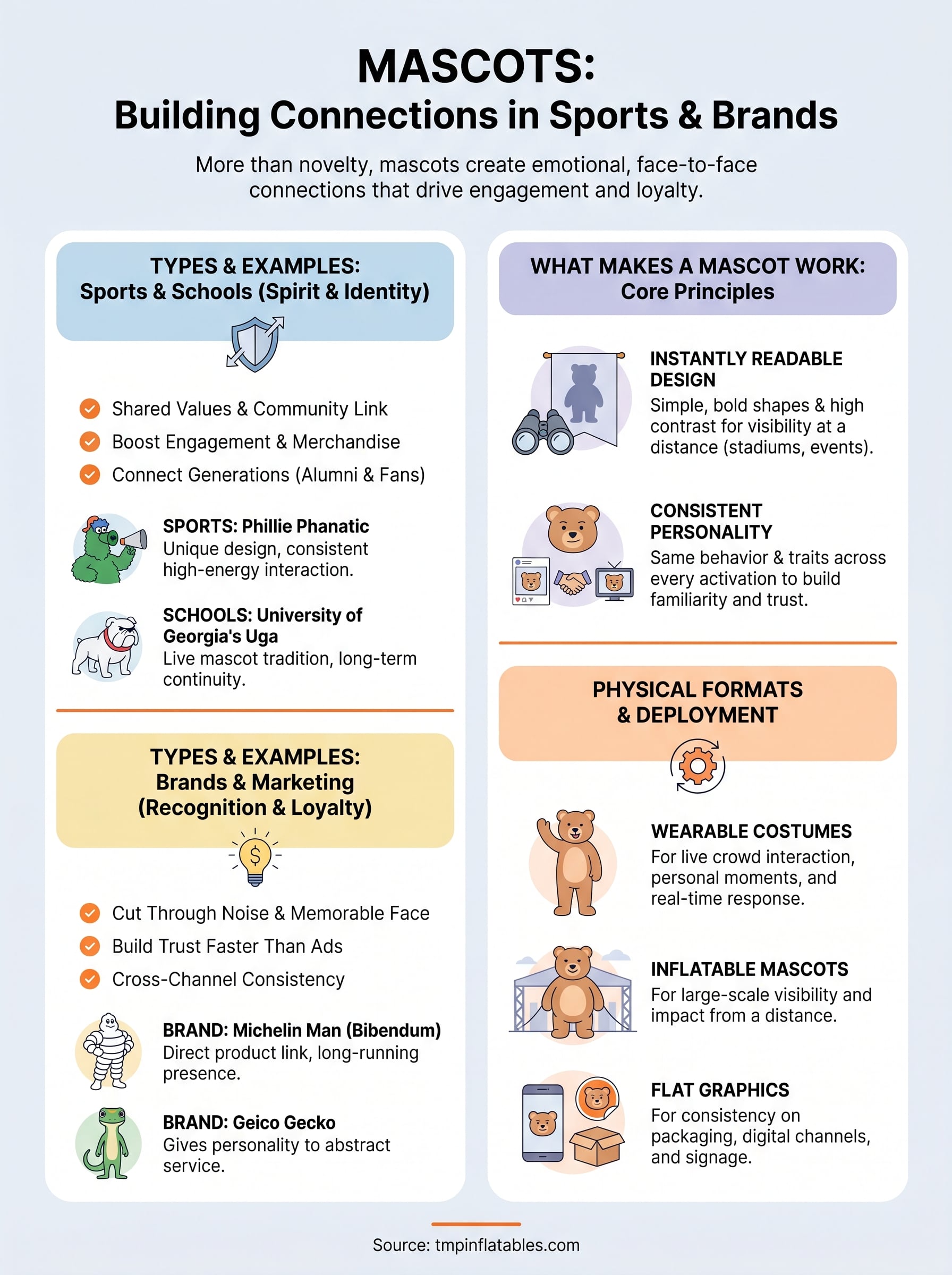
Mascots serve a practical function that goes well beyond novelty. Whether you’re running a sports franchise, managing a university athletics program, or marketing a consumer brand, a well-executed mascot creates a focal point that unifies your audience around a shared identity. People don’t just recognize a mascot; they feel something when they see it, and that emotional pull is one of the most valuable things any marketing asset can produce.
The role mascots play in team and school identity
For sports teams and schools, mascots carry enormous weight. They represent a shared set of values that players, students, fans, and alumni all connect with. When a team takes the field with a mascot leading the charge, that character becomes a physical expression of the team’s spirit. Fans cheer louder, students feel a stronger sense of belonging, and the overall energy in the space shifts in a measurable way.
A mascot isn’t just a symbol on a jersey. It’s a living, moving representation of what your team or school stands for, and that presence makes a real difference in how engaged your audience becomes.
Strong brand symbols, including mascots, are consistently linked to higher group cohesion and community engagement. For schools in particular, a recognizable mascot can drive alumni donations, boost merchandise sales, and create a visible thread connecting generations of students. The mascot becomes the face of the institution, something that persists even as coaches, athletes, and administrators cycle through over the years. When a former student sees that character decades later, the emotional response is immediate, and that’s the kind of loyalty money can’t buy through traditional advertising alone.
How brands use mascots to drive recognition and loyalty
For companies, mascots solve a real and recurring marketing problem: how do you make your brand memorable in a market flooded with competing messages? A character cuts through the noise in a way that a logo or tagline alone rarely does. The Geico Gecko, Tony the Tiger, and the Pillsbury Doughboy didn’t become cultural fixtures by accident. Each was built to give the brand a human, relatable face that consumers could form a genuine connection with.
When your brand has a mascot, you give your audience something to build a relationship with over time. Consumer trust grows faster through character-based engagement than through traditional advertising. People can remain skeptical of claims made in an ad, but they develop real affection for a well-crafted character, and that affection carries directly over to the brand itself.
Mascots also function across every channel and format without losing impact. The same character that appears on your product packaging can show up at a trade show, in an experiential marketing activation, at a grand opening, or at a stadium event. That consistency across touchpoints reinforces recognition and makes your brand feel cohesive rather than fragmented across campaigns. When you invest in a mascot, you’re not acquiring a single-use campaign asset. You’re building a long-term brand property that compounds in value the more your audience encounters it, and that’s a return most marketing tactics simply can’t match over a 10 or 20-year horizon.
What makes a mascot work in the real world
Not every mascot succeeds. Plenty of characters get designed, produced, and deployed only to fade out within a season or two without leaving any real impression. The difference between a mascot that sticks and one that disappears comes down to a few core design principles that hold true across sports, schools, and brands alike. Understanding these principles before you commit to a character will save you time, budget, and a lot of missed opportunities.
A design that reads instantly at a distance
Your mascot needs to work in the worst viewing conditions: a packed stadium, a crowded trade show floor, or a busy street activation. Simple, bold shapes with high-contrast colors will always outperform intricate, detailed designs in those environments. The Phillie Phanatic works from the upper deck because its silhouette is completely unique. If your mascot requires a close look to understand what it is, it will fail in exactly the situations where you need it most.
A mascot that doesn’t read clearly at 50 feet is a mascot that most of your audience will never actually connect with.
Consider how the character looks when it’s scaled up for an inflatable, printed on a banner, or worn as a costume. Testing your design across multiple formats before finalizing it will catch problems early and keep your production costs from escalating.
A personality that stays consistent across every activation
Mascots build recognition through repetition, but repetition only compounds if the character behaves the same way every time your audience encounters it. That means defining a clear personality, a specific set of traits and behaviors, and sticking to them whether the mascot appears in a social post, a stadium walkthrough, or a live brand activation.
Inconsistent character behavior confuses audiences and erodes the emotional connection you’re working to build. When fans or customers encounter your mascot in different contexts and it feels like the same character each time, their trust in the brand deepens alongside their familiarity with the character itself.
Types of mascots and common formats
Mascots come in a wide range of forms, and understanding the different categories helps you make a smarter decision when you’re building one for your team, school, or brand. The character type you choose shapes how your audience relates to it, while the physical format you deploy determines where and how effectively it shows up in the real world. Both decisions carry real consequences for your budget, your audience’s response, and the long-term versatility of the asset.
Animal and creature mascots
Animals are the most common mascot category across sports and schools, and for good reason. Animal characters translate quickly because people already have built-in associations with specific traits: a bear reads as powerful, a fox reads as clever, a hawk reads as fast. Your audience processes those associations instantly, which cuts down the work your mascot has to do on its own to communicate personality. Many brands also use animals for exactly this reason, since the character can carry meaning without requiring a complex backstory.
The most effective animal mascots don’t just borrow from animal stereotypes; they push those traits in a specific direction that matches what the team or brand actually wants to communicate.
Human and fantasy character mascots
Human-shaped mascots, or fantasy figures with humanoid features, give you more flexibility in expressing specific behaviors and emotions during live events. A character that walks, gestures, and interacts in a recognizable human way tends to connect with children and adults in more direct ways than a strictly animal character. Many brand mascots in this category, like a chef, an athlete, or a stylized hero figure, let you embed product-relevant storytelling directly into the character’s design.
Physical formats: costumes, inflatables, and flat graphics
The same mascot character can be deployed across multiple formats depending on your event type and environment. Wearable costumes work well for crowd interaction, live events, and sports venues where a performer can move and engage in real time. Inflatable versions scale up dramatically for outdoor events, storefronts, and trade show floors where you need visibility from a distance without a performer inside. Flat graphic versions, used on signage, packaging, and digital channels, keep your character consistent across every touchpoint where a physical format isn’t practical.
Mascot examples in sports and schools
Looking at real-world examples gives you a clearer sense of what separates a mascot that builds lasting equity from one that gets retired quietly after a few seasons. Across professional sports and higher education, the strongest mascots share common traits: immediate recognizability, a personality that works across live events and media, and a design that scales well in any format.
Sports team mascots that set the standard
The Phillie Phanatic of the Philadelphia Phillies stands as one of the most studied examples in professional sports. Introduced in 1978, the character has an intentionally absurd look: green, rotund, and impossible to confuse with any other sports mascot in existence. Its success comes not just from the design but from the consistent physical energy performers bring to every game. The Phanatic interacts with fans, taunts opposing players, and creates moments that travel far beyond the stadium through news coverage and replay clips.
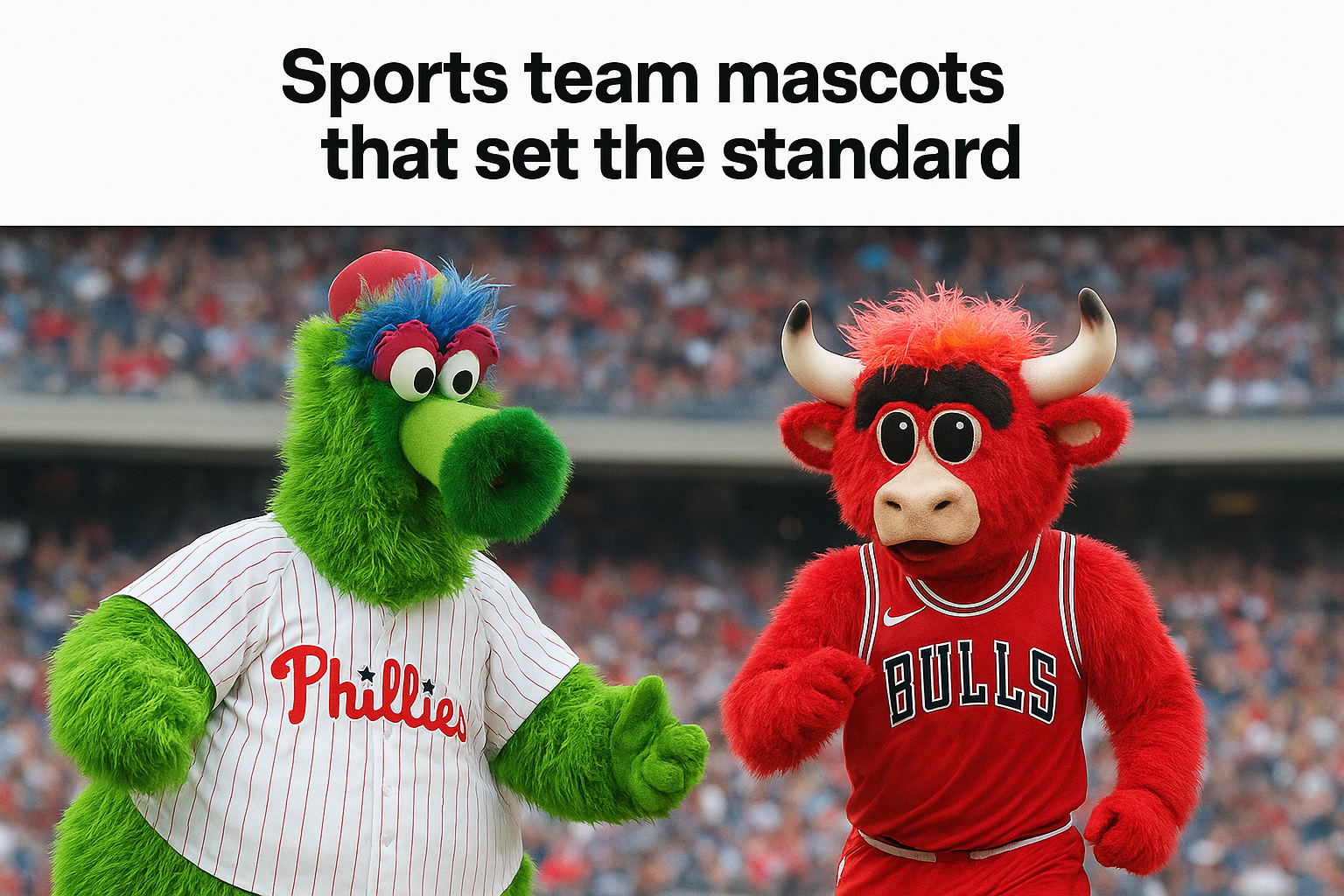
The Phanatic generates more earned media per appearance than most paid advertising campaigns could justify, and that effect compounds every season the character stays active.
Benny the Bull of the Chicago Bulls follows a similar pattern. The character has appeared at nearly every Bulls home game since 1969 and built a reputation across the NBA as one of the most entertaining in-game performers in professional basketball. The physical costume format lets a skilled performer drive direct crowd engagement in ways no signage or digital asset can replicate.
School and university mascots
University mascots carry the additional responsibility of representing a community that spans current students, alumni, faculty, and local supporters across decades. The University of Georgia’s Uga, a live English Bulldog, creates an entirely different kind of presence than a costumed character, one rooted in tradition and continuity. The University of Texas Longhorns’ Bevo works the same way, turning the mascot itself into an event that fans plan their experience around.
Costumed university mascots like Penn State’s Nittany Lion or Michigan State’s Sparty show how a well-designed character can become the primary visual symbol of an institution, often appearing more frequently in media coverage than the university’s official seal or wordmark.
Mascot examples in brands and marketing
Brand mascots operate under different conditions than sports characters. Instead of a home stadium filled with loyal fans, a brand mascot has to perform across packaging, advertising, digital content, and live events simultaneously. The strongest examples in marketing history show how a single character, when built and managed well, can carry a brand through decades of shifting consumer preferences without losing relevance.
Brand mascots built for long-term recognition
The Michelin Man (Bibendum) has represented Michelin since 1898, making it one of the longest-running brand mascots in recorded marketing history. What makes the character work is how directly it connects to the product: a figure built from stacked tires communicates the core product in a single glance. That immediate product relevance is a principle every brand mascot should aim for. When your character communicates what you do before a single word is read, you’ve eliminated a significant barrier between your brand and your audience.
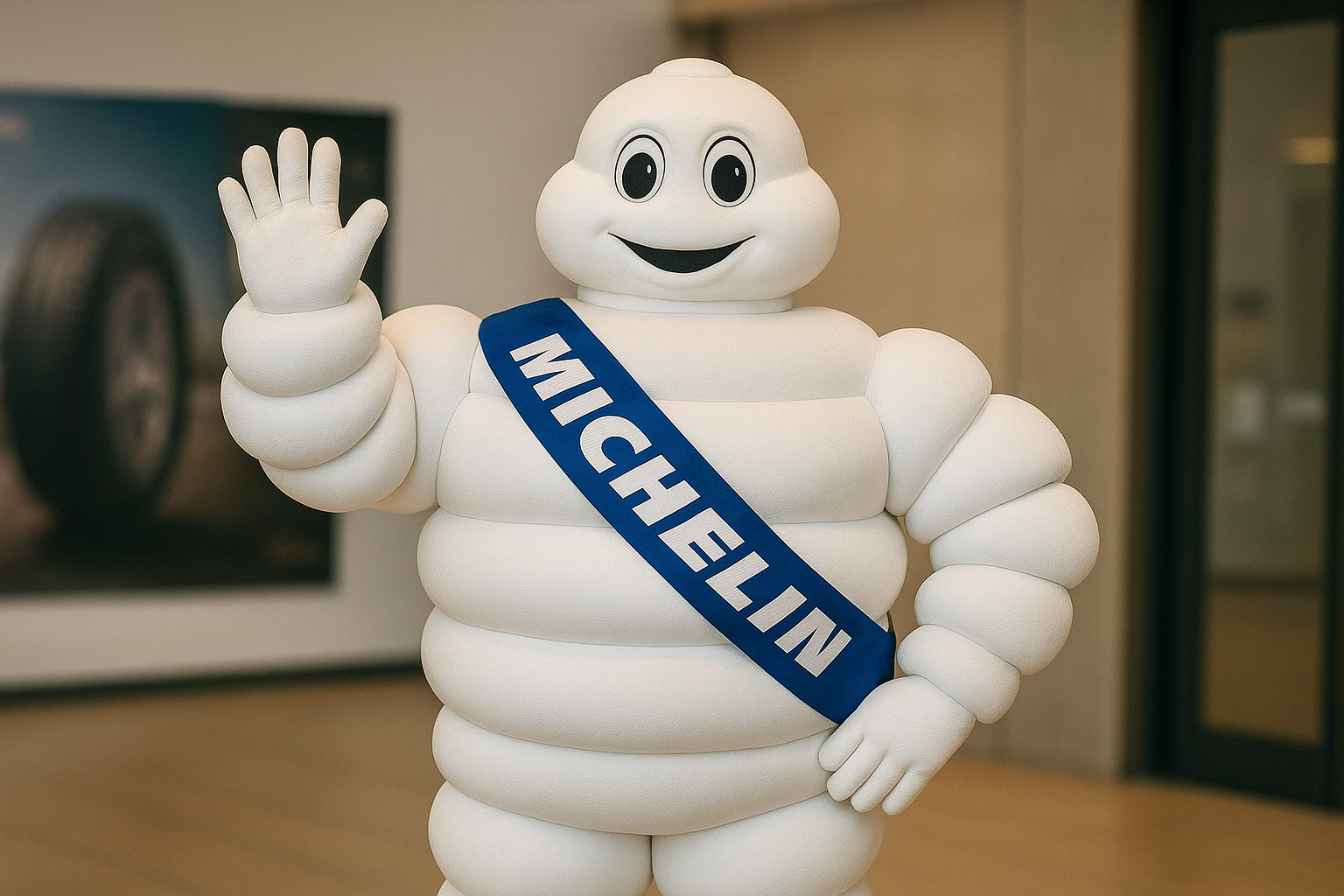
Tony the Tiger, introduced in 1952, remains one of the most recognized brand mascots globally precisely because the character’s energy and personality map directly onto how Kellogg’s wants consumers to feel about Frosted Flakes.
The Geico Gecko follows a different logic. The character doesn’t represent the product literally; instead, it gives a personality to an abstract service category, auto insurance, that otherwise offers almost no visual identity to work with. When your product or service is difficult to depict visually, a mascot gives your brand a tangible, relatable presence that consumers can form an attachment to regardless of what you’re selling.
How mascots move across marketing channels
Brand mascots translate across every format in a marketing mix in ways that few other creative assets can match. The same character that appears on a product label can show up in a television spot, a social media campaign, a trade show display, and a live event activation without losing its effect. That cross-channel consistency compounds your audience’s recognition over time.
Physical activations like inflatable versions or costumed appearances bring brand mascots into spaces where traditional advertising has no reach, directly in front of your audience at the moment they’re most engaged.
Mascot costumes and inflatable mascots for events
When you’re planning a live event, the physical format of your mascot determines how much impact it actually delivers. Wearable costumes and inflatable versions serve different purposes, and choosing the right one, or combining both, comes down to the specific environment you’re working in and how directly you want your audience to engage with the character.
Wearable costumes for crowd interaction
A performer inside a costume can do something no static display can replicate: respond in real time to the crowd in front of them. At sports events, trade shows, grand openings, and retail activations, a costumed mascot moves through the space, interacts with attendees, and creates individual moments that people photograph, share, and talk about long after the day ends. That kind of direct human engagement is where costumed mascots generate their highest return.
The personal interaction a costumed mascot creates in a live setting is the kind of marketing moment your audience will recall long after the event ends.
Your costume also needs to hold up under real event conditions. Durability and performer comfort matter as much as the visual design, since a performer who can’t move freely or manage heat inside a costume won’t deliver the energy that makes the character work. Investing in a well-built custom costume from the start protects both your performer and your brand’s on-site reputation.
Inflatable mascots for large-scale visibility
Inflatable mascots solve a completely different problem: getting your character seen from a distance when a performer inside a costume simply can’t fill the space. A large-format inflatable version of your mascot positioned at a venue entrance, a trade show booth, or an outdoor activation creates immediate visual impact that pulls in your audience before they’ve even reached your brand’s footprint.
Inflatables also function as standalone displays when you don’t have a performer available. You can deploy them across multiple locations at the same time, something a costumed character can never do. For brands coordinating multiple activations on the same weekend, inflatable mascots deliver consistent visual presence across every location without the complexity of managing several performer teams simultaneously.
Final thoughts
Mascots do more than fill space at events or decorate a product label. When you build a character with a clear design, a consistent personality, and the right physical format for your environment, you create a brand asset that keeps delivering long after your initial campaign wraps up. The examples across sports, universities, and major consumer brands all point to the same conclusion: the strongest mascots outlast the strategies that introduced them because they form genuine emotional connections with the audiences they serve.
Whether you need a wearable costume for crowd interaction or a large-format inflatable for maximum outdoor visibility, the format you choose shapes how effectively your character performs in the real world. Both solve real problems, and both require smart design and quality production to work. If you’re ready to bring your character to life, request a custom inflatable mascot quote and our team will walk you through the process from concept to delivery.
