

Every custom inflatable we build at TMP Inflatables starts the same way: someone has an idea, and that idea needs to become a real, physical product. A branded arch for a marathon. A 20-foot product replica for a trade show. A misting tent for a summer activation. Getting from “here’s what we want” to “here it is, ready to ship” is product development in action, and after more than 20 years of doing exactly this, we’ve learned a thing or two about what makes the process work (and what makes it fall apart).
But product development isn’t exclusive to inflatables or promotional products. It’s the structured process any company uses to take a concept and turn it into something customers can buy, whether that’s a physical item, a digital tool, or a service. It involves research, design, prototyping, testing, and launch, each stage with its own set of decisions that shape the final result. Understanding how these stages connect gives you a serious advantage when planning your next product, regardless of your industry.
This article breaks down what product development actually means, walks through the core stages from ideation to market launch, and covers the most widely used frameworks that teams rely on to stay organized and move efficiently. We’ll also look at strategies that help reduce risk, speed up timelines, and improve your odds of building something people actually want.
Why product development matters
Most companies don’t fail because they lack ideas. They fail because they turn ideas into products without a structured process to validate whether those ideas are worth building in the first place. Product development gives you that structure. It forces you to ask the right questions early, when changes are cheap, rather than late, when changes cost real money and time. Whether you’re launching a consumer packaged good or a custom inflatable for a brand activation, the same fundamental question applies: does this product solve a real problem, and can you build it well enough to compete?
The companies that consistently bring winning products to market aren’t luckier than their competitors. They just have better processes.
It drives revenue and competitive advantage
New products are one of the most direct levers a business can pull to grow revenue. When you develop a product that solves a problem better than what already exists, you earn customers who weren’t yours before. You also give existing customers a reason to stay and spend more. Research from McKinsey shows that companies in the top quartile of product development performance generate twice the revenue growth from new products compared to their industry peers. That gap doesn’t come from spending more on R&D. It comes from executing development with discipline and focus.
Your product line also signals where you stand in your market. A retailer that launches a well-designed, differentiated product tells customers something about its brand. The same is true in B2B and experiential marketing contexts. When a client sees a custom inflatable product replica that’s been designed, refined, and manufactured with precision, it builds confidence in your ability to deliver. That confidence is a competitive advantage that’s hard to replicate with any amount of advertising.
It protects you from expensive mistakes
Skipping steps in the product development process feels like it saves time. In practice, it usually generates rework, wasted materials, and delayed launches. A prototype that fails because nobody tested it under real conditions costs far more to fix after production than it would have cost to catch early. The same logic applies to market fit: releasing a product that customers don’t actually want is significantly more expensive than discovering the problem during research.
A structured development process helps you catch the most common failure points before they become financial problems:
- Market misalignment: Building something for a customer need that doesn’t actually exist or isn’t significant enough to justify the product
- Scope creep: Adding features or complexity that inflate costs and delay timelines without adding meaningful value
- Production gaps: Moving from design to manufacturing without validating that the design is actually buildable at the required quality and cost
- Launch timing errors: Releasing a product before it’s ready, or missing the market window because development moved too slowly
Understanding which of these failure points is most likely in your specific context takes experience and honest self-assessment. But the process itself gives you a repeatable framework to check against, so you’re not relying on gut instinct alone when the stakes are high.
Stages of product development
Every product follows a path from concept to customer, but that path has distinct stages that each serve a specific purpose. Skipping or rushing any one of them is where most teams run into trouble. The stages below represent the core sequence that most product development processes follow, regardless of industry or product type.
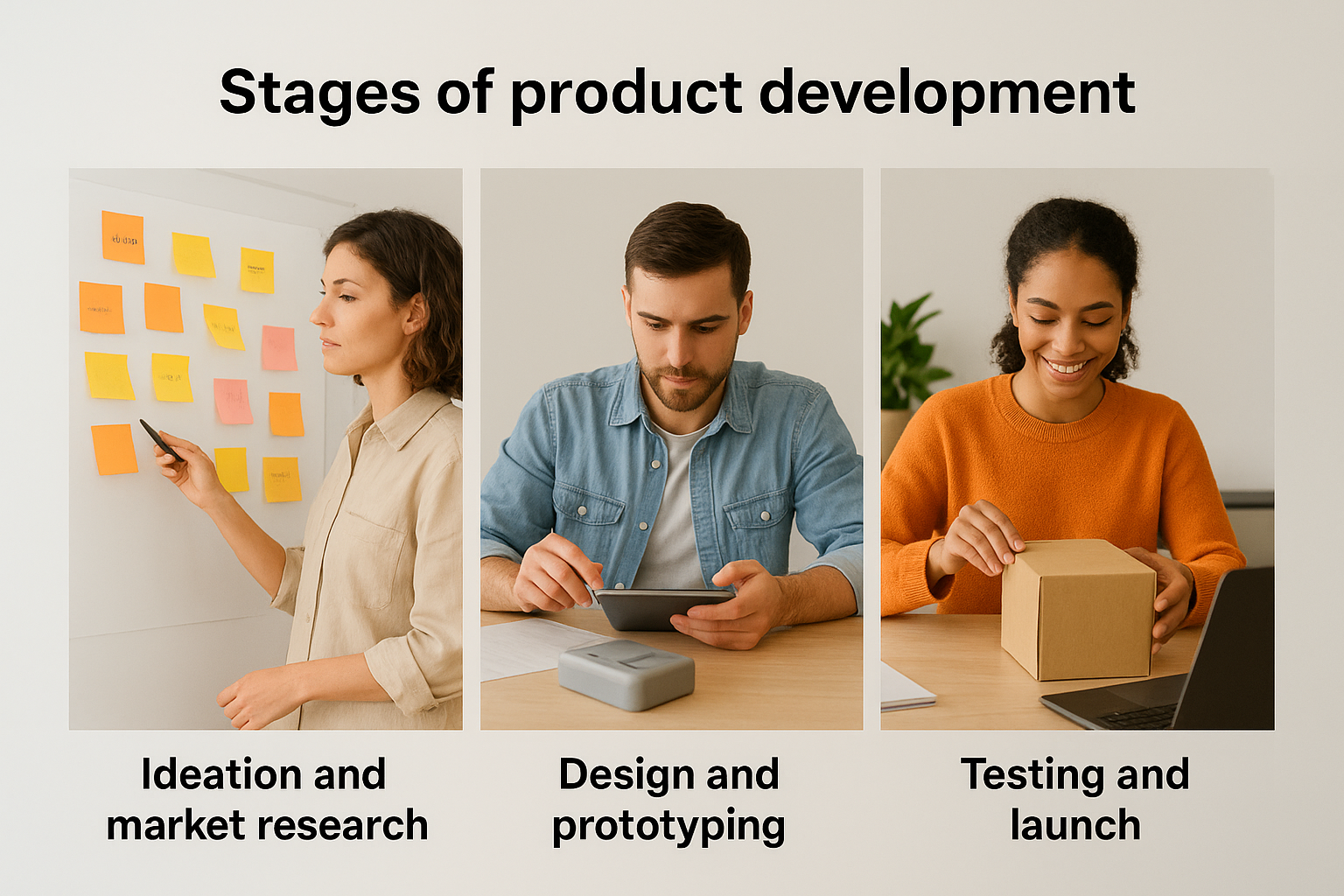
Ideation and market research
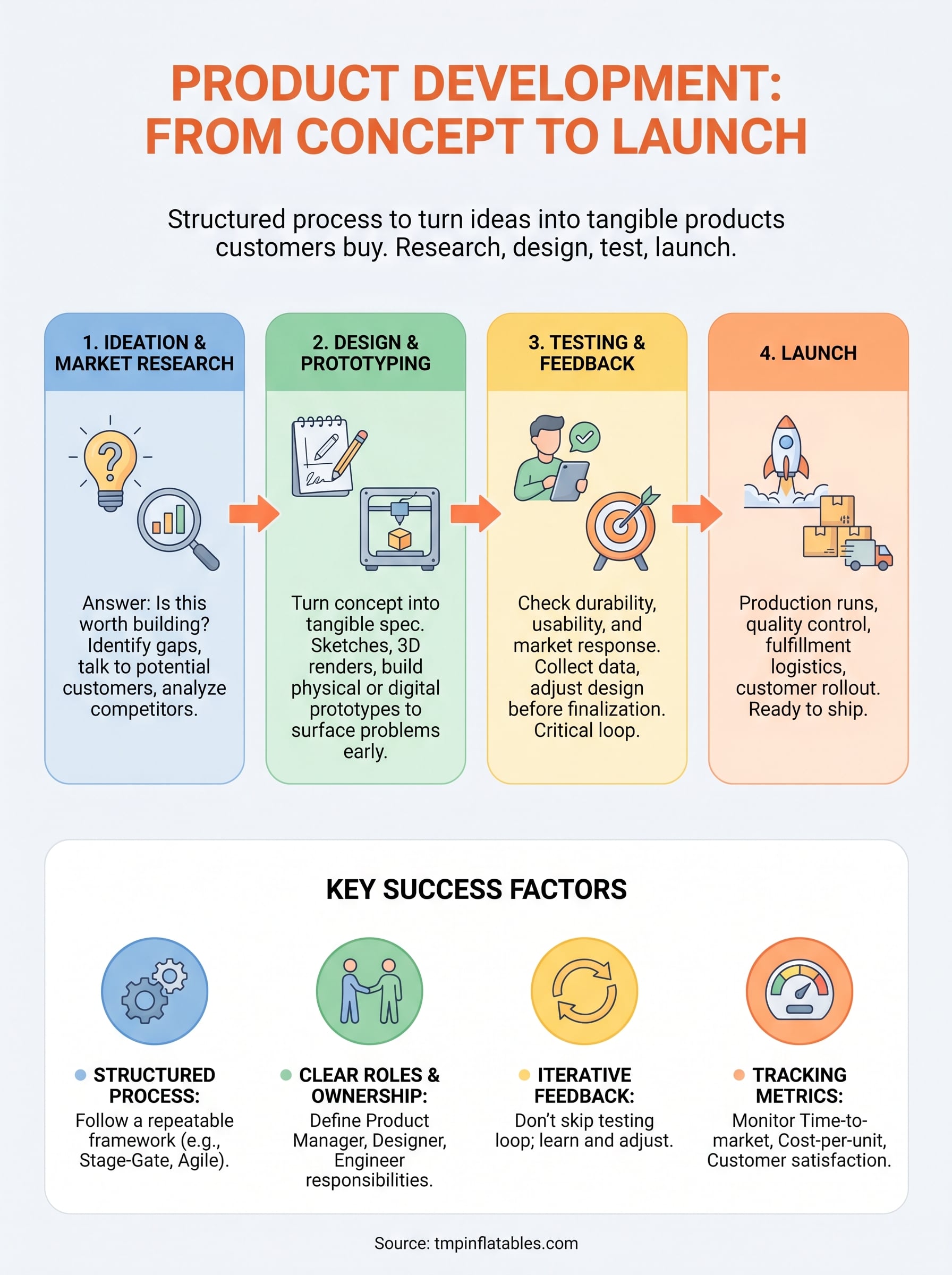
The first stage is about generating ideas and stress-testing them against real market data. You’re trying to answer one question: is this worth building? That means talking to potential customers, analyzing competitors, and identifying gaps that your product could fill. Many teams skip this step because they’re confident in their idea, but confidence without evidence is just assumption. At TMP Inflatables, for example, a client might come to us with a concept for a branded inflatable structure, and our first conversation always focuses on the event context, the audience, and what the product actually needs to accomplish.
The research stage is where bad ideas get filtered out before they cost you real money.
Design and prototyping
Once you’ve validated that the idea has legs, the design phase turns the concept into a tangible specification. This includes sketches, 3D renders, materials selection, and cost estimates. The prototype follows: a physical or digital version of the product that lets you see how your decisions play out in reality. Prototyping surfaces problems that look fine on paper, like a structure that’s difficult to assemble or a material that fails under stress. Catching these issues at the prototype stage costs a fraction of what you’d spend fixing them after committing to full production.
Testing and launch
Testing puts the prototype in front of real conditions and real users. You’re checking for durability, usability, and market response, and collecting specific data that tells you whether the design needs adjustment before you finalize it. That feedback loop is critical. Skipping it usually means discovering problems after customers already have the product in their hands. Once testing confirms readiness, the launch phase begins: production runs, quality control, fulfillment logistics, and customer-facing rollout. The cleaner your earlier stages, the fewer surprises you face when the product finally ships and the faster you can respond if adjustments are needed.
Frameworks and methodologies
The framework you choose for product development shapes how your team makes decisions, handles changes, and measures progress. No single methodology works for every situation, but understanding the most common ones helps you pick the approach that fits your product type, team size, and timeline. Some frameworks prioritize speed and iteration while others prioritize predictability and control, and knowing the difference saves you from applying the wrong tool to the wrong problem.

Stage-Gate
Stage-Gate is one of the most widely used frameworks in product development, particularly for physical products and manufactured goods. The process divides development into distinct stages separated by review points called “gates.” At each gate, a cross-functional team evaluates the work completed and decides whether to advance, revise, or stop the project. This structure works well when you need stakeholder alignment at multiple points and when production costs are high enough that you want formal sign-off before committing further resources.
Stage-Gate’s strength is its built-in checkpoints, which force your team to evaluate risk before spending more.
Agile and Scrum
Agile development breaks the product roadmap into short work cycles called sprints, typically one to four weeks each. At the end of each sprint, your team delivers a working version of something, gets feedback, and adjusts the next sprint’s priorities based on what you learned. Scrum is the most widely adopted Agile framework and assigns specific roles, including product owner, scrum master, and development team, to keep the process structured.
Agile works best when requirements are likely to change and when you can release incremental versions to gather real user feedback early. Software companies adopted it first, but physical product teams increasingly use Agile principles to manage design iterations and testing cycles.
Lean product development
Lean focuses on eliminating waste from the development process, meaning any activity that doesn’t directly contribute to delivering value to the customer. The core idea is to build only what you need, test it quickly, and learn from the result before investing in the next step. This approach pairs well with early-stage development when you’re still confirming what the right product looks like before scaling production.
Roles, artifacts, and deliverables
A product development project doesn’t run on ideas alone. It runs on people with clear responsibilities and documented outputs that move the work forward at each stage. When you know who owns what and what each phase is supposed to produce, you spend less time managing confusion and more time making actual progress.
Key roles on a product development team
Every successful product development effort depends on having the right people in the right seats. The product manager sets the direction: they define the problem, prioritize the roadmap, and confirm the team is building something the market actually wants. Designers translate requirements into visual and functional specifications. Engineers or manufacturers turn those specifications into something real. On larger teams, you’ll also find market researchers, QA specialists, and project managers who each own a specific slice of the process.
When everyone on your team has a clear role, you eliminate the most common source of delay: waiting for someone to make a decision that nobody knew was theirs to make.
Knowing which role is responsible for which decision removes ambiguity from your workflow. Here are the core roles and their primary responsibilities:
- Product manager: owns the roadmap, customer requirements, and go/no-go decisions
- Designer: creates specifications, prototypes, and visual assets
- Engineer or manufacturer: builds the product to specification and flags production constraints early
- QA or tester: validates that the product meets quality and performance standards before launch
- Project manager: coordinates timelines, resources, and cross-functional communication
Artifacts and deliverables
Artifacts are the documented outputs your team produces at each stage, and they serve two purposes: they keep the current project on track, and they become reference material for future work. Common artifacts include product requirements documents (PRDs), design specs, prototype builds, test reports, and launch checklists. Each one captures a decision or a result that the next stage of development depends on.
Deliverables are slightly different. A deliverable is a specific output promised to a stakeholder by a defined date, while an artifact is more of an internal working document. For example, a finalized 3D render submitted to a client for approval is a deliverable. The underlying design notes and revision history are artifacts. Keeping both organized gives your team a reliable paper trail that reduces rework and makes it easier to brief anyone who joins the project partway through.
Metrics and common pitfalls
Tracking the right numbers during product development tells you whether your process is working before you get to launch and discover it wasn’t. Metrics give you early warning signals that let you course-correct while you still have time to do so without blowing your budget or your deadline. Without them, you’re making decisions based on opinion rather than evidence, which is a reliable way to end up with a product that misses the mark.
Metrics that tell you if development is on track
The metrics you track should map directly to the decisions your team needs to make at each stage. Time-to-market measures how long your development cycle takes from initial concept to customer delivery, and shortening it without sacrificing quality is a primary goal for most teams. Cost-per-unit tracks whether your production estimates are holding up against reality. Prototype iteration count tells you how efficiently your design process is running: too many rounds of revision usually points to unclear requirements at the start.
If your metrics only tell you what happened after launch, they’re not actually helping you manage the development process.
Other useful indicators include customer satisfaction scores collected during test phases, defect rates from QA, and on-time delivery performance against your project milestones. Together, these numbers give you a clear picture of where your process is strong and where it’s leaking time or money.
Common pitfalls and how to avoid them
The most consistent mistake teams make is treating the development process as a straight line when it’s actually iterative. Skipping the feedback loop between testing and design because you’re under time pressure almost always creates bigger delays later. A second common pitfall is underestimating production constraints: your design might look perfect in a render but create real assembly problems at scale that your manufacturer flags only after you’ve committed to a full production run.
Two additional pitfalls worth tracking closely:
- Unclear ownership: when nobody knows who has final decision-making authority on a design change, the project stalls while people wait for direction
- Scope additions without timeline adjustments: adding features mid-development without extending deadlines forces your team to cut corners elsewhere, which shows up directly in the final product
Final takeaways
Product development works when you treat it as a system rather than a series of one-off decisions. Every stage connects to the next, and the quality of your output at each step directly shapes what you’re able to build at the end. Whether you’re designing software, consumer goods, or custom promotional products, the teams that succeed are the ones that follow a structured process, track the right metrics, and stay honest about where their approach is falling short.
Starting with solid research, clear roles, and a methodology that fits your team’s reality gives you the foundation to build products that reach the market on time and actually perform once they get there. Skipping any of that foundation is where most projects run into trouble.
If you’re planning a brand activation and need a manufacturer with over 20 years of custom production experience, request a custom inflatable quote and tell us what you’re building.

