
Every business needs to be seen. Whether you’re opening a new location, exhibiting at a trade show, or launching a product, choosing the right sign company can make or break your brand’s visibility. But the term covers a lot of ground, from vinyl banner printers to full-service firms that handle design, fabrication, and installation of complex signage systems.
At TMP Inflatables, we work in the same arena. Since 2004, we’ve designed and produced custom inflatables, branded arches, and promotional displays for experiential marketing agencies and businesses across North America. We’re not a traditional sign company, but we solve the same core problem: helping brands command attention in physical spaces. That overlap gives us a front-row perspective on what makes a signage partner worth hiring, and what to watch out for.
This article breaks down what a sign company actually does, the different types of signage providers available, and the key factors to evaluate before you commit. Whether you need traditional signage, large-format graphics, or eye-catching promotional displays like custom inflatables, you’ll walk away knowing exactly what to look for.
What a sign company does
A sign company handles the creation of physical branded materials that represent your business in the real world. That sounds simple, but the scope of work varies enormously depending on the provider. Some companies specialize in a single format, like vehicle wraps or illuminated channel letters, while others manage every step from concept sketches to on-site installation. Understanding what these companies actually do helps you ask better questions before you spend a dollar.
Core services most sign companies provide
Most sign companies offer a standard set of services that cover the basics of commercial signage production. These typically include design consultation, material selection, printing or fabrication, and delivery. A full-service provider goes further, handling permitting, structural assessments, and installation crews. Knowing which services are included in a quote, and which cost extra, is one of the first things you should clarify before moving forward.
Here are the most common services you’ll find across the industry:
- Custom sign design: creating graphics and layouts tailored to your brand
- Large-format printing: banners, posters, window graphics, and trade show displays
- Dimensional lettering: raised or cut letters for storefronts and office interiors
- Vehicle graphics and wraps: full or partial coverage for company fleets
- Illuminated signage: LED channel letters, light boxes, and neon-style displays
- Trade show displays: backdrops, pop-up stands, and portable signage systems
- Wayfinding systems: directional signs for facilities, campuses, or retail environments
The more services a sign company handles in-house, the more control they have over quality, timelines, and cost.
Design and fabrication: what happens behind the scenes
Before anything gets printed or cut, a sign company’s design team translates your brand assets into production-ready files. That means taking your logo, color palette, and messaging and adapting them for the specific material, size, and environment where the sign will live. An outdoor banner printed on vinyl needs different file specs than an indoor foam display or a backlit trade show graphic. Getting this right upfront prevents costly reprints and delays.
Fabrication follows design. Depending on the sign type, this step involves CNC routing, UV printing, laser cutting, welding, or injection molding. Higher-end sign companies run their own fabrication shops, which gives them tighter quality control and faster turnaround. Budget providers typically outsource production, which can introduce inconsistency, especially on complex or large-scale orders.
Installation, maintenance, and ongoing support
Delivery is not the finish line. Many sign projects, particularly exterior signage and permanent installations, require professional mounting, electrical connection, or structural anchoring. A sign company that skips installation often passes that responsibility to you, which creates liability and logistical headaches. Always confirm whether your provider handles on-site installation or partners with certified installers in your region.
Maintenance matters too. LED signage, illuminated displays, and vinyl wraps all degrade over time. Some sign companies offer service agreements that cover inspections, bulb replacements, and graphic refreshes. If your signage is mission-critical, like a flagship retail location or a permanent trade show presence, a maintenance contract is worth factoring into your total budget from the start.
Why the right sign company matters
Picking the wrong provider doesn’t just produce a bad-looking sign. It can delay your event, blow your budget on reprints, and send customers the wrong message about your brand. Every physical display you put into the world is a direct representation of your company’s standards, and a mediocre sign company will produce mediocre results that follow you long after the project ends.
Poor execution has real business costs
Bad signage is rarely cheap to fix. When a provider mishandles color matching, material quality, or file specifications, you end up paying twice: once for the original order and again for the correction. Installation errors add a third bill if hardware gets damaged during mounting. These aren’t edge cases. They happen regularly when companies prioritize the lowest price over proven production capability.
Choosing a sign company based on quote price alone almost always costs more before the project is finished.
Beyond reprints and corrections, poor-quality signage can derail a product launch, trade show appearance, or store opening. A misprinted banner at a high-profile event doesn’t just look unprofessional. It pulls attention away from your message at exactly the moment you need the opposite.
Your sign reflects your brand everywhere it appears
Every sign you deploy carries your brand’s credibility. A clean, well-produced vehicle wrap or storefront display communicates that your business is established and detail-oriented. A faded, misaligned, or poorly finished sign sends the opposite signal. Customers, partners, and competitors all see your signage in the real world, and they form opinions quickly based on what they observe.
This extends to trade shows and experiential marketing environments, where visual impact directly drives foot traffic. Whether you’re running traditional signage or dimensional displays like custom inflatables, the quality of your materials tells people whether your brand is worth engaging with. A skilled sign company treats quality as a baseline, not a premium add-on.
Timelines are not flexible when events are on the calendar
Marketing events have hard deadlines. A provider that misses a production window doesn’t just cause frustration. It forces you into last-minute alternatives that compromise quality and drain your budget. Always verify a provider’s standard turnaround times and ask specifically about their process for rush orders, because “we’ll try our best” is not a production guarantee.
Types of sign companies and when to use each
Not every sign company operates the same way, and choosing the wrong type for your project wastes time and money. The industry breaks into several distinct categories, each with specific strengths that align with different project scopes, budgets, and timelines. Matching your needs to the right provider type is the fastest way to get quality results without burning through your budget on revisions or last-minute alternatives.
Full-service sign companies
Full-service providers handle everything under one roof: design, fabrication, installation, and ongoing maintenance. These companies are the right choice when you need permanent signage for a storefront, office building, or facility, where errors in mounting or material selection carry long-term consequences. Because they manage the entire project internally, they maintain tighter quality control and offer clear accountability if something goes wrong.
You typically pay more for full-service providers, but the cost reflects the reduction in coordination work on your end. For large-scale or permanent installations, that trade-off is almost always worth it.
Online sign printing services
Online sign shops specialize in high-volume, standardized formats like banners, yard signs, window clings, and retractable displays. They work well for straightforward projects where you already have print-ready files and need a fast, cost-effective turnaround. Many businesses use these platforms for event banners, real estate signage, and short-term promotional materials that don’t require complex fabrication.
The trade-off with online providers is limited customization and no installation support, so they work best when your project is simple and repeatable.
The main limitation is that these platforms rarely offer design consultation or material expertise. If your project requires anything beyond a standard size or substrate, you’ll outgrow their capabilities quickly.
Specialty and experiential display providers
Some companies focus on a specific format or application rather than signage in general. Vehicle wrap specialists, trade show display producers, and experiential marketing suppliers like TMP Inflatables fall into this category. These providers bring deep technical knowledge in their niche, which matters when your display needs to perform in demanding environments like outdoor festivals, multi-day trade shows, or high-traffic retail activations.
Choosing a specialty provider makes sense when your project involves dimensional formats, custom fabrication, or branded structures that a general sign company doesn’t regularly produce. The expertise you get from a focused provider directly reduces the risk of production errors on complex builds.
How to choose a sign company
Choosing a sign company comes down to matching their actual capabilities to your specific project requirements. A provider who excels at storefront lettering may struggle with a large-scale trade show display, and vice versa. Before you request a single quote, get clear on what your project actually needs: the format, the timeline, the environment where it will be displayed, and whether installation is part of the scope.
Check their portfolio and production capabilities
A provider’s portfolio tells you more than any sales pitch will. Look for completed projects that are similar in format and scale to what you’re planning. If you need dimensional signage or custom fabrication, confirm that the company produces those in-house rather than outsourcing to a third party. Outsourced production introduces quality variability and extends lead times, both of which create risk when you’re working toward a fixed deadline.
Ask directly how they handle file preparation and material selection for the specific application you need. A knowledgeable team will walk you through substrate options and explain trade-offs based on where the sign will be used. If they can’t answer those questions clearly, that’s a signal their expertise doesn’t match your project.
A provider who asks detailed questions about your environment and use case before quoting is almost always more reliable than one who sends a price within minutes.
Verify turnaround times and communication standards
Standard production timelines vary widely across the industry. Online print shops can turn around simple banners in two to three business days, while full-service fabrication on dimensional or illuminated signage can take three to six weeks. Get a specific production timeline in writing before you commit, and ask what happens if they miss it. A provider who can’t answer that question clearly has no accountability built into their process.
Communication quality matters just as much as speed. You want a point of contact who responds quickly, confirms order details in writing, and flags potential issues before they become costly corrections.
Confirm what’s included in the quote
Line-item quotes protect you from unexpected charges. Before signing anything, confirm whether design revisions, shipping, installation, and hardware are included or billed separately. Some providers quote only the print cost and add significant fees at each subsequent stage. Ask for a complete project breakdown that covers every phase from file submission to final delivery, so you’re comparing accurate totals when evaluating multiple providers.
What you need for pricing and production
Before you contact any sign company, gather the basic project details that every provider needs to generate an accurate quote. Walking into a conversation without this information wastes time on both sides and often results in estimates that change significantly once the real scope comes into focus. Having your specs ready from the start speeds up the quoting process and gives you a clean basis for comparing multiple providers.
The information every quote requires
Every pricing conversation starts with the same core inputs. Providers need to know what you’re ordering, where it will be used, and how long it needs to last before they can give you a number that actually reflects your project. Vague requests produce vague estimates, and vague estimates turn into budget surprises during production.
Before reaching out, have the following ready:
- Dimensions: exact width and height for each sign type you need
- Quantity: total piece count, since most providers price better on higher volumes
- Material preference: outdoor vinyl, rigid substrate, fabric, foam board, or specialty materials
- Environment: indoor or outdoor, and whether the sign faces direct sun, wind, or moisture
- Installation requirements: whether you need hardware, grommets, mounting brackets, or professional installation
- File status: whether you have print-ready artwork or need design work included in the scope
- Deadline: your required delivery date, not just your preferred one
Providing accurate dimensions and a realistic deadline upfront eliminates the most common source of mid-project cost increases.
How production timelines affect your total cost
Rush fees are one of the fastest ways to inflate a signage budget. Most providers charge a premium for expedited production, and that premium grows the closer your deadline gets. If you’re ordering standard banners or simple printed materials, you have more scheduling flexibility because online printers can often turn those around in two to three days. Complex fabrication on dimensional displays or illuminated signage requires three to six weeks under normal conditions, so building that window into your campaign timeline prevents unnecessary upcharges.
Your file readiness also affects the production clock. Artwork that arrives in the wrong format, at the wrong resolution, or with missing fonts adds revision cycles that eat into your schedule before the printer ever runs a single sheet. Deliver production-ready files at the correct color profile and resolution, and confirm those specs with your provider before you submit.
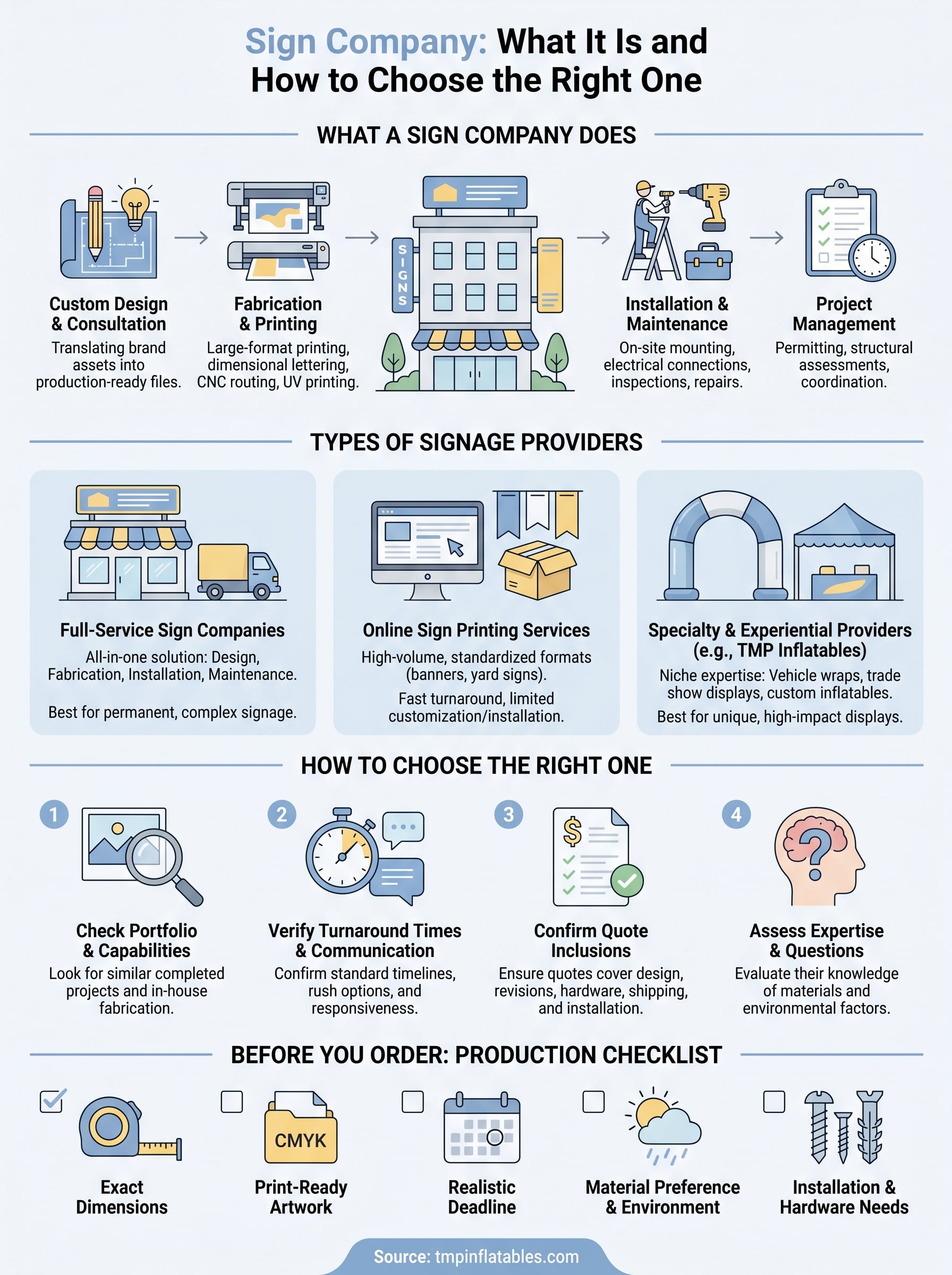
Final checklist before you order
Before you place an order with any sign company, run through the basics one more time. Confirm you have exact dimensions, a realistic deadline, and print-ready artwork at the correct resolution and color profile. Verify that the quote covers every phase of the project, including design revisions, hardware, shipping, and installation if required. Check that your provider has produced work similar in format and complexity to what you need, and that you have a named contact who commits to keeping you updated throughout production.
If your campaign calls for something beyond traditional printed signage, such as branded inflatable structures, custom arches, or dimensional promotional displays that generate real attention at events, the approach is the same: find a specialist with proven experience in that format. TMP Inflatables has been building custom promotional displays since 2004. Request a quote for your next project and get a direct response from our team.
