

Spheres are everywhere, from basketballs and globes to massive architectural landmarks like the Amazon Spheres in downtown Seattle. As a geometric shape, the sphere is one of the most fundamental forms in mathematics. As a design element, it’s one of the most visually striking structures you can put in front of an audience.
At TMP Inflatables, we’ve spent over 20 years designing and producing custom inflatables for experiential marketing and creative agencies, and spherical inflatables remain some of the most requested products in our lineup. There’s a reason for that: the sphere naturally draws the eye, commands attention, and works at virtually any scale. Whether you’re building a branded installation or mapping out a trade show booth, understanding what makes this shape so effective starts with knowing what it actually is.
This article breaks down the sphere from multiple angles. You’ll get a clear definition of the geometric shape, learn about its mathematical properties, see real-world examples, and find practical details on visiting the famous Amazon Spheres in Seattle, including how reservations work and what to expect when you get there.
What a sphere is in math and everyday language
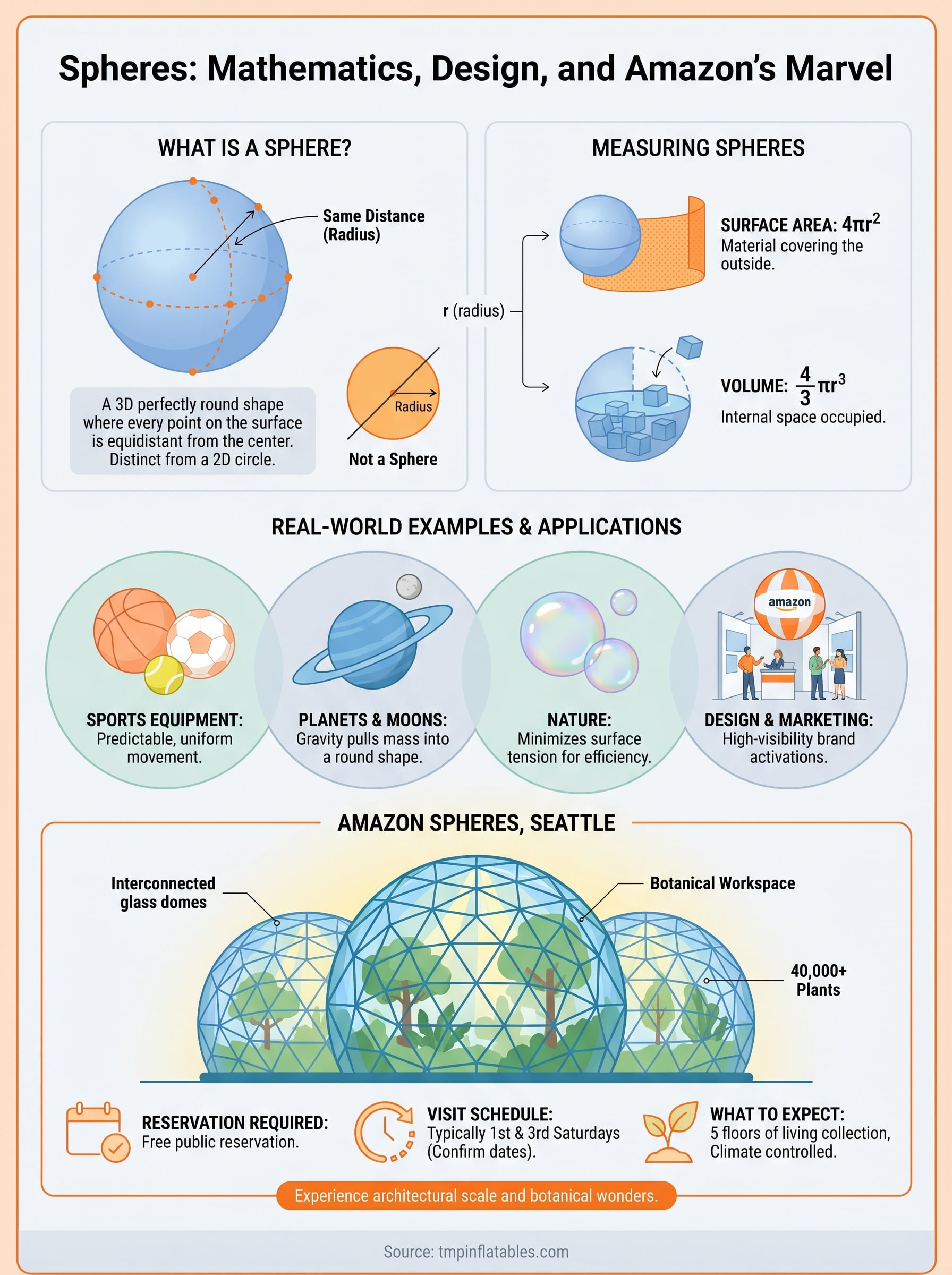
A sphere is a perfectly round, three-dimensional shape where every point on the surface sits at the same distance from the center. That distance is called the radius. Unlike a flat circle, which exists in two dimensions, a sphere occupies three-dimensional space and has both surface area and volume. Think of a basketball or a globe. Those objects aren’t perfect mathematical spheres, but they’re close enough to give you an accurate mental picture of the shape.
The geometric definition
In geometry, a sphere is defined as the set of all points in three-dimensional space that are equidistant from a single central point. That central point is called the center, and the fixed distance from the center to the surface is the radius. The diameter is simply twice the radius, running straight through the center from one side of the surface to the other. This strict definition makes the sphere one of the most symmetrical shapes in mathematics. No matter how you rotate it around its center, it looks identical from every angle.
A sphere has no edges, no corners, and no flat faces, which makes it unique among common three-dimensional geometric solids.
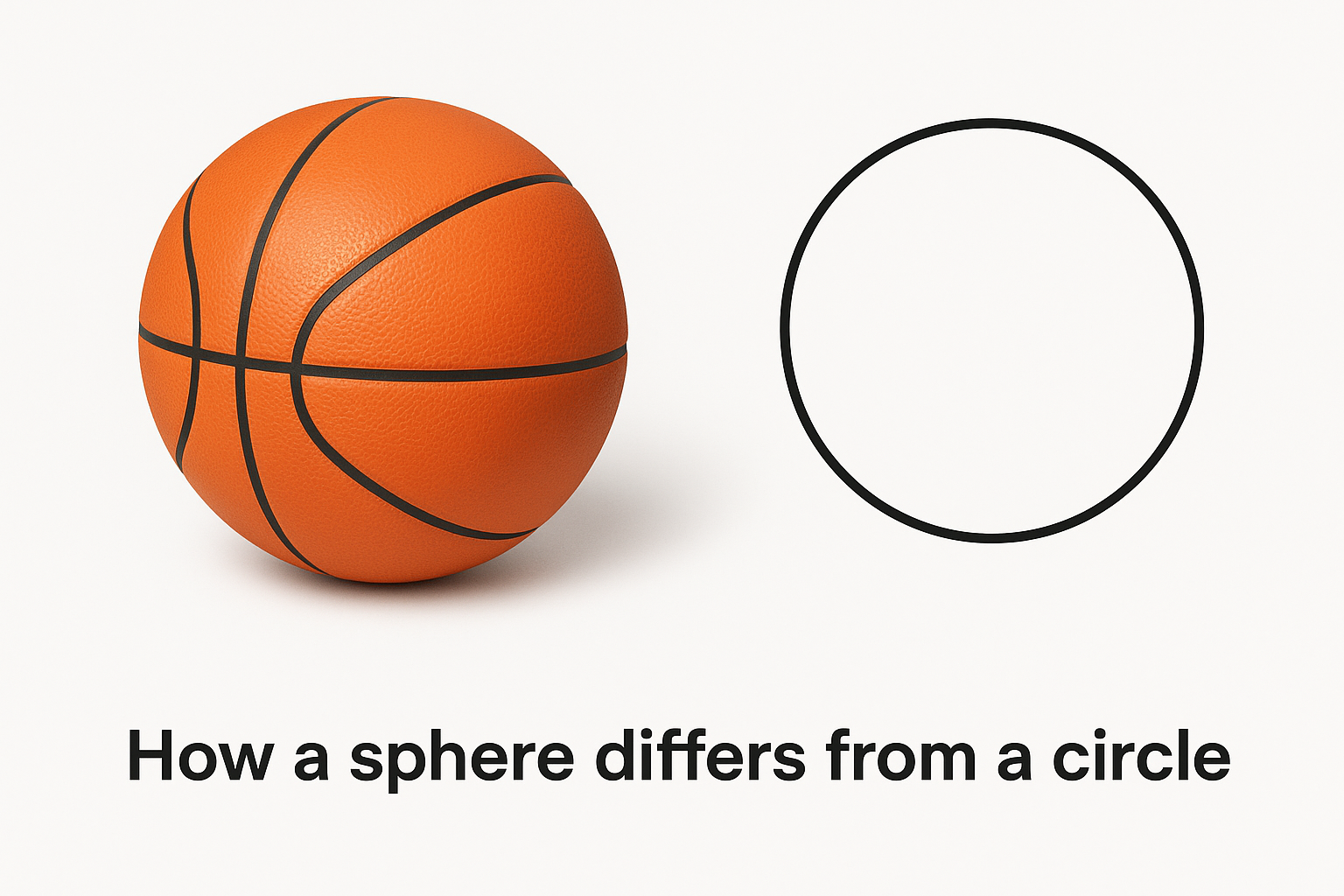
How a sphere differs from a circle
A circle is a two-dimensional figure: a flat, closed curve where every point sits the same distance from the center. A sphere is the three-dimensional counterpart of that concept. You can think of it this way: if you took a circle and rotated it 360 degrees around its diameter, the path it traces forms a sphere. In everyday language, people often use the word loosely to describe any round object, but in mathematics, the distinction between a circle and a sphere is exact and carries real consequences for how you calculate size, area, and volume.
Why spheres show up everywhere
Spheres appear across every field because the shape is extraordinarily efficient. A sphere encloses the maximum possible volume for a given surface area, which means nature and engineering both favor it by default. When a system needs to minimize surface while maximizing internal capacity, the sphere becomes the logical result. You see this principle play out at every scale, from microscopic cells to entire planets.
The sphere’s efficiency isn’t just mathematical theory; it’s a fundamental principle that drives design decisions across nature, architecture, and manufacturing.
The physics behind the shape
Physics plays a major role in how often spheres appear in the world around you. When pressure acts equally in all directions, the resulting form is spherical. This is why water droplets, bubbles, and celestial bodies all tend toward a round shape over time. Gravity pulls mass inward uniformly, and equal pressure distributes outward uniformly, and both forces produce the same outcome.
Designers and architects apply the same logic deliberately. Spherical structures distribute stress evenly across their surface, making them strong without requiring extra material. In experiential marketing, that structural advantage translates directly into large-scale inflatable installations that hold their shape reliably under real event conditions.
How to measure a sphere
Measuring a sphere comes down to two key calculations: surface area and volume. Both formulas use the radius as their starting point, which is why getting that single measurement right matters more than anything else. Once you know the radius, everything else follows directly.
Surface area
The surface area of a sphere tells you how much material covers the outside. The formula is 4πr², where r is the radius. If you’re working with a sphere that has a radius of 5 inches, the surface area equals 4 × 3.14159 × 25, which comes out to roughly 314 square inches. This calculation matters directly in physical applications like manufacturing custom inflatables, where material yield affects both cost and production time.
Getting the surface area right at the design stage prevents material waste and keeps production on schedule.
Volume
Volume measures how much space a sphere occupies internally. The formula is (4/3)πr³. Using the same 5-inch radius, the volume equals approximately 523 cubic inches. For large-scale inflatable spheres used in events and marketing, volume determines how much air the structure needs to hold its shape under real conditions.
Here are the two formulas to keep handy:
- Surface area: 4πr²
- Volume: (4/3)πr³
Sphere examples you see in real life
Spheres appear in more places than most people notice. Sports equipment like basketballs, soccer balls, and golf balls use the spherical form to deliver predictable, uniform movement. Planets and moons take spherical shape over millions of years as gravity pulls mass evenly toward a central point. Even something as simple as a soap bubble self-organizes into a sphere because that shape minimizes surface tension.
Spheres in design and marketing
Brands use spherical shapes deliberately because they stand out in cluttered environments. Large inflatable spheres at trade shows, product launches, and outdoor events draw attention from a distance and hold it up close. The shape works at any scale, which makes it a reliable tool for high-visibility brand activations.
A perfectly round object has no sharp edges to distract the eye, so your audience focuses entirely on the surface, where your branding lives.
Product replicas shaped as spheres, like an oversized branded ball or globe, immediately communicate scale and create a memorable impression that flat signage simply cannot match.
Amazon Spheres in Seattle and how to visit
The Amazon Spheres are three interconnected glass domes at Amazon’s Seattle headquarters, housing over 40,000 plants from more than 400 species. Built between 2016 and 2018, these structures function as both a botanical workspace and a public attraction. The spheres show how the geometric form scales into striking, large-scale architecture that stops people in their tracks.
What you’ll find inside
Inside, you’ll find a living plant collection spread across five floors of walkable space. Amazon designed the environment to support both employee wellness and public exploration on select open days.

Key highlights:
- A four-story living wall called the Understory
- Over 400 plant species from tropical and cloud forest environments
- Climate controlled to replicate specific ecosystem conditions year-round
How to reserve your spot
You can request a free public reservation through Amazon’s official reservations page. Visits typically run on the first and third Saturdays of each month, though dates shift seasonally, so confirm the schedule before you finalize plans.
Book your spot well in advance since available slots fill up fast, especially during peak months.
Checking the page on a regular basis gives you the best shot at securing a time that fits your visit without scrambling at the last minute.
Key takeaways
Spheres are three-dimensional shapes where every surface point sits at an equal distance from the center. That single property makes them structurally efficient, visually dominant, and mathematically precise. You calculate their surface area with 4πr² and their volume with (4/3)πr³, both formulas built around the radius. In the real world, the shape turns up everywhere from sports equipment to planetary bodies because physics and engineering keep arriving at the same conclusion: round works.
The Amazon Spheres in Seattle give you a chance to experience the form at architectural scale, with free public visits available on select Saturdays through Amazon’s reservations page. Book early since spots go quickly.
If you’re planning a brand activation, product launch, or trade show appearance, large-scale inflatable spheres deliver the kind of visual impact that flat signage cannot. Ready to put the shape to work for your brand? Request a custom inflatable quote and our team will help you build something that gets noticed.
