
You’ve probably seen inflatable games at a company picnic or a school fundraiser and thought, that would be perfect for our next event. Then you start searching and hit a wall of vague listings, unclear pricing, and no idea whether you should buy or rent. That confusion costs you time you don’t have if your event date is already set.
Here’s the direct answer: inflatable games are air-filled structures built for interactive play, ranging from obstacle courses and sports arenas to carnival-style challenges like joust arenas or giant Twister. Some are made for commercial use and can handle back-to-back rentals or daily activations, while others are lighter-duty units meant for occasional backyard use. Knowing which category you need determines whether you buy outright or work with a rental supplier, and it changes your budget significantly.
This article breaks down exactly what counts as an inflatable game, the main types available for events and rental fleets, and how buying versus renting stacks up depending on your usage. We’ll also cover what to check before you commit, from safety certifications to setup requirements, so you can make a decision that actually fits your event or business.
Why inflatable games matter for events and rentals
Walk any street fair, corporate picnic, or trade show floor and your eye goes straight to the giant obstacle course or the towering slide before it lands on anything else. That’s not an accident. Inflatable games work because they’re big, colorful, and impossible to ignore in a sea of folding tables and pop-up tents. For event planners, that visibility translates directly into foot traffic, and foot traffic is what every sponsor, exhibitor, and marketing manager is actually paying for.
Inflatable Games Have Crowd-drawing power that other activations can’t match
Compare a branded inflatable to a static banner or a table of pamphlets and the difference is obvious. People walk past printed signage. They stop, take photos, and line up for an inflatable game. This matters most at outdoor festivals, school carnivals, and brand activations where you’re competing for attention against dozens of other booths or vendors. A 20-foot obstacle course branded with your logo does double duty: it entertains guests and puts your name in front of everyone waiting in line, plus everyone who photographs it for social media.
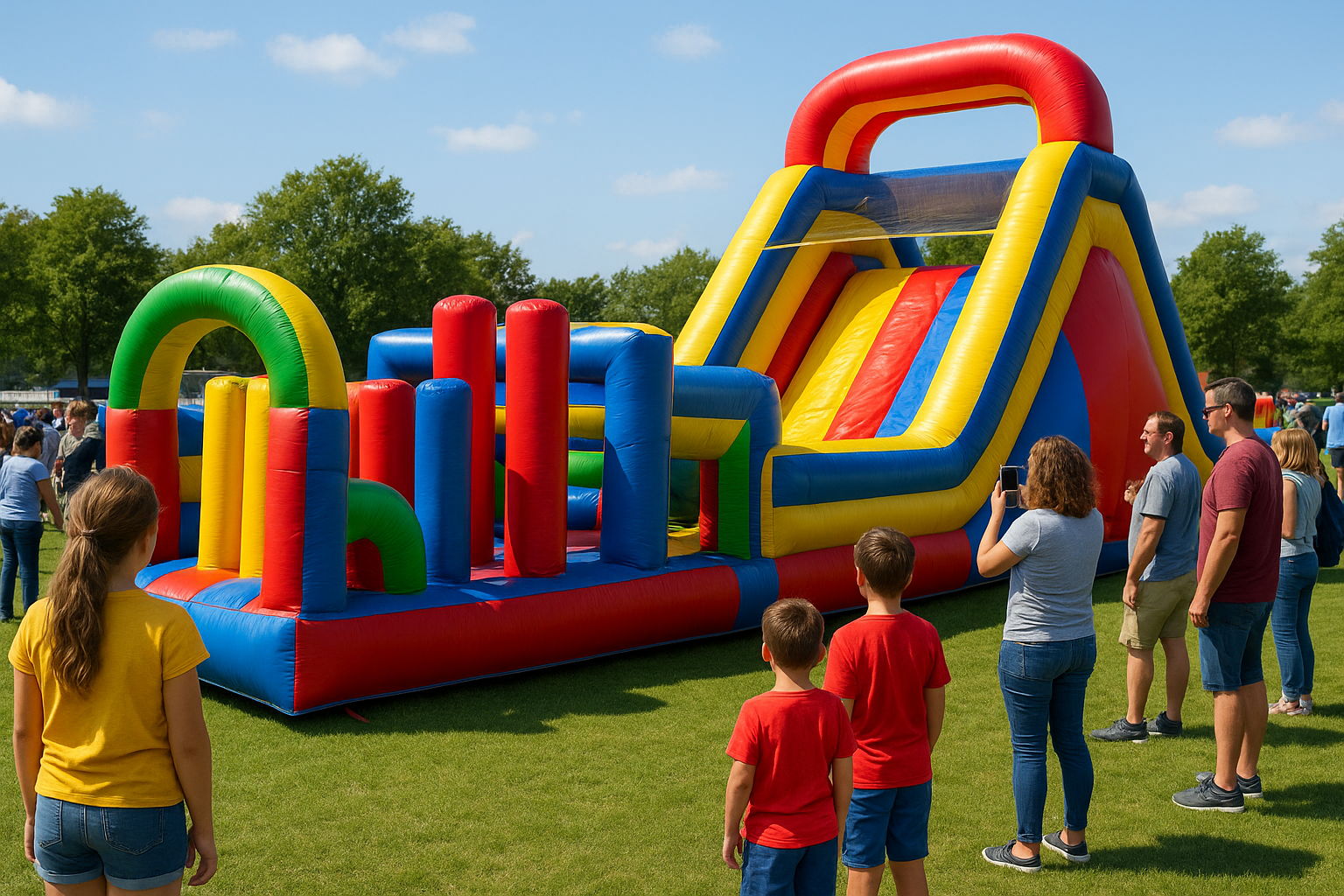
Branded inflatable games turns waiting in line into free advertising.
That combination of entertainment and visibility is why experiential marketing agencies and event planners keep coming back to inflatables year after year, even as other trends in event entertainment come and go.
Inflatable Games have a dependable revenue engine for rental businesses
If you’re running or starting a party rental company, inflatable games are one of the few product categories where the math is straightforward. A single obstacle course or interactive sports game can be rented dozens of times per season, and each booking covers a meaningful chunk of the unit’s purchase cost. Unlike a bounce house alone, game-style inflatables (think joust arenas, giant Twister, or interactive basketball challenges) appeal to adult clients too, which opens up corporate events, fundraisers, and team-building days on top of the usual birthday party circuit.
Here’s how that breaks down in practice for a rental operator:
| Factor | Standard bounce house | Interactive inflatable game |
|---|---|---|
| Typical client base | Kids’ birthday parties | Corporate events, schools, festivals, adult leagues |
| Average rental rate | $150-$250/day | $300-$600/day |
| Repeat bookings | Seasonal (spring/summer) | Year-round with indoor venue rentals |
| Setup complexity | Low | Moderate (often needs staff for safe play) |
That wider client base is exactly why many rental businesses expand their fleet with games before adding more standard bounce houses.
Inflatable Games have Practical advantages beyond the wow factor
Beyond the visual impact, inflatable games solve real logistical problems that other entertainment options don’t. Setup usually takes under an hour with a blower and a few stakes or sandbags, so you’re not coordinating a stage crew or waiting on rented furniture. Most units pack down small enough to transport in a cargo van or trailer, which matters if your rental fleet needs to service multiple events on the same weekend.
Safety is another piece worth flagging here, since it’s the difference between a smooth event and a liability headache. Commercial-grade units are built with reinforced seams, safety netting, and weight limits that are tested against industry standards like those referenced by the ASTM International F24 committee, which governs amusement ride and inflatable device safety in the US. Renting or buying from a supplier who can show you certification and inspection records isn’t a nice-to-have, it’s what keeps your insurance valid and your guests unhurt.
Finally, inflatable games flex with the weather and the venue in ways that fixed entertainment can’t. A misting-tent-style cooling zone paired with a game area keeps guests comfortable at a July festival, while the same units move indoors for a winter trade show without redesigning your whole layout. That adaptability is exactly why so many event planners treat inflatable games as a foundation piece of their entertainment budget rather than an afterthought.
How to choose the right inflatable games
Picking the wrong unit costs you more than a bad afternoon. It costs you a canceled booking, a refund, or worse, an injury claim. Choosing the right inflatable game starts with matching the unit to your actual event conditions, not just picking whatever looks biggest in a catalog photo.
Match the game to your space and audience for inflatable games
First, measure your space before you fall in love with a design. A 30-foot obstacle course looks great online, but it won’t fit a backyard or a tight festival footprint with an 18-foot clearance. Ask your supplier for exact dimensions including the blower placement and any anchor points, not just the footprint of the inflatable itself. Second, think about who’s actually playing. A joust arena or interactive sports game draws teenagers and adults, while a classic bounce-and-slide combo skews toward younger kids. Mismatching the game to your crowd means low engagement no matter how much you spent.
The best inflatable game is the one that fits your space and your crowd, not the one that looks biggest online.
Check safety certifications and materials for inflatable games
Every commercial-grade inflatable should come with documentation you can actually verify, not just a verbal assurance. Look for units built from reinforced PVC or vinyl rated for commercial use, with double-stitched seams and safety netting on elevated play areas. Ask specifically whether the unit has been tested against standards referenced by the ASTM International F24 committee, which covers amusement and inflatable device safety in the US.
Use this checklist before you sign off on any unit:
- Manufacturer certification or inspection tag attached to the inflatable
- Weight and occupancy limits clearly stated
- Anchoring method appropriate for your surface (grass, pavement, or indoor flooring)
- Blower with a working safety cutoff and backup power option
- Liability insurance coverage from the supplier or rental company
Factor in setup, staffing, and logistics for inflatable games
Beyond the inflatable itself, think through what happens on event day. Games with moving parts, like joust arenas, usually need an attendant to manage turns and enforce safety rules, so budget for that staffing cost upfront. Weather matters too. Wind speeds above 25 mph typically require deflating the unit, so outdoor events need a backup plan or indoor alternative built into the contract.
Finally, confirm power access on-site. Most blowers run on standard 110V outlets, but larger units or multiple inflatables may need a generator, which adds cost and setup time. Sorting out these logistics before booking day saves you from scrambling when the truck shows up and there’s nowhere to plug in.
Popular types of inflatable games and their uses
Walk through any rental fleet or event catalog and you’ll find that inflatable games fall into a handful of distinct categories, each suited to a different kind of event. Knowing the differences helps you avoid the generic “bounce house” search that turns up hundreds of options with no clear fit for what you’re actually planning.
Inflatable Games like Obstacle courses and inflatable races
Obstacle courses are the workhorse of the category, and for good reason. They scale from a compact 20-foot backyard version to a 60-foot dual-lane race unit built for corporate field days and school fundraisers. Teams love the head-to-head format because it turns a simple game into a competition with a clear winner, which works well for corporate team-building events and sponsor activations that want a photo-worthy finish line. Rental operators often keep two or three sizes in the fleet so they can quote the right unit for a tight backyard or a wide-open festival field.
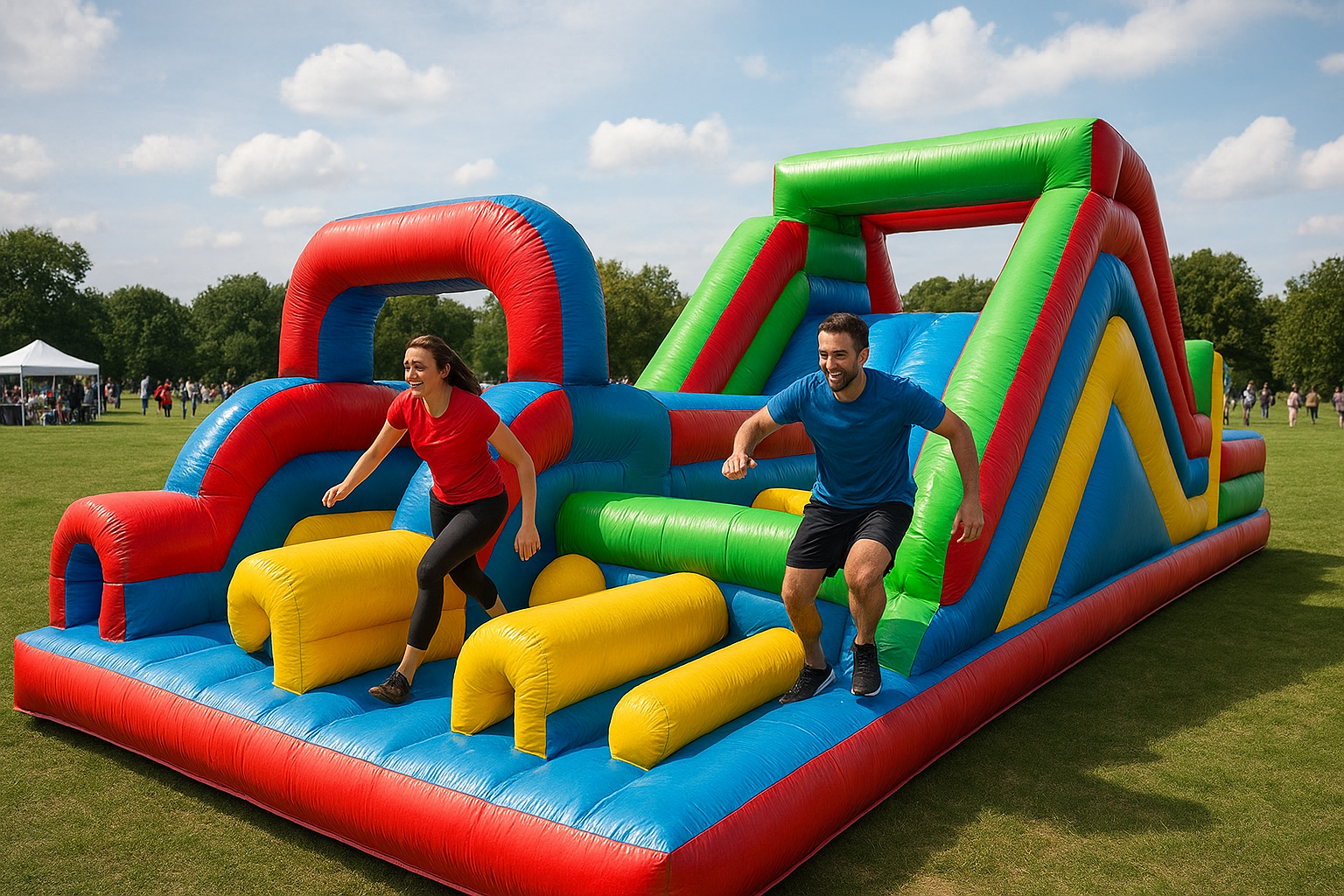
Interactive sports and challenge games
Interactive sports games, like inflatable basketball pop-a-shots, soccer darts, and human foosball, bring adult appeal that standard bounce houses don’t. These units draw teenagers and grown adults just as easily as kids, which opens the door to corporate happy hours, brewery events, and adult league fundraisers on top of birthday parties.
Interactive sports inflatables are the category most likely to turn a walk-by adult into a paying customer’s next referral.
Because many of these games involve competitive scoring, they also generate natural crowd gathering, since people stop to watch friends compete, which extends dwell time at a booth or activation far longer than a static display ever could.
Inflatable Games like Carnival-style challenge games
Joust arenas, giant Twister, and gladiator-style battle zones fall into the carnival category, and they consistently rank among the most requested units for festivals and school events. Most require an attendant to manage turns and enforce padding rules, so factor that staffing cost into your planning from the start.
| Type | Typical size | Best audience | Common use case | |—|—|—| | Obstacle course | 20-60 ft | All ages, teams | Corporate field days, festivals | | Interactive sports game | 10-20 ft | Teens and adults | Happy hours, fundraisers | | Joust arena / carnival battle | 15-20 ft | Teens and adults | School events, festivals | | Giant Twister / floor games | 15-15 ft | Families, mixed groups | Trade shows, backyard parties |
Matching the type to your audience, as this table shows, matters more than picking whichever unit looks most impressive in a brochure photo.
Inflatable Games Buying vs. renting: what to consider before you commit
Deciding whether to buy or rent inflatable games comes down to how often you’ll actually use them and how much storage, transport, and maintenance you’re willing to take on. A single school buying one obstacle course for an annual fall festival has a completely different equation than a rental business planning to book that same unit forty weekends a year. Get this calculation wrong and you either overpay for storage space you don’t need, or you’re stuck paying rental fees every summer for something you’d have owned outright by year two.
When buying makes the most sense
Ownership pays off once your usage climbs past occasional. Rental companies, schools with recurring events, and venues that host activations year-round typically break even on a commercial-grade inflatable within one to two busy seasons. Buying also gives you full control over branding, since a custom-printed obstacle course or joust arena becomes a permanent marketing asset you can deploy whenever you need it, not just when a rental supplier has availability.
If you’re booking the same type of event three or more times a year, buying almost always beats renting.
Owning also means you control maintenance, storage, and repair timelines instead of depending on someone else’s fleet schedule, which matters if your event calendar is tight and non-negotiable.
When renting makes the most sense
Renting wins when your need is occasional or you want to test a product category before committing capital. A one-off company picnic, a single trade show appearance, or a first attempt at adding games to a birthday party business are all situations where a rental supplier absorbs the storage, transport, and repair costs for you. Renting also lets you rotate through different inflatable games each season, which keeps repeat clients interested instead of seeing the same joust arena every year.
Comparing the real costs side by side
Sticker price only tells part of the story. Storage space, delivery logistics, and repair costs add up fast on either path, so compare the full picture before you sign anything.
| Consideration | Buying | Renting |
|---|---|---|
| Upfront cost | $3,000-$15,000+ per unit | $300-$600 per event |
| Storage needed | Yes, dry and climate-controlled | None |
| Maintenance responsibility | Owner | Rental supplier |
| Best for | 3+ uses per year, rental businesses | One-off or occasional events |
| Branding control | Full, permanent | Limited to supplier’s inventory |
Questions to ask before you decide
Run through these before committing either way:
- How many events will this unit realistically cover in a year?
- Do you have dry, secure storage for an off-season inflatable?
- Can your team handle setup, takedown, and minor repairs, or do you need a supplier who provides staff?
- Does the supplier offer international shipping if you’re sourcing custom branding from outside your region?
- Is the unit certified against standards like those from ASTM International, regardless of whether you buy or rent?
Answering these honestly usually makes the buy-or-rent decision obvious well before you get a quote.
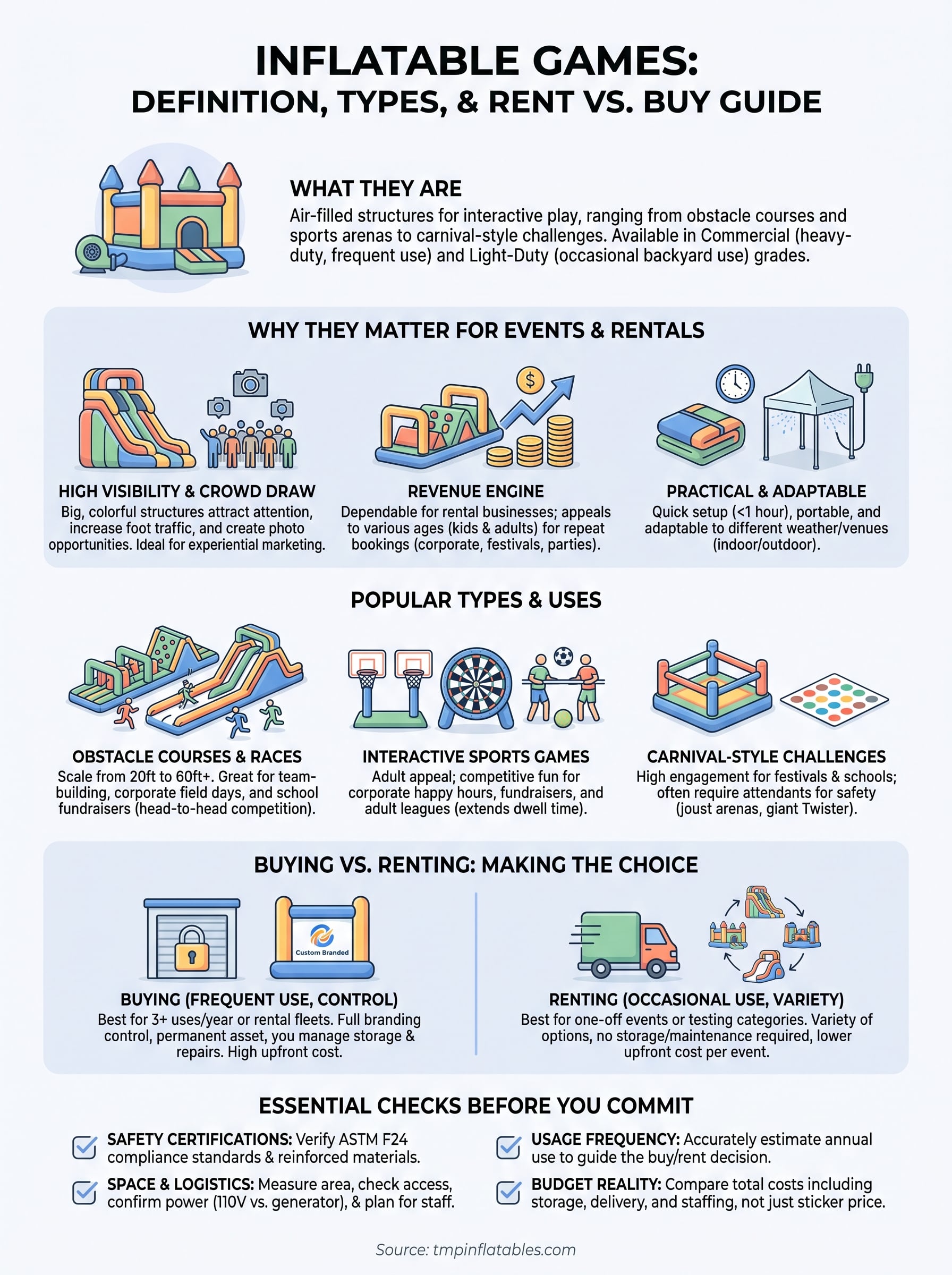
Finding the right fit for your event
Good inflatable games come down to matching the unit to your crowd, your space, and how often you’ll actually use it. An obstacle course pulls in families at a festival, an interactive sports game keeps adults engaged at a corporate happy hour, and a joust arena turns a school fundraiser into the thing everyone talks about on Monday. Whether you’re buying for a rental fleet or renting for a single event, the checklist stays the same: verify certifications, confirm setup logistics, and pick the type that fits your actual audience instead of whatever looks biggest in a photo.
If you’re still weighing options, don’t guess your way through a catalog. Custom-branded inflatables built for your exact event, budget, and timeline beat generic listings every time. Talk to TMP Inflatables and get a quote for a game built around what your event actually needs.