
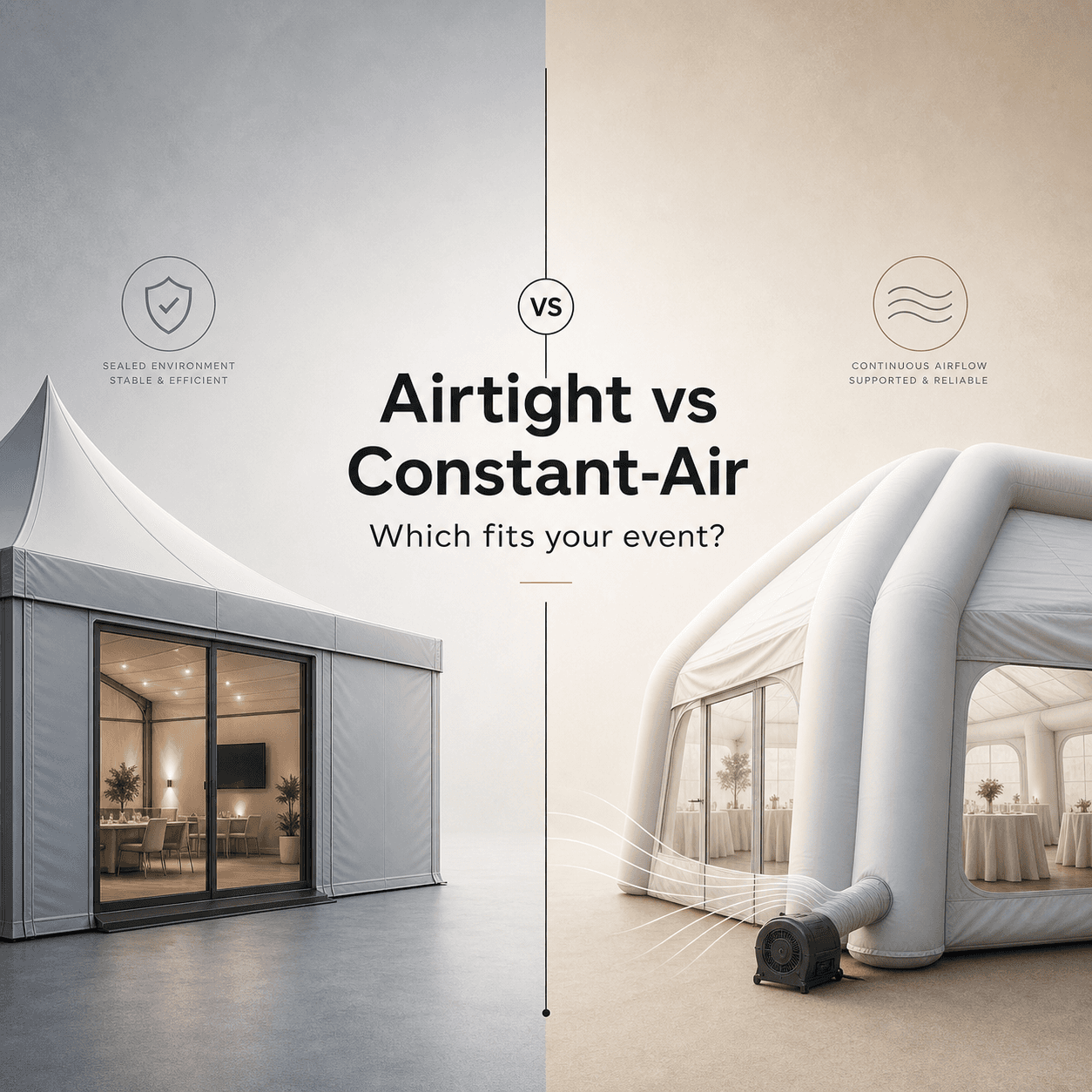
This is an article for those interested in various Types of Inflatables. If you’re shopping for custom inflatables for an event, you’ll run into one question almost immediately: airtight or constant-air?
They can look similar in photos, but in real life they behave very differently. One is designed to hold air like a sealed vessel. The other is designed to stay inflated because a blower keeps feeding it air the whole time.
And choosing the right one is not just a technical detail. It affects your event setup, noise level, power plan, safety checklist, transport, and how “premium” the inflatable feels when people interact with it.
This guide breaks it down in plain English, with practical recommendations for common event scenarios, so you can confidently choose what fits your timeline, venue, and marketing goals.
If you want help deciding for your specific event, TMP Inflatables can guide you. You can also fill out the quote request form at https://tmpinflatables.com and a team member will get back to you within 1 to 2 business days.
Types of Inflatables and What “Airtight” Actually Means
An airtight inflatable is made from materials and seams designed to minimize air leakage. You inflate it (often with a pump), close the valves, and it holds pressure for a long time.
You might still top it up occasionally depending on size, temperature, and usage, but the key point is this:
It does not need a blower running nonstop to stay inflated.
Common examples
- Inflatable advertising balloons (sealed)
- Some inflatable domes/tents designed as sealed air structures
- Certain giant replicas or display shapes built as airtight units
Types of Inflatables and What “Constant-Air” Actually Means
A constant-air inflatable (also called continuous-air) is designed with airflow in mind. It uses a blower to keep steady pressure inside. There is always some controlled air escape through seams, vents, zippers, or the fabric itself, and the blower compensates.
The simple way to think about it:
No blower, no inflatable (or it starts to soften and collapse).
Common examples for these Types of Inflatables
- Air dancers / tube men
- Many inflatable arches (especially event start/finish lines)
- Many inflatable tents and domes used for quick setup
- Bouncy castles and obstacle courses
Types of Inflatables & The Fastest Way to Decide (Airtight vs Constant-Air)
If you only read one section, read this.
Choose airtight when:
- You want minimal noise (no constant blower hum)
- You have limited or unreliable power
- People will be close to it, leaning on it, taking photos, or filming content
- You want a more “solid,” premium feel
- You want simpler overnight use (depending on local rules and safety planning)
Choose constant-air when:
- You want fast setup and takedown
- The inflatable will see high activity (kids, sports, repeated impacts)
- Your event already has a strong power plan
- You want big visual impact at lower structure weight
- You’re running short, high-energy activations where a blower is normal
Now let’s get more specific, because the best answer often depends on where the inflatable will be used.
Types of Inflatables & Setup Time and Event Logistics
Types of Inflatables like Airtight: slower to dial in, calmer once it’s up
Airtight inflatables often take a bit more patience during initial inflation because you’re aiming for the right internal pressure, especially on larger structures. Once you’re there, it’s stable and quiet.
Best for: brand displays, VIP/photo areas, premium experiential spaces, venues with sound sensitivity.
Types of Inflatables like Constant-air: quick to deploy, but you must manage the blower
Constant-air inflatables are typically faster to “pop up.” Turn on the blower and you’re basically live.
But you also inherit a few ongoing tasks:
- Managing power and cable runs
- Keeping the blower protected from foot traffic
- Preventing accidental unplugging
- Handling the noise and airflow around the unit
Best for: festivals, races, busy outdoor activations, events with crews that already manage power distribution.
Power Requirements (This Is Where Many Events Get Stuck)
Power is usually the deciding factor, especially for outdoor events, pop-ups, and mobile roadshows.
Types of Inflatables like Airtight and power
Airtight inflatables often need power only for inflation, then they can stay up without continuous electricity (again, sometimes with minor top-ups).
This helps if you are:
- Activating in a park or public space
- Working from a vehicle
- Using a small generator
- Trying to keep the footprint clean and cable-free
Types of Inflatables like Constant-air and power
Constant-air needs reliable power the entire time. This is not necessarily a problem, but you need to plan it.
Key questions to ask before choosing constant-air:
- Do we have dedicated circuits available?
- Are we outdoors and using generators?
- How far is the power source from placement?
- Will the unit be in a high-traffic area where cords can get kicked or disconnected?
- Do we need backup power or a contingency plan?
If your event is in a convention center, stadium, expo hall, or a venue with experienced production staff, constant-air can be easy. If you’re doing guerrilla-style marketing or a multi-stop tour, airtight may make your life simpler.
Types of Inflatables & Noise Level (Big Deal for Indoor Events)
If your inflatable will be indoors, noise matters more than people expect.
Types of Inflatables like Airtight: quiet
Once inflated, it’s basically silent. That can be a big advantage for:
- Trade show booths where you’re having conversations
- Press events and product launches
- Interview or podcast-style activations
- Premium brand environments where you want a clean, polished vibe
Types of Inflatables like Constant-air: blower noise is part of the package
Some blowers are quieter than others, but a constant-air inflatable will almost always create ambient noise.
That may not matter at:
- Outdoor festivals
- Race start lines
- Concert entrances
But if you’re trying to run a classy booth experience inside a hall, you may prefer airtight or consider blower placement and sound dampening strategies.
Types of Inflatables & How They “Feel” to People (And Why That Matters for Branding)
This sounds minor, but it affects how people perceive quality.
Types of Inflatables like Airtight provide firmer, more structured feel
Airtight inflatables often feel more “solid” because the pressure stays consistent without constant airflow fluctuations.
This is great for:
- Photo moments where people touch the inflatable
- Close-range brand displays
- Inflatable product replicas that need to look premium
Types of Inflatables Constant-air are slightly softer, more dynamic
Constant-air can feel softer and more forgiving, which is a plus for play inflatables and high-contact use cases.
If your inflatable is meant to be climbed, bounced on, or repeatedly impacted, constant-air is typically the standard for a reason.
Types of Inflatables & Wind, Weather, and Outdoor Reality
Outdoor use is where planning separates a smooth activation from a stressful one.
Airtight outdoors
Airtight inflatables can perform very well outdoors, but they still need:
- Proper anchoring
- Smart placement away from sharp edges and high abrasion zones
- A plan for temperature changes (heat can increase pressure, cold can reduce it)
Because airtight inflatables hold air, they can be sensitive to big temperature swings. Not a dealbreaker, just something to account for.
Constant-air outdoors
Constant-air inflatables handle minor pressure changes naturally because the blower maintains shape. That’s convenient.
However, the blower becomes a single point of failure:
- If it loses power, the inflatable softens quickly
- If the blower intake gets blocked (debris, fabric, people), performance drops
- If it rains, you need proper protection and safe electrical setup
Either way, you still need proper anchoring. Outdoors, anchors are non-negotiable.
Types of Inflatables and Durability with Materials (What You Should Actually Ask About)
People often ask, “Which one is more durable?”
The honest answer: durability depends more on materials, seams, design, and intended use than on airtight vs constant-air.
That said, here’s a practical way to think about Types of Inflatables:
- Airtight inflatables are often built with sealed construction that prioritizes air retention and long holds.
- Constant-air inflatables are often built to withstand continuous airflow and repeated use, with design features that accommodate that.
When you request a quote from TMP Inflatables for custom inflatables designed for advertising and events, ask these questions to ensure you get the right product tailored to your needs:
- What fabric or material is recommended for my use case?
- Is the printing UV-resistant and suitable for outdoor use?
- What kind of seam construction is used for stress areas?
- What anchoring points and accessories are included?
- What’s the recommended wind limit and operating guidance?
To get started on your custom inflatable journey using these Types of Inflatables request a tailored recommendation based on your event requirements, submit your quote request at TMP Inflatables.
Branding and Printing: Which Gives Better Visual Impact?
Both airtight and constant-air can look incredible. The difference is less about “can it be branded?” and more about how your design will be viewed.
Types of Inflatables like Airtight provide branding advantages
- Often used as premium display pieces, so the final look can feel very polished
- Great for giant replicas and photo moments where people are close
- Strong choice when your brand needs crisp visuals for content capture
Types of Inflatables like Constant-air also provide branding advantages
- Big, bold visibility from a distance (arches, dancers, tents)
- Excellent for high-energy environments where movement is a feature
- Easy to scale for large footprints
If your main goal is “make people stop and look,” both can work. If your goal is “make people stop and film,” airtight often gives you that clean, quiet, premium presence, especially indoors.
Types of Inflatables & Typical Event Use Cases (And the Best Choice)
Here’s a practical cheat sheet based on common scenarios.
Types of Inflatables for Trade shows and conventions
Usually best: Airtight
Why: quieter, cleaner experience for booth conversations and demos.
Constant-air can still work if you’re using an inflatable archway or tent as a booth structure and the venue logistics support it, but plan for blower placement and sound.
Types of Inflatables for Race events (start/finish lines)
Usually best: Constant-air
Why: arches are often constant-air because they deploy fast and stay stable with the blower maintaining shape.
Types of Inflatables for Festivals and outdoor brand activations
Depends on your setup
- If you have power handled and want quick deployment: constant-air
- If you want a quieter, premium display zone: airtight
Types of Inflatables for Retail pop-ups and mall activations
Usually best: Airtight
Why: indoor noise matters and power access can be limited or regulated.
Types of Inflatables for Sporting events and stadium concourses
Often best: Constant-air
Why: strong power availability, high foot traffic, and quick event turnover.
Photo moments and influencer activations
Usually best: Airtight
Why: quiet, more “solid” feel, better for content capture.
Kids zones, bouncy castles, obstacle courses
Best: Constant-air
Why: designed for active use, constant airflow, and impact.
Looking for more event inspiration: Check out these awesome party/event themes.
Cost: Which Is Cheaper?
This is where it gets tricky because “airtight vs constant-air” is not a simple price toggle.
Pricing depends on:
- Size and complexity
- Material choices
- Printing coverage (full coverage vs partial)
- Shape engineering (especially for replicas and characters)
- Accessories (anchoring, bags, lighting, blower specs)
That said, here are the real-world cost considerations people forget:
Airtight cost considerations
- You may save on running power costs during the event
- You may reduce event complexity because you are not managing blowers and cords all day
- You may spend more on construction depending on the design requirements
Constant-air cost considerations
- You’ll need a blower and continuous power
- You may need longer cable runs, cable covers, or dedicated circuits
- You may want a backup blower for mission-critical events
If you’re comparing quotes, don’t only compare the product price. Compare the full event cost of ownership: power, staffing, risk, and setup time.
Safety and Compliance (Don’t Skip This)
Inflatables are safe when used correctly, but they are still event structures.
No matter which type you choose:
- Anchor properly using the recommended method for the surface
- Keep clear zones around the inflatable
- Follow wind and weather guidance
- Use safe electrical practices for blowers, cables, and generators
- Train staff on what to do if weather changes or a unit needs to be deflated
For constant-air inflatables, plan specifically for:
- Blower safety and protection
- Trip hazards from cords
- Preventing guests from blocking the intake
For airtight inflatables, plan specifically for:
- Pressure checks (especially in heat)
- Valve security and access control
- Safe deflation procedure
If you’re unsure, ask your manufacturer for operating guidelines. TMP Inflatables can help you think through real event conditions and recommend the right setup.
Transport and Storage (What Your Team Will Notice Later)
Airtight
Airtight units can be very transport-friendly because you’re not dependent on a blower running constantly. But larger airtight structures can be heavier or bulkier depending on material and reinforcement.
Constant-air
Constant-air inflatables often pack down efficiently and are common for touring setups. You will also transport blowers and power accessories as part of the kit.
Either way, ask for:
- Packed dimensions and weight
- Recommended crew size for setup
- Any special handling instructions
- Storage requirements (drying, cleaning, folding)
The “Best” Choice Is the One That Matches Your Event Reality
Here’s the most practical way to decide:
Choose airtight if you want:
- Quiet presence for indoor venues
- Minimal reliance on continuous power
- A premium, close-up brand display
- Cleaner setups for photo and video capture
Choose constant-air if you want:
- Fast deployment for short setup windows
- High-energy visibility (arches, air dancers, tents)
- A solution that’s common for outdoor events with established power plans
- A structure designed for frequent impacts or interactive use
And if you’re still on the fence, tell your inflatable partner what matters most:
- Venue type (indoor/outdoor)
- Event duration
- Power availability
- Wind exposure
- Audience interaction level
- Branding goals (distance visibility vs close-up content)
That’s enough to make a confident call.
Want a Recommendation for Your Specific Event?
TMP Inflatables designs and produces custom inflatables for marketing, events, and trade shows, including inflatable arches, domes and tents, advertising balloons, air dancers, giant branded replicas, characters, and more.
If you’re interested in inflatables for advertising and events and you have questions, TMP understands and can help. Fill out the quote request form at https://tmpinflatables.com, and one of the team will be in contact within 1 to 2 business days.
Quick Summary (Cheat Sheet)
- Airtight: quiet, low power dependency, premium close-up feel
- Constant-air: quick setup, needs continuous power, ideal for arches, dancers, and active inflatables
- For trade shows and indoor brand moments, airtight is often the smoother choice
- For races, festivals, and high-energy outdoor events, constant-air often wins on speed and visibility
If you tell TMP your event type, venue, and goals, you’ll get a straight recommendation on what will work best.
FAQs (Frequently Asked Questions)
What is the main difference between airtight and constant-air inflatables?
Airtight inflatables are designed to hold air like a sealed vessel, inflated once and maintaining pressure without continuous airflow. Constant-air inflatables rely on a blower running nonstop to keep them inflated, as air continuously escapes through seams or vents.
When should I choose an airtight inflatable for my event?
Choose airtight inflatables when you want minimal noise, have limited or unreliable power, expect people to be close to or interact with the inflatable, desire a more solid and premium feel, or need simpler overnight use depending on safety rules.
What are the advantages of constant-air inflatables?
Constant-air inflatables offer fast setup and takedown, handle high activity levels such as kids playing or sports impacts well, provide big visual impact with lower structure weight, and suit short, high-energy activations where blower noise is acceptable.
How do power requirements differ between airtight and constant-air inflatables?
Airtight inflatables typically require power only during inflation and can remain inflated without continuous electricity, making them ideal for locations with limited power. Constant-air inflatables need reliable continuous power for the blower throughout the event, requiring careful planning of power sources and cable management.
Why is noise level important when choosing between airtight and constant-air inflatables?
Noise matters especially for indoor events. Airtight inflatables are quiet once inflated, ideal for trade shows, press events, or premium brand environments. Constant-air inflatables generate ambient blower noise continuously, which may interfere with conversations or create less polished atmospheres.
Can TMP Inflatables help me choose the right inflatable for my event?
Yes! TMP Inflatables offers guidance tailored to your specific event needs. You can fill out their quote request form at https://tmpinflatables.com and a team member will respond within 1 to 2 business days to assist you in selecting the best inflatable solution.