

Trade show displays should certainly not blend into the background. Same pop-up banners, same tablecloths, same forgettable setup, row after row. If you’ve been searching for trade show displays you’re probably tired of that reality and ready to do something about it. The good news? Standing out doesn’t require a massive budget. It requires smarter choices about where you put your money and how you use your space.
This article breaks down eight practical trade show displays that work across different booth sizes and price points. Some are simple swaps you can make today. Others are bigger moves, like custom inflatables, that completely change how attendees see your trade show displays from across the floor.
At TMP Inflatables, we’ve spent over 20 years building inflatable promotional products for trade shows, product launches, and branded events. We’ve seen firsthand what pulls foot traffic and what gets walked past. That experience shaped this list, so every idea here is something that actually works on the show floor, not just in a mood board.
1. Add a custom inflatable centerpiece
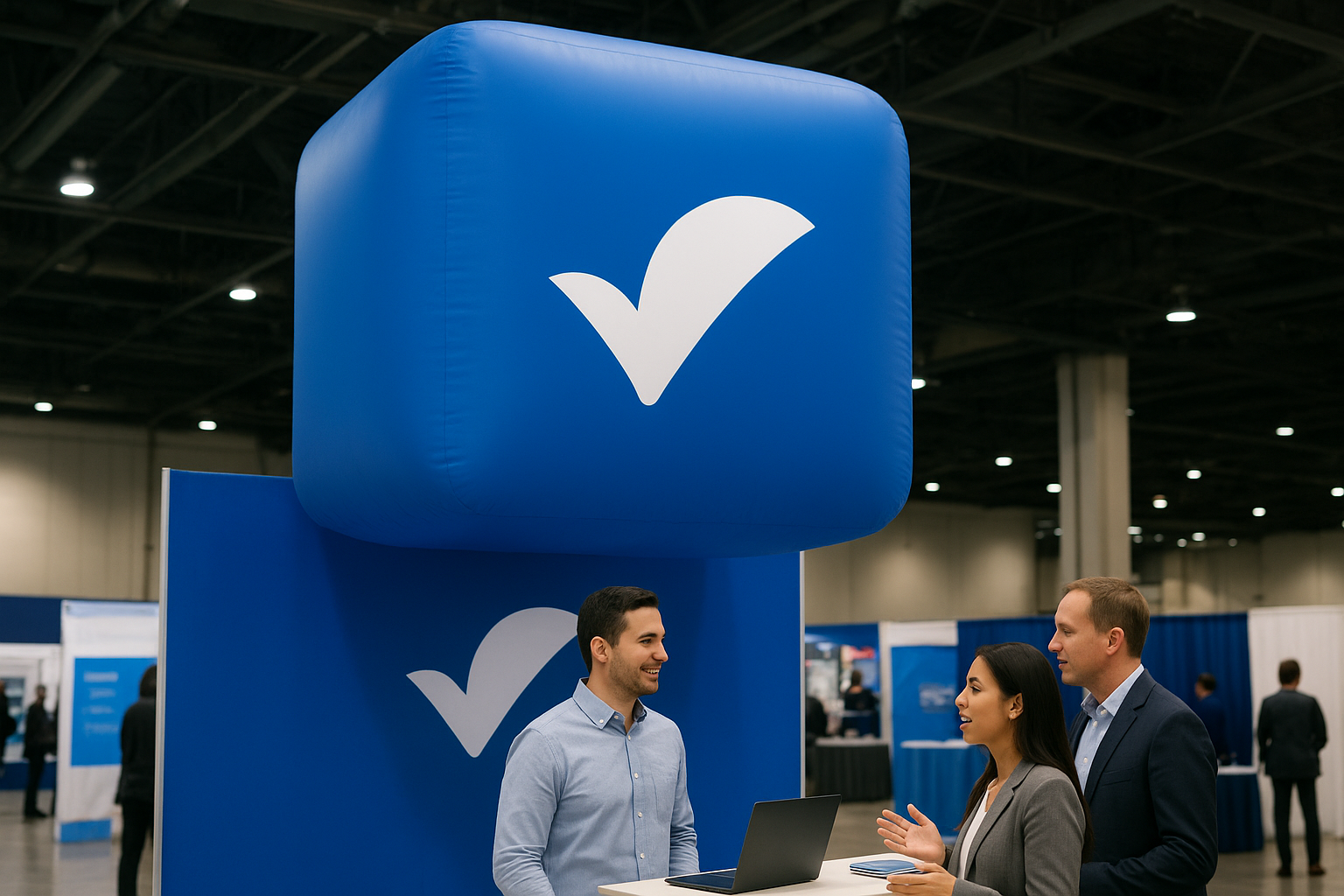
A custom inflatable is one of the most effective trade show booth display ideas you can invest in. Nothing else gives you the same combination of height, color, and movement in a single piece. When you put a large branded inflatable in or above your booth, attendees spot it from the end of the aisle before they read a single word of your signage.
What it is and why it stops traffic
A custom inflatable centerpiece is a three-dimensional branded structure, typically built in the shape of your product, logo, or mascot, that sits inside your booth or rises above it. It works because it breaks the visual pattern of flat banners and standard displays. Height and shape are the two biggest attention triggers on a crowded show floor, and an inflatable delivers both at once.
Most attendees decide whether to stop at a booth within three seconds of seeing it from the aisle. Height wins that decision more often than any other variable.
Best inflatable types for trade show displays
For booth use, product replicas and character inflatables tend to perform best because they’re immediately recognizable and conversation-worthy. Logo balloons work well for brand awareness. Air dancers add motion, which pulls peripheral vision. If ceiling height allows, rooftop or overhead inflatables give you visibility from the entire hall.
How to design it for photos and brand recall
Design your inflatable so it looks good in a phone photo. That means bold colors, clean lines, and your logo or name placed high where it stays visible even when people stand close. Avoid too much text. The goal is that anyone who photographs it and shares it online is essentially running free advertising for your brand.
Setup, power, and safety basics for show floors
Most inflatables run on a small electric fan or blower, which plugs into a standard outlet. Setup typically takes 10 to 20 minutes. Check your show’s exhibitor manual for height restrictions and power allotments before you order, since rules vary by venue. Stake or weight the base to prevent tipping in high-traffic areas.
Budget range and timeline expectations
Custom inflatables for trade shows range from $500 to several thousand dollars, depending on size, complexity, and quantity. Plan for a three to four week production window at minimum. Rush options exist, but ordering early gives your design team time to get the shape and branding exactly right.
2. Go taller with booth signage people can read fast
Vertical signage is one of the most underused trade show booth display ideas available at any budget level. Your booth has roughly three seconds to communicate what you do before an attendee moves on. Height and clarity are the two factors that determine whether those three seconds work in your favor.
What “readable at a glance” looks like on a show floor
Readable signage means your headline sits above eye level, at least six feet high, in large type with strong color contrast. Stick to one core message per sign. If someone walking at a normal pace cannot absorb it instantly, simplify it further.
The simpler your headline, the harder it works across a crowded aisle.
Backdrop and banner choices that travel well
Retractable banner stands and tension fabric backdrops pack flat, set up fast, and hold graphics well under show lighting. Pillowcase-style fabric frames resist wrinkles and hold up through repeated use, making them a reliable choice for companies that exhibit multiple times a year.
Copy and layout that make your offer obvious
Place your company name or key product at the top, followed by one benefit statement in large type. Keep everything else minimal. Negative space helps the eye find what matters instead of scanning past it.
Common signage mistakes that kill foot traffic
- Overloaded text in small font that no one stops to read
- Logos placed low where they get blocked by booth furniture
- Low-contrast color pairings that disappear under fluorescent lighting
Budget range and what to spend money on first
A quality retractable banner runs $150 to $400. A full tension fabric backdrop costs $500 to $1,500 depending on size. Prioritize your headline graphic first, since that single element drives more foot traffic than any other signage investment.
3. Build an interactive demo zone that pulls people in
An interactive demo zone transforms your booth from a passive display into a destination. When attendees can touch, try, or experience something firsthand, they stay longer and remember your brand well after the show ends. This approach is one of the most conversion-friendly trade show booth display ideas you can build around.
Choosing a demo that fits a 30 to 90 second stop
Your demo needs to deliver a clear result fast. Anything that runs longer than 90 seconds will lose people before it finishes. Choose a demo that communicates one specific benefit without requiring any background knowledge from the attendee.
The best demos answer one question: “Why should I care about this right now?”
Hands-on ideas for products and services
Let attendees touch, operate, or test your product directly whenever possible. For service-based businesses, a live comparison tool or a before-and-after visual works well when there is no physical product to hand over.
Staffing and scripting so the booth never feels awkward
Train your team on two or three short opening lines that invite participation without pressure. A scripted opener like “Want to see this in 30 seconds?” keeps interactions focused and removes the hesitation people feel at cold stops.
How to manage lines without blocking your booth
Place queue markers or retractable barriers to guide waiting visitors away from the aisle entrance. Position your demo station toward the back of the booth so foot traffic flows freely past your space.
Budget range from low-tech to high-tech
Low-tech demos cost very little beyond staff preparation time. Tablet-based experiences range from $200 to $1,000 in setup costs, while custom hardware or software demos can run several thousand dollars but typically generate far more measurable engagement data.
4. Use lighting to create contrast and highlight the hero
Most exhibitors skip lighting entirely, which hands you an easy advantage. Strategic booth lighting pulls the eye before any sign or graphic can, making it one of the most underused trade show booth display ideas available at almost any price point.
Why lighting beats more graphics in most halls
Trade show halls run on flat overhead fluorescent light that treats every booth the same. Adding directional light from inside your space creates contrast, and contrast is what guides attendees toward your booth from down the aisle before they even read your signage.
A single well-placed spotlight on your best product does more work than an extra banner ever will.
Simple lighting upgrades that look premium
LED clip-on spotlights attach to banner stands or tent frames in minutes. Battery-powered puck lights work without needing a power drop from the venue. Both options make a fabric backdrop look significantly more polished than it would under ceiling lights alone.
How to spotlight one key product or message
Pick one hero item and aim your brightest light directly at it. Keep everything else slightly dimmer so the focal point reads instantly to anyone stepping into your space. Spreading light evenly across the whole booth dilutes the effect.
Color temperature tips to match your brand vibe
Match your bulb temperature to your brand feel:
- Warm white (2700K-3000K): consumer, lifestyle, and food brands
- Neutral white (3500K-4000K): retail and general commercial
- Daylight (5000K-6500K): tech, medical, and industrial products
Budget range and rental options
Basic LED spotlights run $20 to $80 each, and full lighting kits with stands cost $150 to $500. Check with your venue’s exhibitor services department for rental packages that cut transport costs if you exhibit in one location regularly.
5. Add movement with video, motion, and live activity
Static booths fade into the background on a busy floor. Movement attracts your visitors’ eyes faster than any static graphic, making motion one of the highest-impact trade show booth display ideas you can add without major structural changes.
What to put on a loop so it helps instead of distracts
Keep your video loop under 60 seconds and focused on one outcome: your product working or a clear customer result. Demos, transformations, and before-and-after sequences hold attention far better than company history slides or text-heavy brand reels.
A focused video loop that shows a result in under 30 seconds outperforms a two-minute brand story every time.
Screen placement for small and corner booths
Mount your screen at eye level or slightly above on a back wall or freestanding stand. In a 10×10 booth, angle the screen toward the aisle so passing traffic catches it without needing to step inside first.
Low-cost motion ideas beyond a TV
Not every motion element requires a screen. Consider these lower-cost options:
- Rotating product stands placed on your table surface
- A fan-powered banner or small inflatable element
- Structured staff movement through a repeating demo routine
Sound and captioning so you stay accessible
Keep audio low or off entirely in dense halls. Add bold captions to every video so your message lands clearly even when attendees cannot hear it over crowd noise.
Budget range and equipment checklist
A basic screen and stand setup runs $200 to $600. Pack a media player, power strip, and mounting hardware alongside your display. Budget an additional $50 to $150 for cabling and accessories.
6. Make the layout feel open, welcoming, and easy to enter
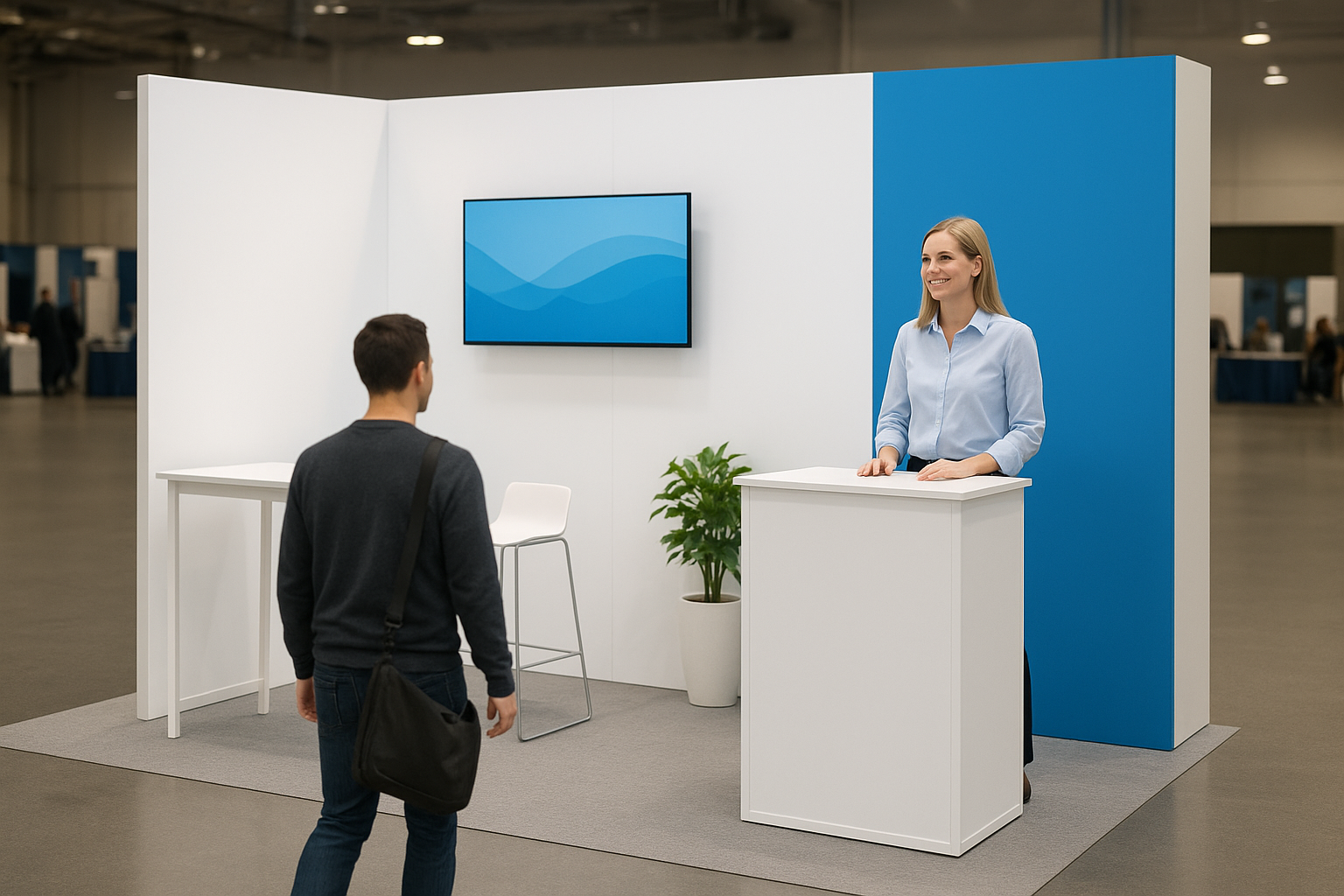
Your booth layout determines whether attendees walk in or walk past. Among all trade show booth display ideas, open floor plans consistently outperform walled-off setups because they remove the psychological barrier of entering a stranger’s space.
The “no front table wall” rule and what to do instead
A table stretched across your booth entrance signals “salesperson territory” and pushes people away. Move your table to the side or back wall and use a tall counter or podium instead, which keeps your space visually open from the aisle and invites people to step in without feeling cornered.
Removing the front table barrier alone can noticeably increase walk-in traffic at most shows.
Traffic flow for 10×10 and 10×20 spaces
In a 10×10 booth, place your hero display or demo at the back and keep the center clear. Larger 10×20 spaces benefit from a U-shaped layout that draws visitors in naturally while leaving two entry points open on either side.
Seating, charging, and micro-break areas that work
Adding one or two stools and a charging station gives attendees a reason to linger, which extends your conversation window. Keep seating toward the back so it pulls people deeper into your booth rather than blocking the entrance.
Accessibility basics for aisles, counters, and demos
Keep aisles at least 36 inches wide inside your booth and set counters at a height that works for wheelchair users. Accessible design signals professionalism and makes your booth welcoming to every attendee on the floor.
Budget range and space-saving furniture picks
Folding counters and modular shelving cost between $80 and $300 and pack flat for easy transport. Prioritize lightweight, multi-purpose pieces that serve as both display surfaces and storage to get the most from a limited booth footprint.
7. Upgrade your flooring to change the feel fast
Flooring is one of the most overlooked trade show booth display ideas on any exhibitor’s planning list. When you swap bare concrete for a finished surface, your booth immediately feels more intentional and polished, which signals to attendees that you take your brand seriously.
Why flooring changes how long people stay
Comfortable flooring keeps people in your booth longer, and more time means more conversation. Hard concrete surfaces make attendees want to keep moving, while a softer or warmer surface subconsciously signals that your space is a place to stop and talk.
A finished floor separates your booth from the show hall visually, giving you a defined space that feels more like a branded environment than a rental square.
Rug, foam tile, and vinyl options compared
Interlocking foam tiles are the most budget-friendly option and pack into a carry bag. Rolled vinyl wrap looks premium and handles heavy foot traffic better than foam. Carpet tiles split the difference and come in a wide range of colors to match your brand palette.
How to keep edges flat and avoid trip hazards
Tape all perimeter edges down with double-sided carpet tape before the show opens. Bring extra tape in your kit for mid-show adjustments if corners lift.
Matching flooring to your brand without custom printing
Choose a solid color that complements your brand palette rather than clashes with it. Dark flooring makes lighter displays pop, while neutral gray or beige works across almost any brand color scheme.
Budget range and transport tips
Basic foam tile kits run $50 to $150 for a 10×10 space. Vinyl options cost $200 to $500. Roll flooring tightly and store it in a protective tube or bag to prevent creasing between shows.
8. Use smart giveaways that start conversations and capture leads
Giveaways are one of the most misused trade show booth display ideas in the industry. Most exhibitors set free items on the table and hope for the best. Done strategically, a smart giveaway system pulls qualified visitors into real conversations and gives you a structured reason to follow up after the show closes.
Choosing swag people keep and actually use
Skip logo pens and cheap notepads. Choose items attendees actually use beyond the show, like a quality tote bag, portable charger, or branded notebook. Practical swag travels home and keeps your brand visible long after the hall empties out.
Placement and timing so giveaways do not attract freebie-only crowds
Keep giveaways behind your booth staff, not sitting open on your front table. Hand them out after a short conversation, not before, so your item reaches people who actually care about your product rather than those just working the aisle for free things.
The best giveaway only makes full sense once someone understands what your business does.
Simple games, drawings, and photo moments that work
A quick raffle or spin-to-win game gives you a natural reason to collect contact information without it feeling transactional. Photo moments next to a branded inflatable or backdrop create shareable content that extends your reach well past the show floor.
Lead capture options from paper to QR codes
Use a QR code linked to a simple intake form or a badge scanner if your show provides one. Paper sign-up sheets work as a backup but require manual data entry later, which slows your follow-up.
Budget range and follow-up plan for after the show
Set aside $200 to $600 for swag depending on quantity and item quality. Send your follow-up emails within 48 hours of the show closing, while your conversations are still clear in attendees’ minds.
Looking for more inspiration, we Love Pinterest, check out: https://www.pinterest.com/experientialhub/trade-show-booths/
Quick recap and next steps
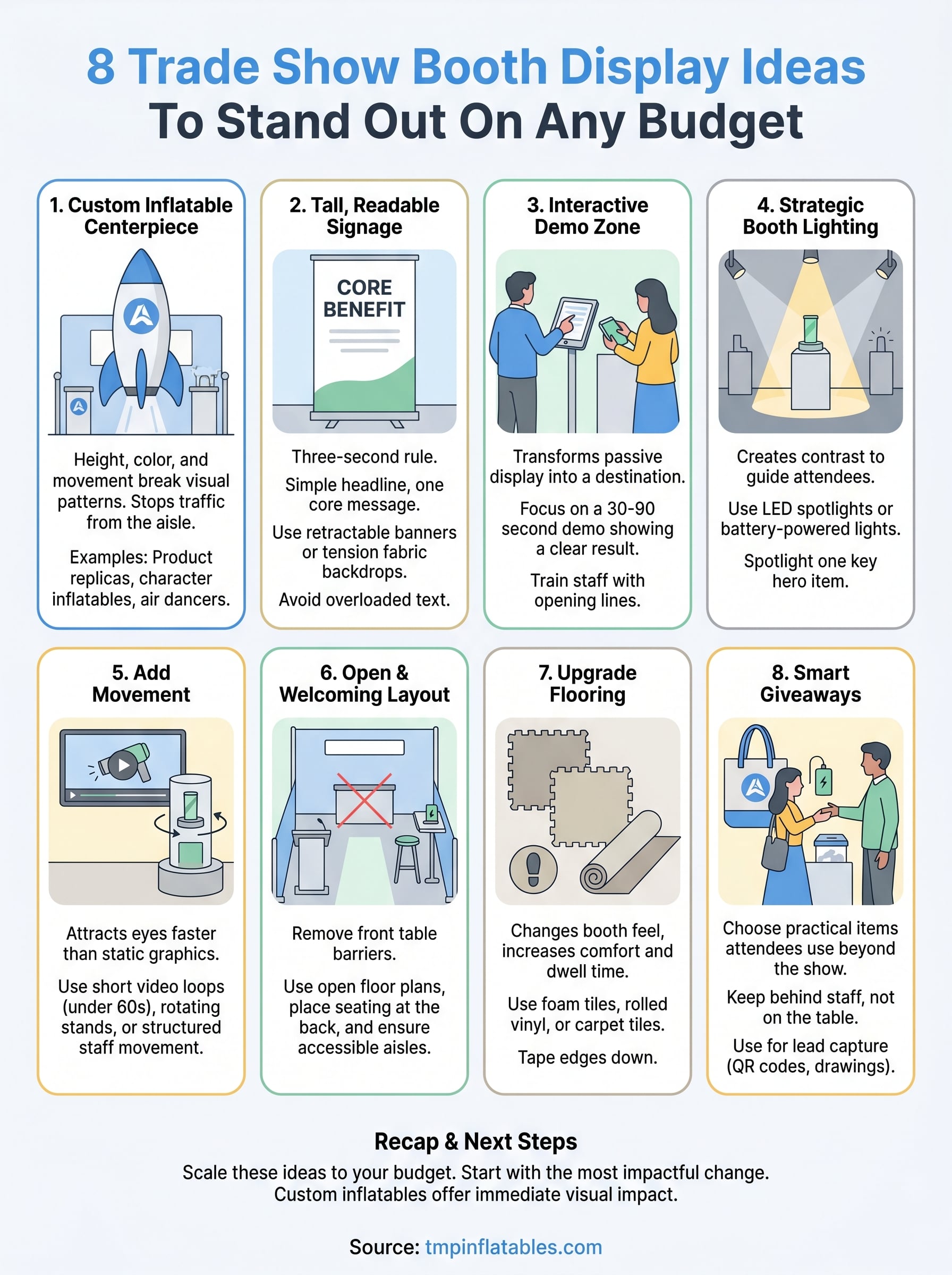
These eight trade show booth display ideas cover every major lever you can pull to increase foot traffic, hold attention, and convert conversations into leads. You do not need to use all of them at once. Start with the changes that address your biggest weakness, whether that is visibility from the aisle, an awkward layout, or a forgettable first impression, and build from there.
Every idea on this list scales to different budgets and booth sizes. A custom inflatable centerpiece tends to deliver the most immediate visual impact because it works at a distance before anyone reads a single word of your signage. If you want to go that route, the next step is straightforward. Request a custom inflatable quote from TMP Inflatables and get a design that fits your brand, your booth space, and your show timeline.
