

Most advertising gets ignored. Billboards blur together, digital ads get skipped, and sponsored posts get scrolled past without a second thought. But when a 20-foot inflatable replica of your product towers over a busy intersection or a branded arch frames the entrance to a packed event, people stop. They look. They pull out their phones. That reaction, turning passive audiences into active participants, is the core of what is brand activation and why it matters more than ever for companies trying to cut through advertising noise.
At TMP Inflatables, we’ve spent over 20 years building custom inflatables for brands that refuse to blend in. From giant rooftop balloons to immersive event tents, our work sits squarely in the brand activation space, giving companies a physical, impossible-to-ignore presence wherever their audience gathers. We’ve seen firsthand what works, what falls flat, and what gets people talking.
This article breaks down brand activation as a strategy: what it actually means, how it differs from traditional marketing, real examples worth studying, and practical ideas you can run with. Whether you’re planning a product launch, a trade show booth, or a street-level campaign, you’ll walk away with a clear framework for building activations that deliver results.
What brand activation is and is not
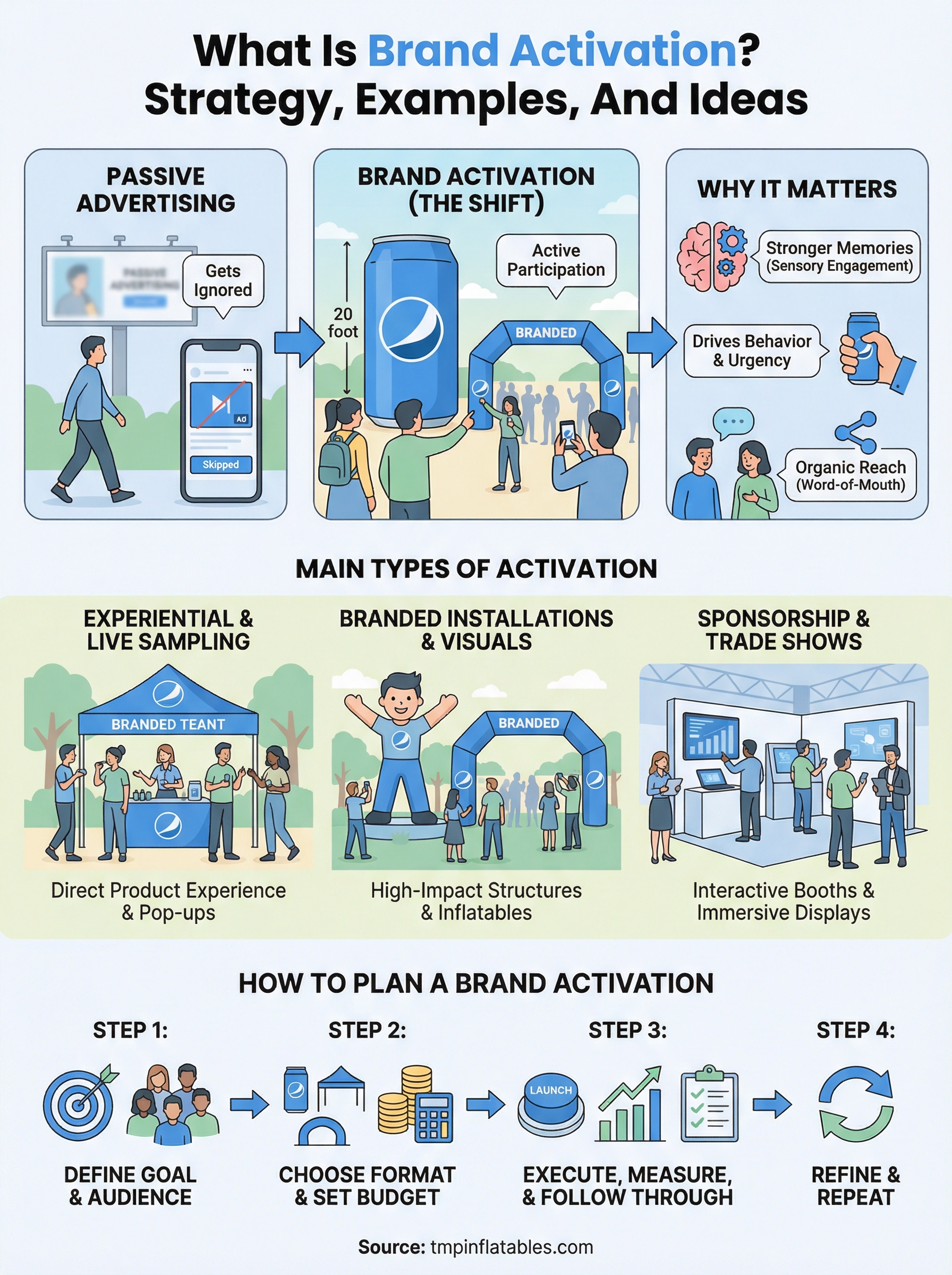
Brand activation is a marketing approach built around creating direct, meaningful interactions between your brand and your audience. Instead of broadcasting a message and hoping it sticks, you design an experience that pulls people in and gives them something to do, feel, or remember. Understanding what is brand activation comes down to one idea: you move your audience from passive awareness to genuine engagement through a specific, intentional moment.
What brand activation actually means
At its core, brand activation is about creating a triggering event, a moment when someone shifts from knowing your brand exists to actually caring about it. That shift can happen at a product sampling station, during an experiential pop-up, at a live event, or through a striking visual installation that makes someone stop mid-stride and reach for their phone. The common thread across all of these is active participation from your audience rather than passive consumption of a message.
The difference between advertising and activation is this: advertising asks people to notice you, while activation gives them a reason to engage.
Brand activation can take many forms, and the format matters less than the intention driving it. A well-executed activation creates a memory, drives a behavior, or deepens loyalty. It works because people trust experiences more than they trust messages. When someone interacts with your brand firsthand, that interaction carries more weight than hundreds of impressions from a display ad they scrolled past without thinking.
What brand activation is not
Brand activation is not the same as general advertising or content marketing, even though all three can support each other. Running a social media campaign, publishing a blog, or airing a TV spot are awareness tools. They push information outward. Brand activation, by contrast, pulls your audience into a two-way experience where your brand is something they encounter, touch, or participate in directly, not just something they see.
It is also not a stunt. Some brands confuse activation with a one-off spectacle designed purely for shock value. A stunt might generate short-lived buzz, but a true brand activation aligns with what your brand stands for and moves your audience toward a specific goal, whether that’s a purchase, a sign-up, or a deeper emotional connection. If the experience ends and people have nothing to connect back to your brand, it was noise, not activation.
Finally, brand activation is not limited to large budgets or major corporations. A regional retailer setting up a branded inflatable arch at a local festival, a startup sampling products at a farmers market, or a sports team deploying a branded tent at a community event all qualify. The scale is secondary. What matters is that the experience is deliberate, clearly branded, and designed to move people toward a measurable action.
Why brand activation matters
Understanding what is brand activation is only the first step. The real question is why it deserves a dedicated spot in your marketing strategy alongside traditional advertising. The short answer is that consumer attention is scarce and skepticism is high. People have learned to filter out ads, mute commercials, and install blockers. Brand activation cuts through that resistance because it doesn’t ask for attention; it earns it through an experience worth having.
Experiences create stronger memory traces
When someone physically interacts with your brand, their brain processes that moment differently than it processes a banner ad. Sensory engagement, whether through touch, movement, or scale, encodes memories more deeply than passive viewing does. This is why seeing a 15-foot inflatable version of a product at a street-level event stays with someone far longer than seeing a digital ad for the same product. The interaction becomes a story they tell, and word-of-mouth generated by real experiences costs you nothing extra but delivers outsized reach.
Experiences people participate in are far more likely to be shared than content people simply consume.
Brand activation drives behavior, not just awareness
Awareness has value, but it doesn’t pay invoices. Brand activation is designed to move your audience toward a specific action, whether that’s signing up, buying, or forming a strong enough impression to choose your brand the next time they need what you sell. Because activations are event-specific and time-bound, they also create urgency that standard advertising rarely generates. When someone walks past a branded tent or pauses at a live sampling station, the decision window is immediate.
Your campaigns can build reach over weeks, but a single well-planned activation can compress that journey into minutes. Brands that combine ongoing digital advertising with physical activation events consistently outperform those that rely on either channel alone, because the two approaches reinforce each other in ways that neither can achieve on its own.
The main types of brand activation
Once you understand what is brand activation, the next step is knowing which format fits your goals, budget, and audience. Activations fall into several distinct categories, and choosing the right one determines whether your effort generates lasting impact or fades quickly after the event wraps up.
Experiential events and live sampling
Experiential activations put your audience inside the brand experience rather than outside looking at it. Pop-up events, live demonstrations, and product sampling stations all fall here. Your audience gets to touch, taste, or try your product directly, which builds the kind of trust that no digital impression can replicate.
These work particularly well for consumer brands launching new products or entering new markets. When someone engages with your brand firsthand, that memory sticks in a way a banner ad never will, and it gives them a story worth sharing with others.
Direct product experience converts skeptical observers into committed buyers faster than almost any other marketing format.
Branded installations and visual activations
Visual activations are physical, high-impact structures or displays that anchor your brand to a specific location or moment. Giant inflatable product replicas, branded arches, custom tents, and towering characters belong in this category. These installations work because scale and presence command attention without requiring your audience to opt in, making them especially effective in high-traffic outdoor spaces where your brand competes with heavy visual noise.
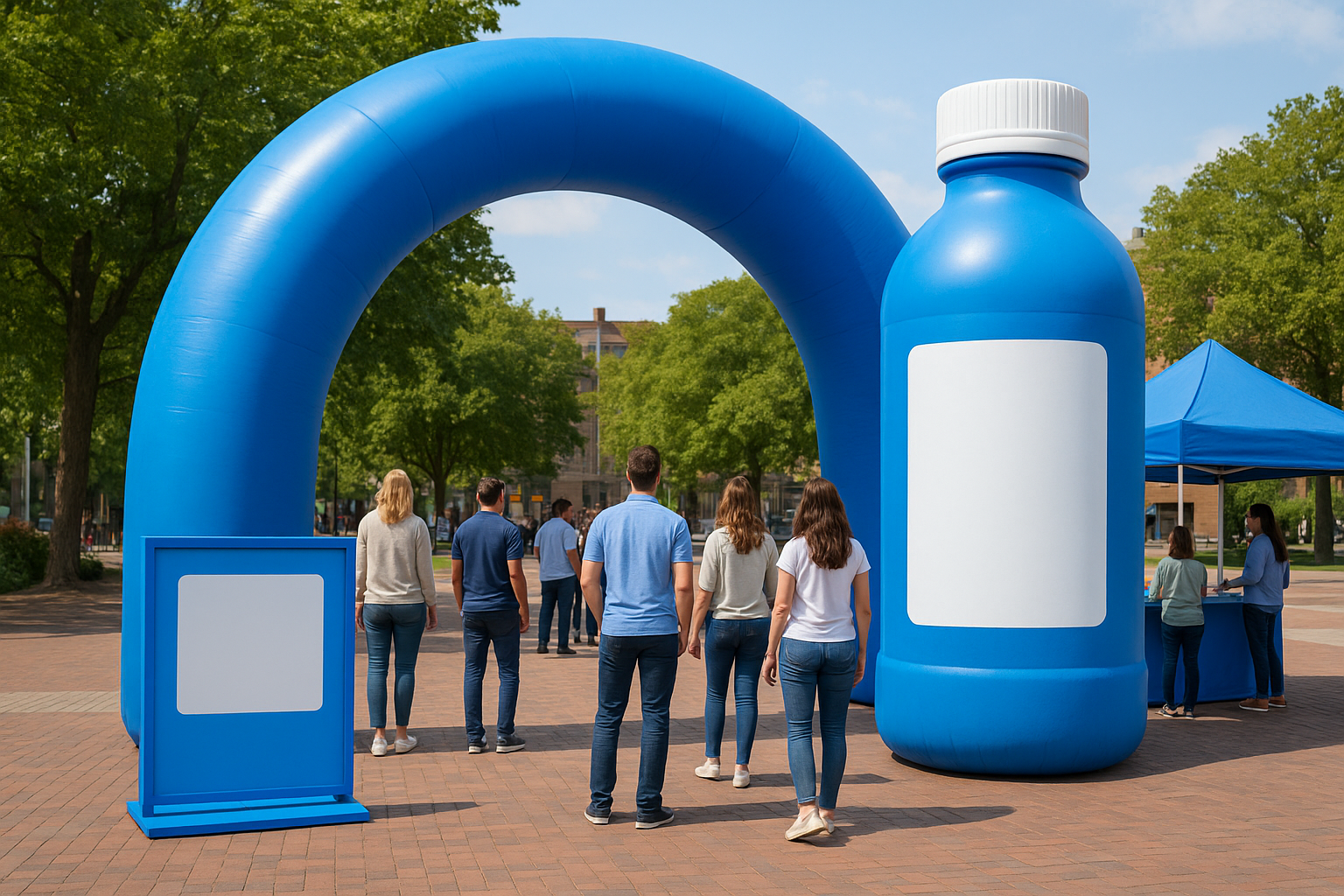
Branded installations also function as organic social sharing triggers. When something is large, striking, or unexpected, people photograph it and spread it across their own networks, extending your reach well beyond the physical footprint of the event.
Sponsorship and trade show activations
Sponsoring an event or exhibiting at a trade show gives you an established audience and built-in context for your activation. The brands that succeed here go beyond a simple logo placement by building interactive booths, branded zones, or immersive displays that give attendees a concrete reason to stop and engage. Passive sponsorship delivers awareness; active, intentional activation at that same event drives measurable follow-through.
How to plan a brand activation step by step
Knowing what is brand activation in theory is useful, but turning that knowledge into a real campaign requires a structured approach. Most activations that fall flat do so not because the idea was weak, but because critical planning steps got skipped that determine whether the experience lands with your audience or misses entirely.
Define your goal and your audience
Every successful activation starts with a single, specific goal. Are you driving product trials, collecting leads, or building local awareness? Your goal shapes every decision that follows. Once your goal is clear, map it to the specific audience you want to move, because an activation built for everyone rarely connects with anyone.
The sharper your goal, the easier every subsequent decision becomes.
Build your brief around these two questions before you spend a dollar:
- What do you want your audience to do, feel, or decide after the activation?
- Where does this audience already gather, and when?
Choose your format and set your budget
Once you know your goal and audience, match those factors to a format that fits your context. Consider where your audience gathers and what level of investment your goal justifies, because a well-placed branded installation at a high-traffic location often outperforms a larger spend on a poorly targeted activation.
| Goal | Recommended Format |
|---|---|
| Product trial | Live sampling or demo station |
| Brand awareness | Visual installation or inflatable display |
| Lead generation | Interactive booth or branded tent |
| Community connection | Sponsored local event activation |
Execute, measure, and follow through
Execution is where plans either hold or fall apart. Brief your team thoroughly and confirm all logistics at least a week before the event so you handle on-site issues without scrambling. Set your metrics before launch so you measure what actually matters to your goal, not just what is easy to count.
After the activation wraps, track the numbers tied to your original objective, whether that’s foot traffic, sign-ups, or direct sales attributed to the event. Those results become your roadmap for making the next activation more effective than the one before it.
Brand activation ideas and examples
Knowing what is brand activation gives you the concept, but seeing it applied to real scenarios makes it easier to translate into your own campaigns. The ideas below span different formats, budgets, and contexts, so you can pull directly from this list when you’re building your next activation brief.
Physical and visual activations that stop traffic
A giant inflatable product replica placed at a busy intersection or outside a stadium creates an immediate visual anchor for your brand. Branded arches at event entrances frame every attendee’s arrival moment with your logo, turning a functional structure into a high-visibility marketing asset. Misting tents at summer festivals pull people in with practical comfort while keeping your brand front and center for as long as they stay cool.
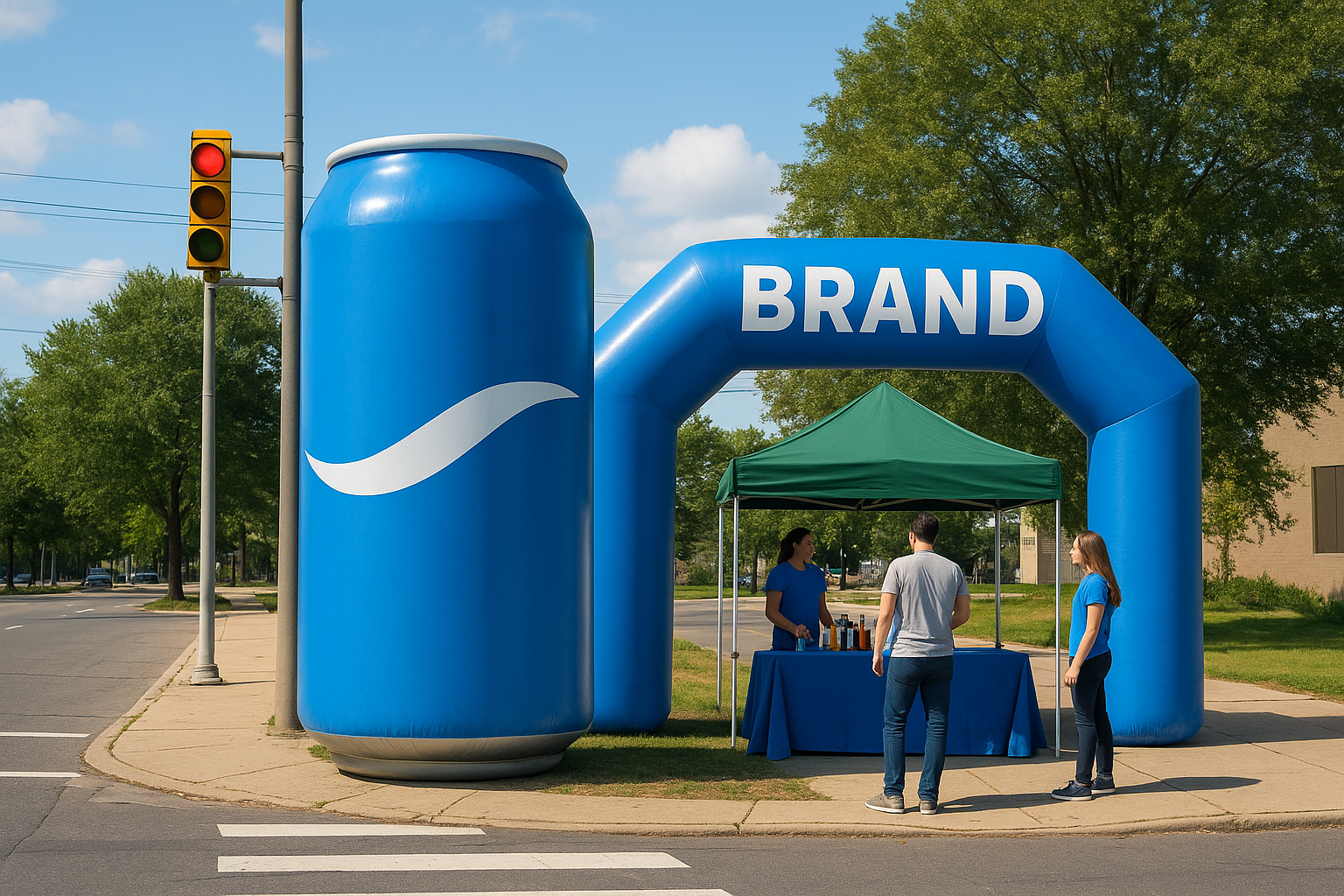
When your activation solves a real problem for your audience, like shade on a hot day, engagement follows naturally without extra persuasion.
Scale and physical presence communicate confidence in a way digital formats cannot. Passersby don’t need to opt in; a well-placed branded installation demands attention on its own terms.
- Giant inflatable product replicas at outdoor events and retail openings
- Branded arches at race finish lines, stadium entrances, or festival gates
- Custom inflatable characters at product launches or trade show floors
- Branded misting tents at summer outdoor events
- Air dancers outside pop-up retail locations to draw immediate foot traffic
Real-world examples worth studying
A regional auto dealership can position a branded inflatable balloon on its rooftop during a model launch weekend, drawing drive-by attention across a wide radius without relying on paid digital ads. A consumer beverage brand can pair a street-level sampling station with a towering branded arch nearby, so every person who tries the product does so framed by the brand, reinforcing the visual memory at the exact moment of first taste.
Both examples show how combining a functional activation element with a high-visibility structure multiplies impact well beyond what either approach delivers on its own. The result is a campaign moment people remember and repeat to others.
Final thoughts
Brand activation works because it shifts your audience from passive observers to active participants. Now that you understand what is brand activation and how it operates across formats, budgets, and goals, the framework is straightforward: pick a specific goal, match it to the right format, and build an experience people will remember long after the event ends.
Physical activations, whether a giant inflatable installation at a product launch or a branded arch at a busy festival entrance, remain one of the most reliable ways to generate that kind of reaction. When people stop, photograph, and share what they see, your brand earns something advertising budgets alone rarely buy: genuine attention and organic reach that extends well beyond the event itself.
If you’re ready to build something that commands real presence at your next campaign, request a quote for a custom inflatable and our team will help you design the right activation for your specific goal.

