

People skip ads. They scroll past banners. They mute commercials. But they don’t walk away from something they can physically step into, touch, or experience firsthand. That’s the core idea behind experiential marketing, a strategy built on real-world, interactive brand moments that stick with people long after the event ends.
Unlike traditional advertising that talks at consumers, experiential marketing invites them in. It turns passive audiences into active participants through immersive activations, live events, pop-ups, and branded installations. The result? Stronger emotional connections with your audience and measurable returns that go well beyond impressions on a screen.
At TMP Inflatables, we’ve spent over 20 years designing and producing custom inflatables, branded tents, inflatable arches, costumes, and large-scale promotional products that serve as the physical backbone of experiential campaigns. We work directly with experiential and creative agencies across the U.S., Canada, the Caribbean, and Latin America, so we’ve seen firsthand what makes these activations succeed and what falls flat. That hands-on perspective shapes everything in this guide.
This article breaks down exactly what experiential marketing is, how it works in practice, and why brands are investing more in it every year. You’ll find real-world examples, a clear look at ROI, and actionable insight into building campaigns that people actually remember. Whether you’re pitching a concept to a client or planning your own activation, this is where you start.
What experiential marketing is
At its simplest, experiential marketing is a strategy where brands create live, interactive experiences that allow people to engage directly with a product, service, or message. Instead of describing a brand to potential customers, you put them inside it. When someone asks what is experiential marketing, the honest answer is: it’s the difference between a billboard and a moment someone talks about for weeks.
The core definition
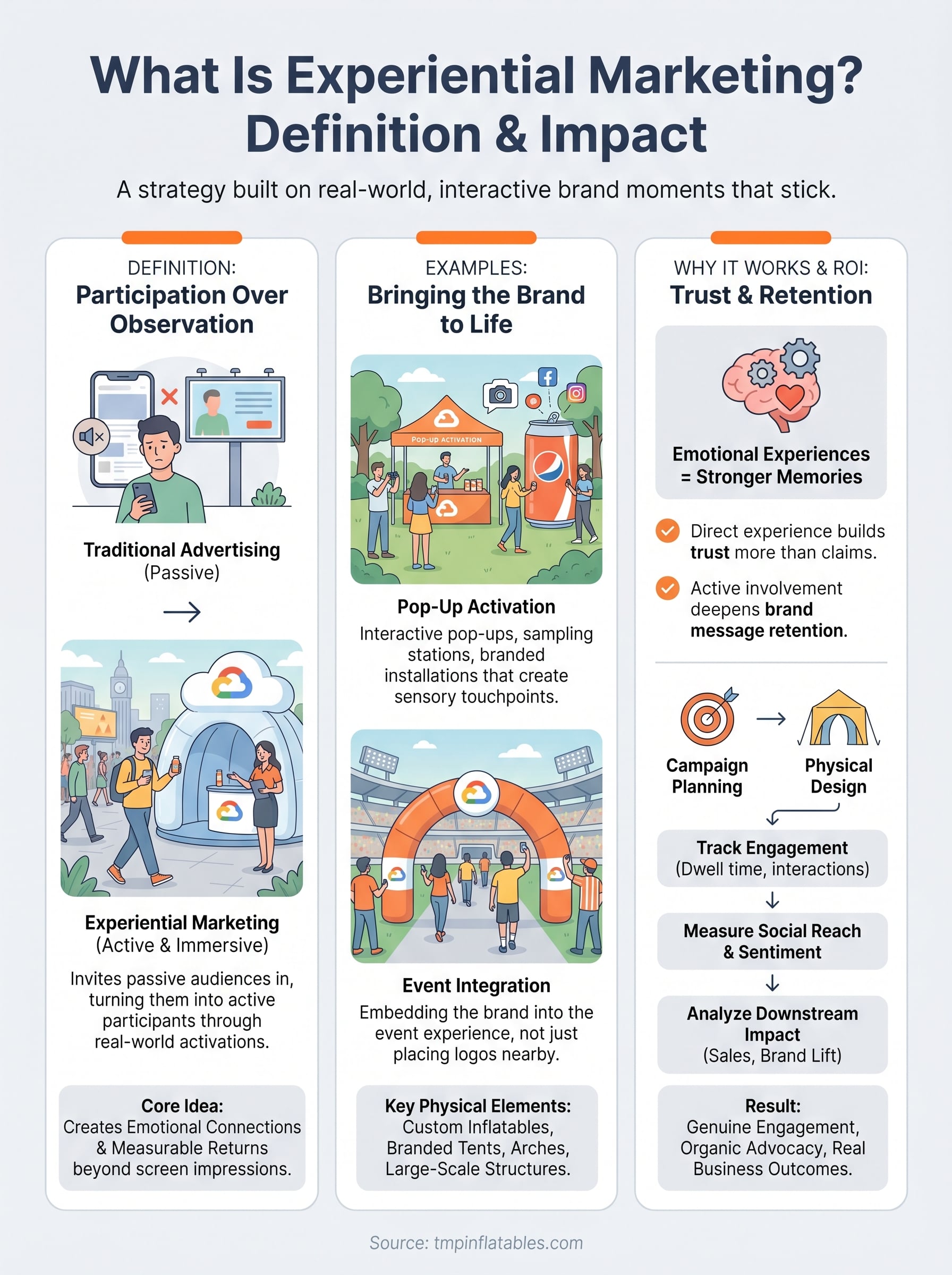
Experiential marketing centers on participation, not passive observation. Traditional marketing delivers a message. Experiential marketing builds a memory. You design a situation where your audience becomes part of the brand story rather than a spectator watching it from the outside.
Experiential marketing works because people remember what they do far more than what they see or hear.
This approach spans a wide range of formats. A pop-up activation in a busy public space invites people to try something new. A branded installation at a trade show gives attendees a reason to stop, stay, and share. A product sampling station with a bold visual presence creates a sensory touchpoint that digital advertising cannot replicate. The format matters less than the outcome: you want people to feel something and connect that feeling directly to your brand.
What it looks like in practice
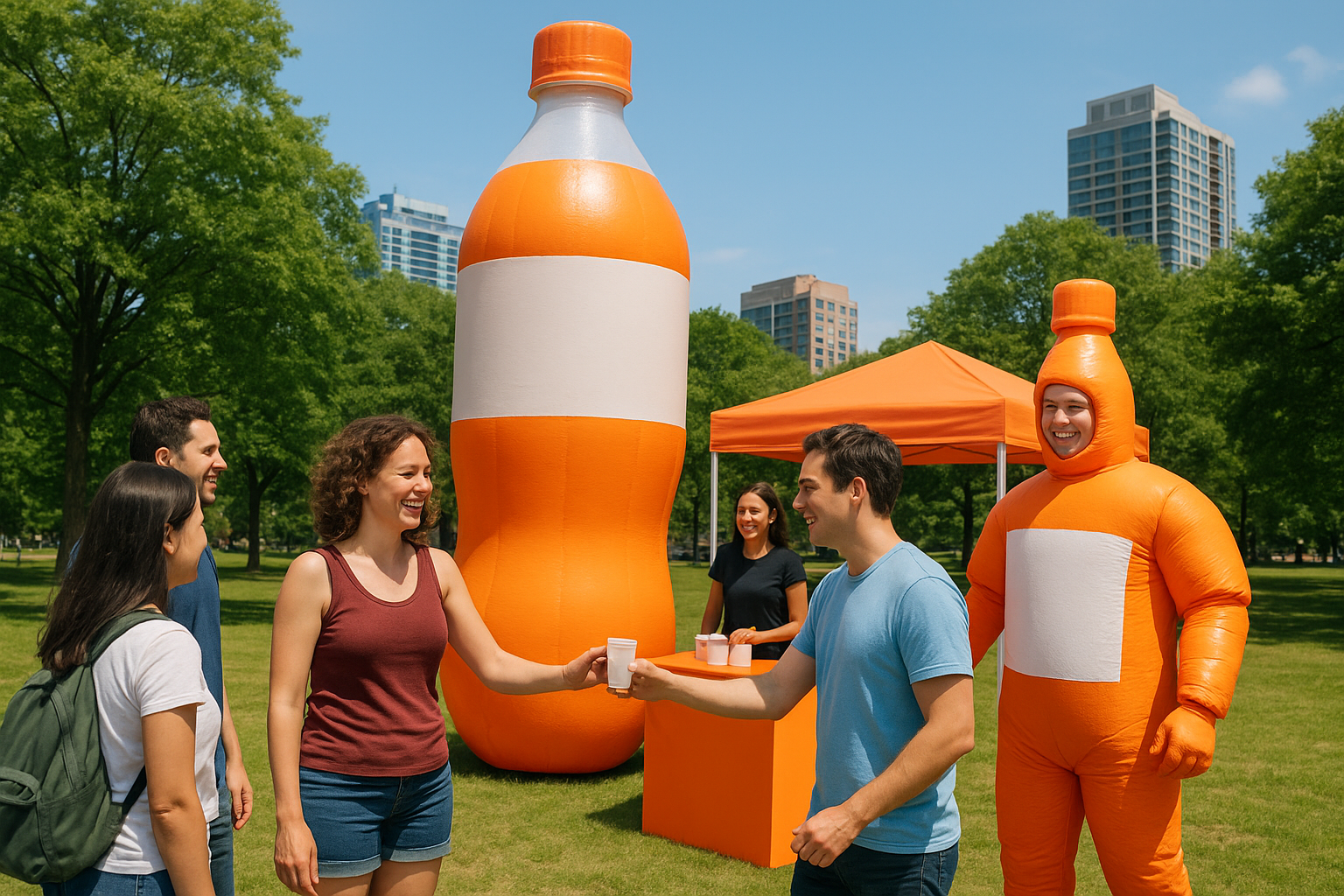
Concrete examples make this easier to understand. Consider a beverage brand that sets up a custom inflatable structure shaped like their product in the middle of a city park. People walk up, take photos, try free samples, and interact with brand ambassadors. That single activation reaches real foot traffic, generates social content organically, and creates a physical memory tied directly to the product.
Another example: a sports team uses a giant branded arch at the entrance to a stadium event. Every fan walks through it. Every fan photographs it. The brand gets embedded in the experience of attending the game rather than just printed on a surface nearby. That’s a fundamentally different relationship between a brand and its audience.
These activations rely on physical elements to anchor the experience. That’s where products like custom inflatables, branded tents, inflatable costumes, and large-scale structures become essential tools. They create the environment that makes the moment feel real, tangible, and worth engaging with. You’re not renting attention from a distracted audience. You’re building genuine engagement on your own terms.
Experiential marketing also applies across a broad range of industries. Retail brands use it to launch products with real impact. Real estate developers use it to generate buzz around new properties and communities. Event organizers use it to amplify the energy of concerts, festivals, and sporting days. The scale and format change depending on the goal, but the principle stays consistent: give your audience something to actually experience, and they will do a significant portion of your marketing work for you.
Why experiential marketing works
Understanding why experiential marketing works starts with how people actually form memories and make purchasing decisions. Emotional experiences create stronger, longer-lasting memories than information delivered through traditional advertising. When someone physically participates in a brand moment, their brain encodes it differently than a static ad viewed for two seconds on a phone screen. That difference is not subtle. It drives real behavior at every stage of the customer journey.
People trust what they experience firsthand
Research in cognitive psychology consistently shows that direct experience shapes attitudes far more powerfully than secondhand exposure. When you let a customer physically interact with your product or brand environment, you remove the skepticism that every polished advertisement carries. They are not reading your claims. They are forming their own conclusions based on what they touched, heard, and saw. That distinction matters when you consider what is experiential marketing at its core: a strategy that puts the audience in control of how they interpret your brand.
The most credible brand statement you can make is one your audience reaches on their own, through direct experience.
This shift in trust has a multiplier effect. A person who walks through your branded activation and enjoys it becomes an advocate, not just a customer. They share the experience socially, describe it to friends, and carry a positive association with your brand that no retargeted ad can build.
Participation drives retention
The second reason experiential marketing consistently outperforms passive advertising comes down to active involvement. When someone participates in an experience rather than observing it, they process and retain the brand message at a much deeper level. Attention is no longer borrowed. It is earned and held.
Consider what happens at a well-executed activation. Attendees make choices, interact with staff, take photos, and sometimes bring others along. Each of those touchpoints reinforces the brand message without feeling like a sales pitch. The result is a lasting impression that travels far beyond the event itself, carried by the people who were actually there.
Experiential marketing vs event marketing
People often use these two terms interchangeably, but they describe different things. Event marketing means organizing or sponsoring an event to promote a brand, product, or service. The event itself is the vehicle. Experiential marketing focuses on the quality and depth of the interaction that happens during that activation. One is about showing up. The other is about what you actually create when you’re there.
The difference between event marketing and experiential marketing is the difference between attendance and immersion.
Where the overlap ends
Both approaches put a brand in front of a live audience, but event marketing tends to treat that audience as a crowd to be reached, while experiential marketing treats each person as a participant to be engaged. A brand sponsoring a concert and placing its logo on a banner is doing event marketing. That same brand building a custom interactive installation at the same concert, where fans step inside a branded environment and generate their own shareable moments, is doing experiential marketing.
The distinction matters when you’re planning a budget and setting expectations. Event marketing measures success through attendance numbers and brand impressions. Experiential marketing tracks deeper signals: how long people engaged, how many shared the experience, and how strongly the interaction shifted brand perception.
Why the distinction matters for your campaigns
Understanding this difference helps you make smarter decisions about where your investment goes and what outcomes you can realistically expect. If your goal is broad awareness, event marketing can accomplish that. If your goal is to build genuine emotional connection with your audience and generate organic advocacy, you need the experiential layer on top of it.
Many of the most effective campaigns combine both. You attend or sponsor an event, then you build something within that space that people want to actively participate in. Knowing what is experiential marketing and how it differs from simply showing up at an event gives you a clear strategic advantage when pitching concepts and allocating resources.
How to plan and run a campaign
Knowing what is experiential marketing is one thing. Turning that knowledge into a campaign that actually runs is another. Every successful activation starts with a clear process, and skipping steps in that process is where most campaigns fall flat. The framework is straightforward once you break it down into manageable phases, and working through each one deliberately keeps your budget, timeline, and creative direction aligned.
Start with a clear objective
Your objective shapes every decision that follows, from where you host the activation to what physical elements you build. Before you sketch a concept or request production on a custom inflatable, you need a defined answer to one question: what do you want someone to feel, do, or believe after engaging with your brand?
Vague goals produce vague results. The more specific your objective, the more directly you can design an experience that achieves it.
Common objectives include driving product trial, building brand awareness in a new market, generating organic social sharing, or supporting a product launch. Each of these requires a different design approach, a different environment, and different physical assets to deliver it effectively. Pin down your objective first, then build everything else around it.
Design the physical experience
Once your objective is clear, build your environment around it. The physical elements of your activation do most of the heavy lifting. They attract attention, signal your brand, and give people a reason to stop and engage. A towering custom structure, a branded tent that people can walk through, or a large-scale product replica creates immediate visual impact that pulls foot traffic toward your space rather than away from it.
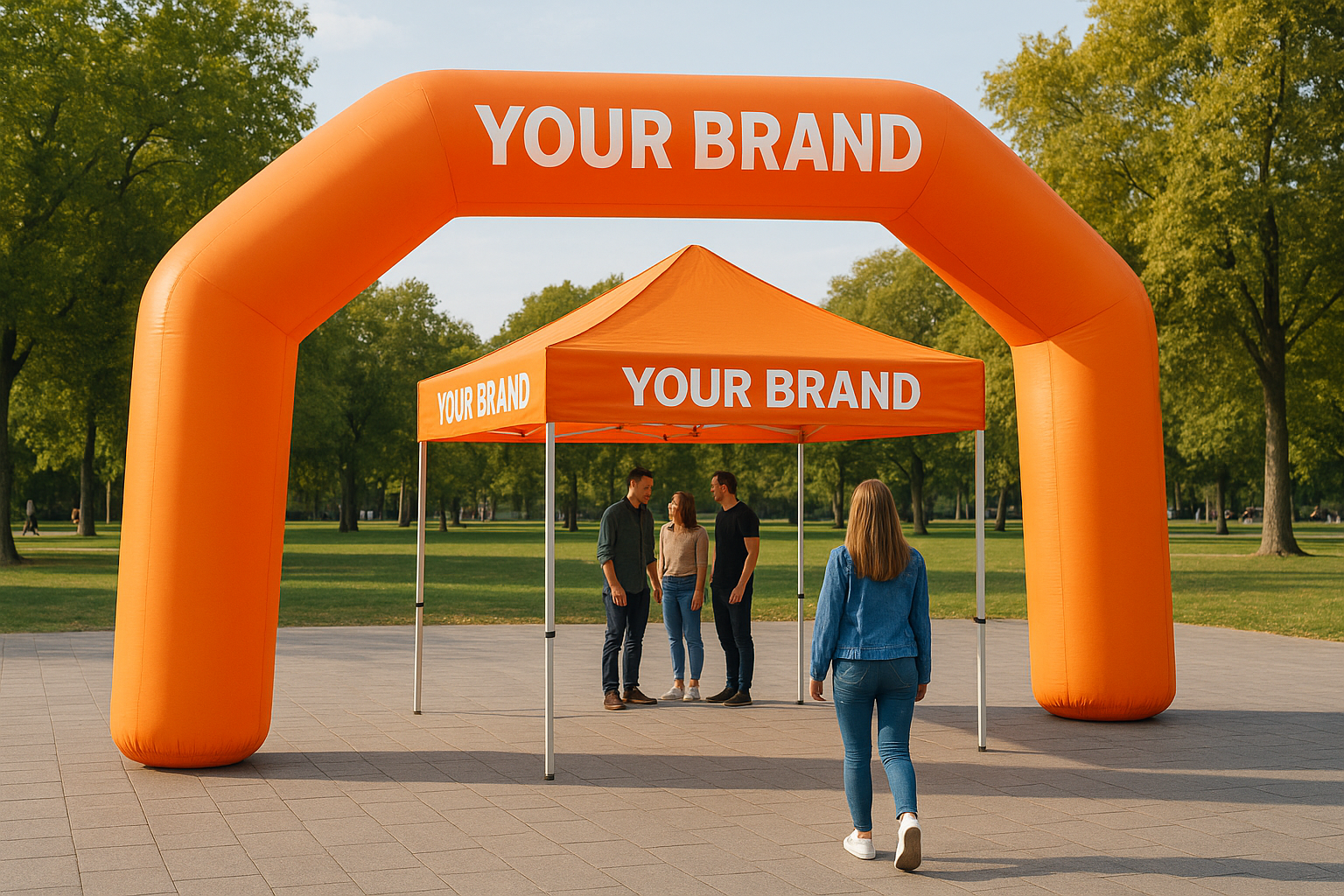
Scale and visibility matter more than most teams anticipate at busy events or crowded public spaces. Your activation competes with everything else in that environment for attention, so your physical presence needs to cut through. A well-designed inflatable arch or oversized branded character accomplishes that in a way a folding table and a printed banner simply cannot. Match your physical scale to the size of your audience and the density of your environment, and your campaign has a real foundation to build on.
How to measure ROI and success
One of the most common concerns around experiential marketing is accountability. How do you quantify something as intangible as a memory or an emotional connection? The answer is that you don’t measure the feeling directly. You measure the behaviors that feeling produces, and those behaviors leave clear, trackable signals if you set up your measurement framework before the activation launches, not after.
Track engagement during the activation
Real-time data collection during your event gives you a foundation to work from. Count the number of people who physically interacted with your space, how long they stayed, and how many requested more information or took a next step like signing up or scanning a QR code. These dwell time and conversion metrics tell you how effectively your activation held attention and moved people toward your objective.
Social reach adds another layer. Track how many people posted content featuring your activation, what total organic reach those posts generated, and what sentiment surrounded the mentions. When people share your branded experience voluntarily, that organic amplification has measurable value you can compare directly against paid media costs for equivalent reach.
If someone shares your activation unprompted, that single post carries more credibility than a targeted ad served to the same audience a hundred times.
Measure downstream impact
Post-event surveys give you direct insight into brand perception shifts. Ask attendees whether the experience changed how they think about your brand, and compare those responses to a baseline gathered from people who did not attend. This before-and-after comparison makes the impact on brand awareness and sentiment concrete and defensible when you report results to clients or leadership.
Sales data and lead quality round out the picture. Monitor conversion rates and purchase behavior in the weeks following your activation and compare them against periods without experiential activity. Knowing what is experiential marketing in terms of real business outcomes means connecting your event investment to revenue signals, not just attendance numbers. When those connections are clear, the ROI case makes itself.
Quick recap and next step
Experiential marketing puts your audience inside your brand story rather than placing ads in front of them. When you understand what is experiential marketing at a strategic level, the path forward becomes clear: create real moments that people choose to participate in, and you build trust, retention, and advocacy that no banner ad can match. The gap between event marketing and experiential marketing comes down to depth of engagement, not just presence. Your objectives shape your physical environment, your environment drives participation, and your measurement framework connects that participation to real business results.
The physical elements you use, from custom inflatable structures and branded arches to large-scale product replicas and branded tents, are what make these moments tangible and attention-grabbing. If you’re ready to build something your audience will actually remember, request a custom inflatable quote and we’ll help you design it.